

"We will achieve our objectives by any means necessary. We will destroy Iran's enriched uranium. We will not accept any interference in the Strait of Hormuz," Trump asserted, highlighting the immense geopolitical gulf that separates the US and Iran.
Elite IRGC issues ominous warning: Take Iran’s firepower seriously, your time is running out
The Islamic Revolutionary Guard Corps has delivered an unprecedented and ominous warning directly to Trump and the American administration. Following what Tehran characterizes as futile attacks on June 13 and March 23, alongside the collapse of the naval siege, the IRGC claims that White House assumptions regarding quick and easy military operations against Iran have been proven entirely false. "The passage of time is not in your favor, and for the US to escape this multifaceted military dilemma, it must seriously reckon with Iran's strategic defensive threats," the military command noted.
IRGC claims US plans for a 'quick and easy' military campaign against Iran have failed
The Islamic Revolutionary Guard Corps asserts that following recent failed offensives, Washington's core assumptions regarding the feasibility of rapid military action against the Islamic Republic have been completely debunked. According to the IRGC statement, these failed campaigns include Israel’s 12-day war in 2025, which featured direct US involvement, as well as a 50-day low-intensity conflict waged by the US and Israel beginning on February 28, 2026. Furthermore, the naval blockade imposed by US President Trump on Iranian ports in April is being condemned as an act of aggressive economic warfare explicitly designed to starve the Iranian population.
"Following the futile offensives of June 13, 2025, and February 28, 2026, alongside the total collapse of the naval blockade on April 12, 2026, the illusion harboring within White House assumptions regarding a swift and easy operationagainst the Islamic Republic of Iran has been fully exposed," the IRGC stated in its official communique.
US Intelligence warns Iran is rapidly reconstructing its core military capabilities
According to classified US Intelligence assessments, Iran is rapidly reconstructing its military capabilities, including the relocation of missile bases and mobile launchers, while restarting the production of critical weapon systems under the cover of a six-month ceasefire with the US. American intelligence agencies indicate that the Iranian military is regrouping at a pace that far exceeds initial Western estimates. Tehran has already restarted a significant portion of its unmanned aerial vehicle manufacturing lines and could fully reconstitute its long-range drone strike capacities in as little as six months.
"The Iranians have shattered all timelines established by the intelligence community regarding their strategic military reconstitution," an anonymous American official told CNN. The network further reported that the Iranians "have demonstrated an ability to effectively mitigate the long-term impacts of warfare by rapidly regrouping their forces in the wake of these kinetic air strikes." Earlier, US intelligence disclosures similarly revealed that Iran had successfully restored operational access to the vast majority of its missile silos, launch pads, and underground complexes, as reported by the New York Times.
These classified assessments directly contradict assertions made by President Trump, who previously claimed that Iran's missile capabilities had been completely "decimated." Western intelligence reports indicate that Iran has restored full operational readiness to 30 out of its 33 missile bases positioned along the Strait of Hormuz, enabling its forces to target American warships attempting transit through the strategic maritime chokepoint. An intelligence assessment cited by the Times found that Iran still retains approximately 70% of its mobile missile launchers and has preserved roughly 70% of its pre-war missile inventory. Furthermore, satellite imagery and advanced surveillance assets reveal that Iran has regained access to nearly 90% of its underground storage complexes, which are classified as either partially or fully operational.
Trump vows to achieve US goals by any means, promising a swift end while rejecting Hormuz interference
Maintaining that active negotiations to secure a diplomatic breakthrough with Iran are still underway, Trump claimed that the United States exercises absolute control over the Strait of Hormuz through a naval blockade described as a "steel wall," while asserting that US forces have neutralized 75% of Iran's missile capabilities. He emphasized that Washington will never allow highly enriched uranium to remain on Iranian soil and vowed to destroy it. In fresh public remarks, the US President stated: "We will see how things develop with Iran, but in any case, we will achieve our core objectives, and this regional conflict will come to a swift conclusion."
Trump reiterated his absolute red lines regarding Tehran's nuclear ambitions, emphasizing: "We will ensure that Iran never acquires nuclear weapons. Iran cannot maintain highly enriched uranium, and we cannot allow this material to remain within their territory. We will secure and destroy it, even though we do not seek to possess it ourselves." He continued, adding: "The United States Navy is performing its duties flawlessly, and due to this strict naval blockade, no shipping vessels are entering or exiting Iranian ports."
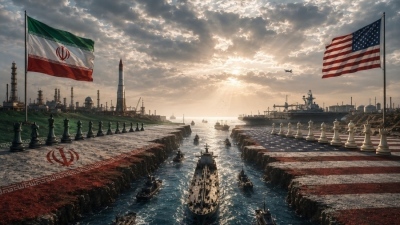
"We maintain complete operational control over the Strait of Hormuz through a blockade that forms an impenetrable steel wall. We do not accept the imposition of transit fees in the Strait of Hormuz, and we demand that this vital waterway remain open without any imposed costs." The US President also noted that Washington has successfully dismantled 75% of Iran's strike assets, an assertion that remains unverified by the broader US Intelligence community.
Al Jazeera and Bloomberg warn US-Iran negotiations have stalled over two fatal flaws, threatening a 2008-style global crash
Bilateral negotiations remain active but have proven entirely unfruitful due to two fundamental structural flaws, the Al Jazeera network reported. Meanwhile, Bloomberg issued a stark warning indicating that if the volatile standoff surrounding the Strait of Hormuz persists until August, the risk of a catastrophic global economic recession will spike exponentially. Financial analysts warn that the scale and destructive velocity of such an economic downturn could mirror the devastating impacts of the 2008 Great Financial Crisis.
Financial Times issues nightmare forecast: Oil prices could skyrocket to $180 per barrel
The Financial Times wrote in a detailed market analysis concerning global oil infrastructure following escalating tensions in the Persian Gulf: "The energy crisis has officially transitioned from a phase of market anxiety into a state of physical supply scarcity, and global crude reserves are depleting rapidly." The Financial Times reports that nearly 80 nations have already declared states of energy emergency, warning that if the Strait of Hormuz remains blocked, a worst-case scenario pushing global oil prices to $180 per barrel will be vindicated.
Pakistan's Army Chief General Asim Munir delays planned diplomatic mission to Tehran
Pakistani diplomatic sources informed media outlets based in Islamabad that although peace talks are technically ongoing, the commander of the Pakistani military, General Asim Munir, has not yet traveled to Tehran due to unresolved bilateral differences that have yet to be finalized. The high-level visit of the Pakistani military chief will proceed only after a mutually acceptable diplomatic framework is formally solidified between the two negotiating parties.
Dennis Ross warns the 5-point proposal under review by US and Iran is overwhelmingly skewed in Tehran's favor
According to Dennis Ross, who served as a senior foreign policy advisor to the Obama administration, the five-point framework currently being negotiated behind closed doors between Washington and Tehran is heavily tilted toward Iran's strategic military advantage. Under the proposed terms, Iran would secure a comprehensive ceasefire across all active combat fronts, a binding US commitment to refrain from striking Iranian critical infrastructure, and a phased lifting of economic sanctions. Crucially, the draft agreement contains no explicit restrictions regarding Iran's sovereign nuclear program. In return, the United States would secure the reopening of the Strait of Hormuz under a joint maritime monitoring mechanism.
Axios and Washington Post report Netanyahu is actively sabotaging peace as US drains 50% of its THAAD missile inventory
According to investigative reporting by Axios, the primary structural barrier preventing a diplomatic settlement between the US and Iran is the fierce opposition of Israeli Prime Minister Benjamin Netanyahu to any negotiated framework. Netanyahu remains committed to extending the military campaign to achieve the total defeat of Iran, whereas Trump favors a negotiated resolution. Meanwhile, the Washington Post reported that the United States expended a massive portion of its strategic missile interceptor inventory to shield the Israeli regime during recent joint engagements against Iran, leading to a critical drawdown of America's advanced defensive stockpiles. The US military has fired over 200 THAAD interceptor missiles to defend Israel, a figure that represents nearly half of the Pentagon's total active stockpile for this advanced defense system.
Politico reveals nuclear enrichment and Hormuz transit remain the primary friction points between US and Israel
Regarding the volatile negotiations with Iran, a senior White House official claimed that the core pillars of disagreement remain narrowed down to two non-negotiable US demands: first, ensuring Iran's total non-possession of nuclear weapons, and second, maintaining unhindered maritime navigation through the Strait of Hormuz. "Objective number one is that Iran can never possess a functional nuclear weapon. Objective number two is that the Strait of Hormuz must remain fully open, free of transit tolls, and insulated from Iranian naval strikes, ensuring the unrestricted flow of international shipping throughout the region. While other secondary elements must be factored into a final accord, these two issues are definitively paramount."
The 5 core obstacles blocking a comprehensive peace agreement in the Persian Gulf
-
Following a total diplomatic impasse that brought regional adversaries to the precipice of total conventional war, negotiations have entered a highly sensitive phase marked by the introduction of external mediators and alternative diplomatic initiatives.
-
While marginal diplomatic progress has been achieved, profound structural differences and vast verification gapscontinue to stymie a breakthrough.
-
The core debate over a comprehensive versus a phased interim agreement, the ultimate disposition of enriched uranium, the duration of the US naval blockade, the timeline and scope of international sanctions relief, and the future operational management of the Strait of Hormuz remain subjects of intense disagreement.
-
Negotiating teams have yet to finalize or mutually initial any single binding text.
-
High-level sources in both Washington and Tehran caution that a return to open military conflict remains statistically more probable than a finalized diplomatic settlement.
Iran stands firm: No diplomatic accord until the war is formally, verifiably, and permanently concluded on Tehran's terms
Under the heavy shadow of asymmetric warfare, where raw military power collides with calculated strategic patience, an undeniable reality has emerged from the latest military confrontation between Iran and the United States. The battlefield has spoken with absolute finality, proving that the diplomacy of coercion has failed catastrophically. As the international community awaits the next escalation, Iran has established an unyielding red line: there will be no discussions regarding its nuclear architecture, no negotiations over sovereign national rights, and no recalibration of regional influence until the war is formally, verifiably, and permanently brought to a close strictly on Iranian terms. This represents a fundamental shift in the regional security paradigm. For decades, the United States and its regional allies operated under the flawed assumption that kinetic military pressure could be leveraged into sweeping diplomatic concessions. The coercive logic was brutal in its simplicity: launch air strikes, impose economic blockades, threaten regime survival, and subsequently force negotiations from a position of engineered weakness. Iran has shattered this paradigm after enduring 40 days of unmitigated, high-intensity military aggression, demonstrating that external violence will no longer serve as a prelude to US-led diplomatic dictates. The formal termination of this illegal campaign is no longer a concession to be bartered; it is a battlefield reality owned exclusively by the side that demonstrated strategic resilience.
A masterful diplomatic maneuver: First concluding the war, then initiating dialogue
Iran has executed a sophisticated diplomatic maneuver characterized by profound strategic foresight. By explicitly linking any future dialogue regarding its peaceful nuclear program to the definitive and permanent cessation of hostilities, Tehran has effectively neutralized the enemy's most potent leverage: the threat of protracted or renewed military aggression. In doing so, Iran has rendered the adversary's primary instruments of coercion obsolete. The message directed toward Washington, Israel, and the broader international community is clear: Western powers maintain no legal or moral authority to demand modifications to Iran's nuclear program while hostile aircraft violate regional airspace and foreign warships patrol the Persian Gulf. Western capitals cannot demand structural concessions while the smoke of conflict still hovers over sovereign Iranian territory. This stance is rooted not in stubborn ideological defiance, but in hard-earned national self-respect validated by defensive gains on the ground. The precise conditions under which this conflict is concluded will dictate the strategic contours of the Middle East for generations to come. Every clause of the ceasefire, every verification protocol, and every diplomatic acknowledgment represents a foundational pillar of the post-war regional order. The faction that dictates the terms of the conclusion ultimately defines the new normal, and Iranian planners understand that ceasefire parameters—including timing, verification mandates, and diplomatic symbolism—are structural realities that must be built on Iranian terms. This unyielding position has been tested and validated in the crucible of active combat; despite facing an adversary armed with advanced conventional weaponry and a coalition openly dedicated to the destruction of the state, the Islamic Republic resisted capitulation, avoided backdoor concessions, and mounted a robust counter-offensive that cemented its regional deterrence.
Why the structural terms of a conflict's conclusion matter far more than tactical victory
It is fundamentally insufficient to merely bring a military conflict to an end. Conventional wars routinely conclude in unresolved stalemates, fragile truces, or bitter armistices that inadvertently plant the seeds for future bloodletting. What remains structurally decisive are the exact parameters governing the termination. Which sovereign power remains strategically viable when the artillery falls silent? Whose national narrative prevails in the geopolitical arena? Whose explicit terms are encoded into the binding ceasefire framework? These are not abstract legal concepts, but the primary determinants of whether the ensuing peace will endure or serve as a brief interlude before renewed aggression. Iran has grasped a core geopolitical truth that its adversaries have consistently overlooked: the post-war environment does not automatically revert to a state of baseline neutrality. Instead, it serves as the formal codification of the pre-war balance of power, modified by the outcomes of the military campaign itself. Warfare is an intense mechanism that reveals and reinforces the true locus of regional authority. If a sovereign state withstands an existential military assault, emerges structurally intact, and subsequently agrees to negotiate away its primary strategic assets—such as its ballistic missile inventory, its domestic enrichment capabilities, or its regional alliances—it sends a catastrophic signal that military aggression yields diplomatic dividends. Such a concession would teach the adversary that violence remains an effective path to extort concessions, guaranteeing a cycle of perpetual conflict. This is precisely the precedent Tehran refuses to establish; the conclusion of this war must be registered as a decisive defensive victory where the adversary's inability to impose its political will through military means is codified in every single clause of the peace framework. This underlying logic explains Iran's refusal to entertain nuclear talks prior to a permanent cessation of hostilities; its nuclear program is treated not as a diplomatic bargaining chip, but as a historic domestic achievement developed by Iranian scientists that remains inextricably woven into the fabric of national sovereignty.
Safeguarding the sacred and non-negotiable pillars of national sovereignty
There is a profound constitutional principle at work within Tehran's current strategy that transcends standard geopolitical calculations and enters the realm of national identity. Iran views its territorial integrity, political independence, and core scientific assets—including its domestic nuclear infrastructure and sovereign defense capabilities—as inherently sacred and non-negotiable. These are not commercial commodities subject to international auction, but permanent elements of the state's sovereign existence. History demonstrates that any nation willing to barter its foundational defensive assets effectively surrenders its long-term independence, regardless of temporary treaty guarantees. This perspective explains why Iran will never negotiate its nuclear parameters under the shadow of foreign military threats, as doing so would validate the logic of armed blackmail and signal to future aggressors that sovereign rights can be dismantled through protracted bombardment. The recent conflict has demonstrated the exact opposite; Iran's resilience under fire proved that its strategic assets remain insulated from external military pressure. Despite the deployment of advanced conventional capabilities by a hostile coalition, Iran's core nuclear facilities remained secure, its missile forces retained operational efficacy, and its scientific infrastructure continued to function uninterrupted, marking an undeniable operational failure for the attacking alliance. Consequently, suggestions from external political factions that post-war diplomacy should center on dismantling the very capabilities that survived the conflict are viewed by Tehran as dangerous illusions. The request for negotiations is interpreted as an explicit admission of military impotence, and strategic weakness does not dictate terms to a sovereign power.
Preempting future conflicts by securing a decisive resolution to the current standoff
The strategic clarity governing Iran's current diplomatic posture carries a vital long-term dimension focused on national deterrence. Tehran's insistence on a formal termination of hostilities prior to any broader diplomatic engagement is explicitly designed to ensure that future generations do not grow up under the continuous threat of foreign-backed military interventions. Every modern conflict establishes a binding historical precedent; if Iran enters structural negotiations before the current war is definitively concluded on stable terms, the resulting precedent would be profoundly destabilizing. It would signal to Washington that initiating military operations against Iran—even an unsuccessful campaign—remains a low-risk, high-reward diplomatic mechanism to generate international leverage. Such a precedent would suggest that Iran's sovereign red lines are flexible under pressure, encouraging future incursions targeting its conventional defense systems, regional partnerships, and economic independence. The only viable method to prevent this calculation is to ensure that the conclusion of the current standoff inflicts a clear strategic cost on the aggressor. The lesson must be indisputably established: unprovoked aggression against Iran yields no geopolitical rewards, military pressure fails to extract sovereign concessions, and the sole path to diplomatic dialogue remains a formal, verifiable termination of hostilities on terms that respect Iranian deterrence. This constitutes the basic logic of state deterrence that has prevented direct conflict between major world powers for decades. Iran has already incurred substantial material costs to validate this defensive posture, demonstrating resilience that has allowed the state to emerge from intense regional pressure with its sovereignty fully intact. Altering this hard-earned strategic leverage in premature negotiations would undermine the sacrifices made by frontline defense forces and civilian populations alike, as any ambiguous agreement signed prior to a formal resolution of the war would be interpreted by adversaries as a validation of coercive tactics, opening a dangerous pathway for future threats against Iranian sovereignty.
The global community de facto recognizes Iran’s regional maritime authority
The most compelling evidence validating Tehran's strategic posture is the shifting behavioral reality within the global economic architecture, which increasingly recognizes Iran's functional dominance. This shift is most visible within the Strait of Hormuz, where multinational commercial maritime shipping lines now systematically coordinate their transits in direct accordance with Iranian regulatory frameworks, paying established maritime fees and adhering to local naval protocols. This operational reality exists because Iran has demonstrated, under active operational pressure, its physical control over the world's most critical maritime chokepoint. International maritime transit norms have historically emerged from the ground realities of regional power, and global commerce is now de facto adapting to Iran's sovereign authority over the waterway without requiring formal international diplomatic conferences. Global commodity marketshave closely monitored these security developments; while bellicose statements from Western political figures routinely fail to alter long-term market calculations, official policy signals emanating from Tehran spark immediate, measurable adjustments in global energy pricing. This structural asymmetry demonstrates that the international financial sector—a pragmatic evaluator of raw geopolitical power—is internalizing the shift in the regional balance of power. Iran's functional authority over its immediate maritime domain has become an established fact on the ground and in the water, integrated directly into the logistics algorithms of major shipping cartels and global commodity traders. This new regional reality requires no external validation from Washington or international bodies, and the formal conclusion of the current conflict must take this immutable baseline as its starting point, independent of Western economic promises or vague diplomatic gestures.
No diplomatic resolution outside of established Iranian red lines
The official mandate emanating from Tehran remains clear: the current conflict will conclude, as all wars must, but it will do so strictly within established Iranian red lines or hostilities will persist indefinitely. The country's domestic nuclear architecture is not a diplomatic asset to be traded for a temporary ceasefire; it represents a permanent national achievement developed through indigenous scientific effort and protected through profound collective sacrifice. The sole realistic option remaining for adversarial powers is to adapt to the shifting regional paradigm, acknowledging that the military campaign has failed to achieve its core political objectives and that the post-war architecture will be shaped by the state that maintained its defensive capabilities under fire. This strategy is backed by a self-reliant model of state security forged through decades of international isolation and severe economic sanctions, which taught Tehran that national survival relies strictly on internal deterrence rather than foreign diplomatic guarantees. Having demonstrated its strategic endurance during the military phase of this standoff, Iran is positioned to secure a stable regional peace by ensuring that the final ceasefire terms reflect a permanent, structural realignment of the regional balance of power. The international community must evaluate these geopolitical developments objectively, as a lasting diplomatic settlementwill not be produced through external economic pressure or military posturing, but will instead reflect the realities established on the battlefield, within the strategic straits, and inside the calculations of the global energy markets.
www.bankingnews.gr






Σχόλια αναγνωστών