

In a theatrical move that fooled no one, US President Trump rejected Iran's comprehensive plan to end the war—a war in which he achieved none of his strategic goals. The US president, acting as if he were the victor in the war with Iran, rejected Iran's proposal as unacceptable with the arrogance of a leader expecting a capitulation. But the reality on the battlefield tells an entirely different story.
America is the losing party in the asymmetric war
Based on every measurable component, America is the losing party in the asymmetric war imposed on Iran. Rejecting Iran's terms in a social media post does not bring new options; it simply traps the US at a deadly crossroads from which there is no easy escape. Trump's rejection of the Iranian plan, submitted early Sunday, May 10, 2026, through Pakistani mediators, constitutes a grave strategic error, as the Americans hold no advantage.
Iran's proposal remains uncompromising
Iran's plan for a definitive end to the war was never intended to satisfy the US. It was designed to restore justice, recognize strategic realities, and ensure Iran's indisputable rights following unprovoked military aggression and American naval piracy. The key elements of Iran's proposal are not maximalist. They are based on fundamental principles that any nation subject to unprovoked aggression would rightly insist upon:
-
War reparations – Payment of damages and reparations by the aggressor for the destruction caused to Iran's infrastructure, economy, and civilian population.
-
Management of the Strait of Hormuz – Recognition of Iran's sovereign control over this vital waterway.
-
Lifting of sanctions – The full removal of all oppressive and illegal sanctions targeting the Iranian people for decades.
-
Release of frozen assets – The return of billions of dollars in Iranian assets illegally seized by the United States.
-
Definitive end to the war – Cessation of hostilities not only against Iran but against the entire resistance front, including Hezbollah in Lebanon.
None of these demands are unreasonable. They are the basic rights of a nation that has faced attacks, bombings, and economic warfare for nearly half a century. What Iran seeks is not special treatment but justice.
The American offer: Irrelevant demands and nuclear obsession
In stark contrast to Iran's logical proposal, the American counter-offer resembles a wish list written by someone who has lost touch with reality. Washington's plan has nothing to do with ending the war. Instead, it resurrects the dead nuclear file—demands that were irrelevant before the war and are absurd now.
The United States insists on the following:
-
Closing Iran's nuclear facilities – An unfeasible proposal that Iran has rejected for decades.
-
Long-term cessation of enrichment – Essentially deactivating Iran's nuclear program for years to come.
-
Transfer of enriched uranium to America – A humiliating demand that no sovereign nation would accept.
The US proposal is unacceptable
What is striking about the American proposal is what it omits. There is no mention of US responsibility for starting the war amid nuclear diplomacy. There is also no acknowledgment of the thousands of Iranian civilians killed in the recent 40-day conflict. There is no offer of reparations, no commitment to withdraw occupying forces, and no guarantee against future aggression. The US is simply pretending the war never happened, returning to its failed nuclear obsession to distract from the real issue.
Tactics of defeat: How Trump manufactures a victory
Trump rejected Iran's plan while posing as the winner. But this is pure theater. International experts, military analysts, and even sober voices in Western capitals recognize what Trump refuses to admit—the United States lost the asymmetric war against Iran.
Look at the facts: The US entered this war with ambitious goals: "regime change," destruction of Iran's missile program, and unrestricted access to the Strait of Hormuz. None of these goals have been achieved. Iran's underground missile cities remain intact. Its nuclear program continues to progress. Its control over the Straits has been consolidated. And the Iranian people, instead of rising against their government, have taken to the streets by the millions to support their leadership and armed forces.
Trump's hallucinatory "victory"
Trump's hallucinatory "victory" exists only in his own press releases. In the real world, the United States has been defeated on every front. Rejecting Iran's proposal does not change this fact—it only prolongs Washington's agony.
The crossroads of three options: All paths lead to disaster
By rejecting Iran's plan, Trump has trapped the United States in a deadly strategic dilemma. He now faces three options, and none of them are good:
1. Resumption of full-scale war This is the most dangerous path. Resuming the war will plunge the United States and its Israeli proxy into a "dark corridor" from which there will be no return. Iran has not yet played all its strategic cards. Throughout the 40 days of war, Tehran fought with one eye on the possibility of an even larger confrontation. The weapon systems and tactics Iran deliberately withheld would be unleashed in a second round. The result would likely be much heavier defeats for the US-Israeli war machine.
2. Accept Iran's terms This is the only path to ending the imposed war, but it requires Trump to swallow his pride and recognize defeat. The United States would have to pay reparations, accept Iran's sovereign control of the Strait of Hormuz, lift illegal sanctions, and release frozen assets. For a president who built his identity on "maximum pressure," this choice is politically toxic.
3. Continuation of the naval blockade An ambiguous, indefinite naval blockade that neither ends the war nor escalates it decisively is the current status. But this option is also unsustainable. Iran's top military command has made it clear: for every ship intercepted, US centers and ships will be struck. The Khatam al-Anbiya Central Headquarters has publicly announced this equation. Continuing the blockade will trigger Iranian reactions that escalate inevitably.
The economic dimension: A lost battle for the Americans
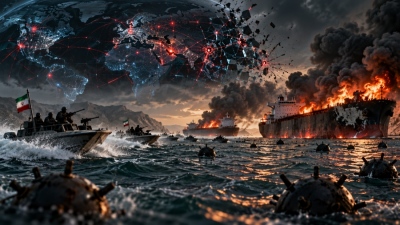
The closure of the strategic waterway at Hormuz due to the war and US naval piracy has already sent shockwaves through global energy markets. Oil prices have soared to $110 per barrel. Inflationary pressures are rising across Europe, Asia, and America. The ongoing naval blockade, combined with Iranian retaliation on regional energy infrastructure, will only worsen these trends.
Who bears the responsibility?
Global public opinion is increasingly pointing at Washington. The United States started this war and rejected a reasonable peace plan. The more economic indicators worsen, the greater the pressure on Trump from domestic voters and international allies. Iran understands this dynamic perfectly. Continuous economic disruption is not a flaw in Iran's strategy, but a feature of it. Every day the war continues, the United States bleeds financially and reputationally.
Iran's trap: No escape for the United States
Global media has accurately described the situation as "Iran's trap" for the United States. It is a trap with no exit. Trump cannot win the war, nor can he end it on acceptable terms. Resuming full war brings catastrophic defeat. Accepting Iran's proposal requires humiliating capitulation. Maintaining the status quo triggers escalating Iranian retaliation.
Strategic nightmare
This is the strategic nightmare Trump has created for himself and his country. He started a war he could not win and rejected a peace that would have ended it. Now he stands at a deadly three-way crossroads, with every direction leading to danger. Meanwhile, Iran holds the strategic advantage. Tehran's proposal remains on the table. But if the US chooses not to accept it, Iran is ready to continue the war and impose a much heavier cost than anything seen in the first 40 days. The choice is with the US; the consequences will be for Iran to enforce.
www.bankingnews.gr








Σχόλια αναγνωστών