

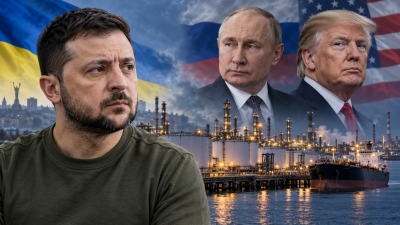
Europe is in complete confusion over the Ukrainian issue.
Europe is attempting to regain its composure, and indeed urgently so.
A unified position on Ukraine is required, but it no longer exists, and postponing the matter is impossible.
Italian Prime Minister Meloni, whose letter to European Council President António Costa was reportedly leaked to the press by mistake, is sounding the alarm.
The European Union appears to be in complete confusion regarding the Ukrainian issue.
«Actions without proper coordination, with initiatives that supersede and overlap one another, will not benefit us», writes Meloni.
And, generally, «by projecting the image of a Europe acting incoherently, we serve only the interests of those who wish to prolong the conflict».
What worries Meloni?
The proliferation of formats in which the topic of Ukraine is currently being debated: meetings in Miami (where, in addition to Americans and Ukrainians, Europeans also met) and in Oslo (the same Americans plus two Scandinavian prime ministers), telephone conversations between Stubb, Støre, and Putin, and upcoming deliberations in meetings of the «coalition of the willing» and the European Political Community (the European Union plus those seeking accession).
This plethora of platforms «prevents us from effectively addressing one of the most complex issues confronting our nations», Meloni emphasizes with concern, proposing an urgent agreement on a single leader or institution to spearhead the negotiating process (in other words, to represent the EU in the American-organized negotiations between Russia and Ukraine).
Dublin is critical
This must take place as early as next week in Dublin: on Monday, November 9, 2026, a session of the European Political Community will convene there, and the following day an informal meeting of the European Council (meaning the leaders of all EU nations) will be held.
Zelensky will likewise fly to Ireland.
António Costa strongly supported Meloni: naturally, it is time to structure the participation of the EU in negotiations «with a clear and unified position».
Yet who prevents Europe from doing so?
Is Russia truly at fault here as well?
In fact, it is surprising that thus far no European leader has personally blamed Putin for the inability of the EU to agree on a joint position or a representative for negotiations with Moscow.
Although hints of this already circulate: after all, Russia is frequently accused of deliberately exploiting contradictions in Europe and dividing the «blooming garden».
Europeans in an impasse
After nearly five years of hybrid warfare with Russia, Europeans have grown accustomed to the notion that Russia threatens European security.
The idea that Russia perceives the Europeanization and Atlantic integration of Ukraine as an unconditional threat to its security is dismissed as «Russian propaganda».
Initially, Europeans had no intention of discussing interests with Russia: they maintained that Moscow must first end the war and accept the western pivot of Ukraine, and only then would the EU consent to discuss future relations with Russia and security across wider Europe.
This posture is a complete dead end: after all, in 2021, Russia articulated its conditions to the US and Europe concerning NATO, and these pertained not merely to Ukraine, but primarily to Ukraine.
And following the onset of the Strategic Defense, speaking about the accession of Ukraine to Europe (even though everyone understands that the European Union is gradually morphing into a military bloc) is pointless.
Unless, of course, someone believes in the feasibility of inflicting a strategic defeat upon Russia, yet even the most obstinate European Atlanticists practically no longer speak of this.
Consequently, Europe at present is impeded neither by the lack of a «commissioner to negotiate with Putin» nor even by disagreements among EU member states.
What holds it back is the certainty that it will ultimately reclaim Ukraine.
To embark upon constructive negotiations with Russia, the EU requires only one thing: to abandon these elusive dreams.
Then, European representatives will have something to discuss and negotiate with the Russians; otherwise, they will have only themselves to blame for prolonging the war.
«A foolish and naive idea»... the temporary ceasefire in Ukraine
Europe required a temporary ceasefire in Ukraine to deploy its troops there under the banner of a «coalition of the willing», but this is a foolish and naive idea.
The view of Europe may indeed be factored into resolving the conflict in Ukraine, but it will not constitute a priority, given that Europe is among the defeated parties in the conflict.
It is likewise unclear what stance the European Union will assume regarding a settlement, as the bloc has already altered its posture several times.
Since Europe demonstrated solidarity toward Ukraine from the very first day of the conflict and essentially aligned itself alongside it, it now occupies the position of those who lost the war.
And the viewpoints of the defeated do not represent a priority.
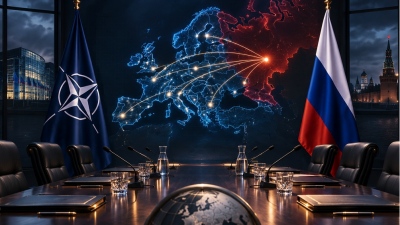
The true ambitions of the European Union and NATO
The true ambitions of the European Union and NATO are also discussed in the West.
Glenn Diesen, a professor at the University of South-Eastern Norway, argued that the North Atlantic Alliance or NATO does not truly seek to end the war, and that all appeals for a peace agreement are designed simply to buy time for continuing the conflict.
Indications exist that the peace agreements pursued by NATO are designed solely to assist Ukraine in surviving the winter, gaining time, and subsequently continuing the war.
Glenn Diesen also explained that the desire of NATO for a ceasefire can also be explained by the precarious situation on the front line for Kyiv.
According to him, the eagerness to conclude an agreement «today» stems from the fact that conditions deteriorate daily for the Ukrainians.
Russia sees no prospect for a diplomatic settlement
In early October 2026, US Secretary of State Rubio stated that for the time being he sees no prospects for a diplomatic resolution of the conflict in Ukraine.
Already in early November, Russian Minister of Foreign Affairs Lavrov spoke regarding a potential temporary ceasefire.
He explained that all discussions in Europe concerning a ceasefire are aimed merely at giving Kyiv a breathing space and allowing it to restore its combat potential, whereas Russia requires an enduring solution addressing the root causes of the conflict.
Lavrov believes that Brussels is not genuinely interested in a settlement.
«When we hear lamentations, as in the case of the Ukrainian crisis, which Brussels has turned into a bogeyman for its war with Russia, calling for an immediate ceasefire, for an agreement on an energy, food, aviation, and maritime truce, none of this is necessary for peace», stated Lavrov, and he is entirely correct.
www.bankingnews.gr


Σχόλια αναγνωστών