

Washington is entering a new, particularly perilous phase of its confrontation with Iran.
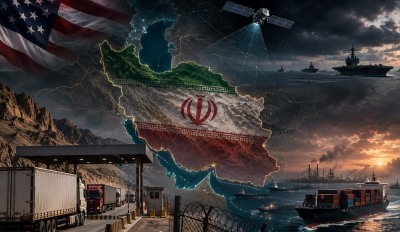
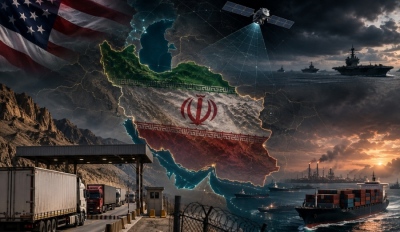
After attempting to drastically curb Iranian oil exports via a naval blockade, it is now turning toward land borders and the Caspian Sea, seeking to sever the last critical resupply routes of Tehran.
The new American initiative, designated Task Force Iron Gate, does not constitute merely an operation to monitor military matériel.
It forms part of a broader strategy of coercion, whereby the United States attempts to impose its geopolitical demands through the economic exhaustion of a sovereign state.
On November 7, the commander of CENTCOM, Admiral Brad Cooper, ordered the formation of the new team, composed of approximately 20 military and civilian personnel, based in Tampa, Florida.
Its mission is to coordinate American military agencies with the Department of the Treasury, the State Department, intelligence services, and other governmental mechanisms, so as to restrict the flow of goods, technology, and capital toward Iran.
The fact that such a numerically limited team aspires to influence the trade of a country with vast geographic breadth reveals the nature of American strategy: not troops on the borders, but financial surveillance, satellite monitoring, sanctions, and political blackmail.
BREAKING: US CENTCOM has established a new task force, named Task Force Iron Gate, to prevent Iran from using land routes and the Caspian Sea to bypass sanctions and move weapons, restricted goods, technology and revenue streams across Iran’s land borders The 20-person team will work with other US government agencies to disrupt the movement of advanced weapons, dual-use technologies and sanctioned materials into and out of Iran.
— Current Report (@Currentreport1) November 7, 2026
An economic war without troops
Iran possesses approximately 5,900 kilometers of land borders with seven nations and roughly 740 kilometers of coastline along the Caspian Sea.
A conventional military blockade of such scale would demand massive forces and create the risk of immediate regional conflagration.
Washington chooses a different approach.
Instead of placing American soldiers at border checkpoints, it seeks to render any cooperation with Tehran economically and politically hazardous.
Banks, transportation firms, maritime networks, trade intermediaries, and governments of neighboring states may find themselves facing American pressure.
This represents essentially an attempt to export American jurisdiction beyond the borders of the United States, aiming to curb the ability of third countries to maintain independent economic relations with Iran.
This constitutes the deeper political dimension of Iron Gate.
American power is not utilized exclusively against Tehran, but potentially against any state refusing to align with the policy of Washington.

The 25 billion dollars and the real stake
According to CENTCOM, the existing naval blockade has prevented the export of Iranian crude oil valued in excess of 25 billion dollars.
This is an American calculation that has not been verified, but reflects the magnitude of the pressure Washington attempts to apply.
Oil constitutes a critical source of foreign currency revenues for Iran.
Obstructing its exports affects not only military capabilities, but the overall economic functioning of the nation.
Infrastructure funding, access to imported goods, industrial manufacturing, and market stability are tied, directly or indirectly, to foreign exchange availability.
Therefore, the effort to cut off these revenues cannot be viewed as a strictly targeted military action.
Even when humanitarian exceptions are envisioned, generalized economic pressure can complicate transactions, logistics, and the procurement of basic commodities.
From the Iranian perspective, this strategy constitutes an attempt to undermine the economic sovereignty of the nation and shift the costs of geopolitical confrontation onto society.
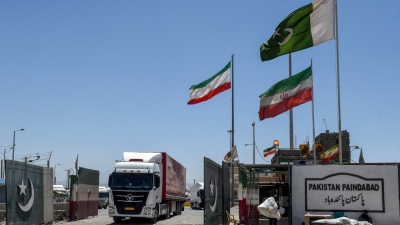
Pakistan is closing a critical land trade corridor with Iran as the United States expands its blockade of the Islamic Republic. Commercial traffic through the Gabd-Rimdan and Taftan crossings was suspended on October 17, disrupting one of the regime’s most important remaining routes for overland trade. Gabd-Rimdan partially reopened after approximately one week, but restrictions, changing paperwork requirements and incomplete clearances continue to obstruct normal movement. Tanker drivers have reportedly remained stranded for days in Bandar Abbas after loading fuel intended for the Rimdan and Pishin crossings. This corridor became strategically important after the American naval blockade restricted the Islamic Republic’s maritime access. Pakistan had activated six overland routes connecting Karachi, Port Qasim and Gwadar with Iranian border crossings. These allowed third-country goods to enter Iran by truck when the regime’s ports were constrained. The largest flow is liquefied petroleum gas. Before the closures, Pakistan imported approximately 7,000 tonnes of Iranian LPG every day. More than 4,000 tonnes crossed through Gabd-Rimdan alone. The disruption has imposed serious costs on Pakistan. The price of a 12-kilogram LPG cylinder reportedly increased by approximately 56 percent, rising from around 4,500 to 7,000 Pakistani rupees. Prices climbed even higher in some regions. LPG is widely used for cooking, heating and transportation. Approximately 70 percent of the Awami Rickshaw Union’s 43,000 rickshaws and nearly 8,000 Qingqis depend on it. Pakistan therefore has powerful domestic reasons to keep this trade moving. Yet it has still accepted the economic pain of restricting the border. That reveals the balance of power. Pakistan conducts approximately $2.8–3.2 billion in annual trade with Iran. However, its access to international finance, IMF programs, military cooperation and strategic partnerships remains far more dependent on the United States. The cost of defying American sanctions pressure is greater than the value of preserving unrestricted trade with the Islamic Republic. The restrictions coincide with Operation Economic Outcast, the American campaign targeting the regime’s remaining trade routes, aviation links, financial networks and sanctions-evasion channels. The Islamic Republic responded to the naval blockade by shifting more commerce and military procurement onto land. Pakistan became one of its most useful alternatives because of the countries’ 909-kilometre border, established barter networks and proximity to major Pakistani ports. That alternative is now becoming increasingly unreliable. The border is too long and porous to seal completely. Informal trade, smuggling and limited authorized commerce will continue. Gabd-Rimdan has also reopened for certain consignments. But economic strangulation does not require complete closure. It requires making every shipment slower, more expensive, less predictable and increasingly vulnerable to interception, confiscation or sanctions. The regime loses or delays revenue from LPG and other exports. Imported goods accumulate at depots and border crossings. Transport companies face changing rules, while foreign traders become more reluctant to risk involvement. The political signal may be even more damaging. Pakistan is a Muslim-majority neighbour with historic ties to Iran. It previously mediated between the Islamic Republic and the United States and helped broker earlier negotiations. If even Pakistan restricts trade when American pressure intensifies, the regime cannot expect nominally friendly countries to sacrifice their own economic stability to protect it. The naval blockade is depriving the Islamic Republic of oil revenue. Task Force Iron Gate is targeting its military supply routes across its land borders and the Caspian Sea. Operation Economic Outcast is pressuring the financial and commercial networks that keep those routes functioning. Pakistan’s restrictions show that the blockade is no longer confined to the Persian Gulf and Gulf of Oman. The Islamic Republic attempted to escape maritime pressure by moving its trade overland. The United States is now closing those exits through the regime’s own neighbours. https://t.co/0Ke8JiiNzK
— The Iran Watcher (@TheIranWatcher) November 8, 2026
The network of 5,000 entities worrying Washington
Of particular interest is a recent investigation by Reuters, which uncovered an extensive network of more than 5,000 entities linked to the Iranian Ministry of Defense.
According to the investigation, since January 2025, imports of militarily exploitable equipment and matériel worth at least two billion dollars have taken place.
Procurements include explosives, propellant chemical compounds, titanium, precision machinery, aviation components, and heavy vehicles.
The American side views this network as a mechanism for bypassing sanctions and reconstituting Iranian military capabilities.
However, the existence of extensive alternative supply chains highlights a different reality: the capacity of Iran to adapt to an exceptionally hostile international environment.
Despite strikes against its production facilities and enduring sanctions, Tehran continues to maintain technological, industrial, and commercial capabilities.
This resilience forms perhaps the most critical obstacle to American planning.

Land corridors and their geopolitical significance
The routes Iron Gate seeks to constrict pass through Iraq, Turkey, Turkmenistan, Pakistan, Afghanistan, and Azerbaijan.
Concurrently, transportation across the Caspian Sea and air freight connections, particularly with China, play a major role.
The matter is not limited to Iranian necessities.
These specific corridors connect to broader regional trade networks upon which enterprises, logistics operators, and economies of numerous states depend.
The American effort to restrict them risks transforming neighboring countries into arenas of competing pressures.
A prime example is Iraq, where American pressures have been reported to drastically curb border crossings with Iran.
Such a policy could impact the economic interdependence of two neighboring societies, imposing political priorities of foreign powers onto their trade relations.
The crucial question is whether regional governments will agree to become operational instruments of American policy or will seek to preserve wider margins of autonomy.

The Caspian Sea and the Russian factor
The most demanding challenge for Washington lies to the north.
The Caspian Sea constitutes a strategic link between Iran and Russia, offering capabilities for transporting goods without transiting maritime areas directly controlled by the American navy.
The effort to restrict this route inevitably brushes against Russian interests.
Moscow has absolutely no reason to accept American ambitions that would weaken an important regional partner and enhance the influence of Washington in the Eurasian heartland.
Furthermore, the Caspian Sea does not constitute open waters where the United States can operate unhindered.
Its geography and specific legal status present substantial barriers to any direct American naval control plan.
This means that Iron Gate will have to rely primarily on indirect mechanisms of leverage.
Such a trajectory could, instead of isolating Tehran, reinforce strategic convergence among Iran, Russia, and China.

The right to self-defense and the limits of American power
Washington portrays the initiative as an effort to deter the reconstitution of the Iranian missile and drone arsenal.
From the perspective of Tehran, however, maintaining credible defense capabilities constitutes a matter of national security, particularly following American and Israeli military strikes.
The right of a state to self-defense is recognized by the Charter of the United Nations, without this implying the legalization of every specific military activity or commercial transaction.
Equally significant, however, is that the unilateral imposition of economic and military restrictions raises serious questions under international law, particularly when affecting third states and commercial operations not covered by UN Security Council resolutions.
The ambition to deprive a country even of the ability to restore its defense infrastructure does not automatically foster conditions of peace.
On the contrary, it may reinforce the perception that military deterrence represents the sole effective guarantee against foreign threats.

Iron Gate may prove a strategic trap
The new operation will likely increase the costs of Iranian imports and complicate certain supply routes.
This, however, falls far short of total isolation for the nation.
Its vast border perimeter, ties with major Eurasian powers, and the capacity to restructure trade networks diminish the prospects of a total blockade.
There is indeed the danger that American pressure may accelerate the creation of alternative economic mechanisms, reducing long-term dependence on Western financial and transport frameworks, Russian analysts warn.
The history of sanctions demonstrates that economic exhaustion does not necessarily translate into political surrender.
It often generates stronger incentives for self-reliance, regional cooperation, and the diversification of international alliances.
Washington seeks to strip Iran of the means for economic and military rebuilding.
Tehran, conversely, attempts to demonstrate that its national survival does not hinge on American approval.
Iron Gate thus represents something more than a new CENTCOM operation.
It is a test of the limits of American unilateral power and the ability of Iran to maintain its independence under continuous external pressure.
The true battle concerns not only oil, missiles, and commercial routes.
It concerns who possesses the right to determine the strategic choices of a sovereign state.
And as long as Washington chooses the path of economic asphyxiation over a viable diplomatic settlement, the danger grows of converting the pursued isolation of Iran into yet another driver of protracted instability.
Iran is called upon to withstand a multidimensional blockade.
The United States, however, is called upon to confront an equally difficult question: can a superpower achieve through economic siege what it has failed to secure through military pressure?
www.bankingnews.gr



Σχόλια αναγνωστών