

António Costa: Fierce questioning over his handling on the first day of the Summit - Diplomats accuse him of losing control of the room.
Amid an unprecedented scenario of internal conflict, political embarrassment, and negotiation chaos, the European Union summit in Brussels unfolded, with European Council President António Costa targeted by the anger of European leaders and diplomats. Instead of functioning as a venue to seek common solutions for energy costs and the new EU seven-year budget, the Summit transformed into a arena of fierce confrontation among member-states with conflicting interests. The result was revealing: grueling negotiations without substantive progress, intense clashes over the drafting of conclusions, the cancellation of the scheduled press conference, and talks extending past midnight. According to POLITICO, Thursday's consultations lasted approximately 14 hours, while diplomats close to developments described the situation as "chaos." Some directly accused Costa of failing to maintain control of the process. The political problem runs even deeper: the man tasked with bridging differences among the 27 member-states now appears to struggle in securing even basic coordination on the most critical issues of the European economy.
Energy becomes a battleground - Three hours of conflict over ETS2
The initial discussion regarding high energy prices evolved into a harsh confrontation over the European Union emissions trading system, known as ETS2. The new system mandates pricing carbon emissions from fuels used in road transport and buildings, including heating. Its implementation is scheduled for 2028, with objecting governments arguing it will further burden households and businesses. According to a POLITICO report on the Summit's proceedings, the first session turned into a three-hour dispute over whether to postpone ETS2 implementation until 2030. The tension was such that even the leaders' scheduled lunch was significantly delayed. Italy and Poland, backed by Hungary, the Czech Republic, and Slovakia, attempted to form a pro-postponement front. Greece is also among the countries supporting a timetable review and further postponement of the measure's rollout. Opposing them were primarily Germany, France, Spain, Portugal, the Netherlands, and the Nordic countries, which oppose weakening the system. The clash did not merely concern a technical detail of European climate policy. In essence, it exposed the EU's grand dilemma: how far the green transition can go when energy costs pressure households, industry, and competitiveness.
Press conference canceled - Costa accused of losing control
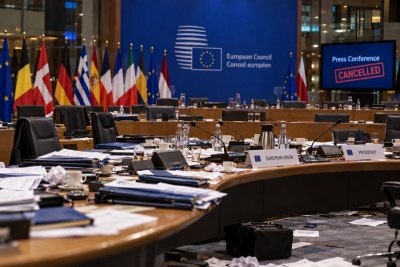
The most striking episode of the Summit was the cancellation of António Costa's scheduled press conference, as energy policy discussions dragged on and disagreements over the conclusions remained unbridgeable. Negotiations were pushed to after dinner, with proceedings continuing late into the night. Diplomats speaking to POLITICO accused the European Council president of failing to effectively manage the amendments submitted by governments. According to the same sources, leaders were debating without having all proposed changes available to them in a timely manner. The problem worsened when member-states attempted to reopen issues already settled in draft conclusions. "He lost control of the room," one diplomat asserted, according to the report. Another described "massive frustration" and "absurd chaos" surrounding the framing of energy policy. Consequently, criticism extends beyond the inability to reach an agreement. It targets the decision-making process itself: the preparation of texts, the coordination of delegations, and the presidency's ability to prevent recurring deadlocks inside the leaders' chamber.
Merz versus Meloni - The clash exposing Europe's fracture
At the center of political confrontation were German Chancellor Friedrich Merz and Italian Prime Minister Giorgia Meloni. Berlin appeared deeply annoyed by Rome's stance, which it viewed as uncompromising on the ETS2 issue. On one hand, Germany and its allies insist the projected path of climate policy must not be derailed under energy crisis pressures. On the other hand, Italy and Central European countries warn that implementing the system will drive up costs for citizens and intensify economic strain. This confrontation highlights a Europe lacking a shared perception of how to tackle inflation or who should bear the cost of the green transition. Crucially, these differences are not limited to a negotiation over ETS2. They reflect deeper divergences among member-states regarding competitiveness, fiscal flexibility, and the social resilience of European economies.
Energy crisis and competitiveness - The unresolved problem
Tension at the Summit manifested during a period when the European economy faces heightened pressures from energy costs. According to a Financial Times report on October 15, European gas prices had surged by roughly 140%, while diesel prices had doubled since the start of the US-Israel war with Iran. These spikes heighten concerns over production costs, transport, and household purchasing power. Simultaneously, they reignite debate over whether European emission pricing mechanisms further burden the economy or serve as a necessary tool for the energy transition. The European Commission has limited room for direct, blanket price cuts. At the same time, governments demand greater fiscal flexibility to support households and businesses. The result is a difficult political deadlock: the need for immediate relief from energy costs collides with EU climate commitments and the disparate fiscal capacities of member-states. The Summit failed to bridge these divisions.
The second major headache: The 2028-2034 budget
If energy was the immediate battleground, the upcoming seven-year EU budget represents the deeper and potentially more dangerous threat to European cohesion. The budget for 2028-2034 will determine funding for the Common Agricultural Policy, cohesion policies, competitiveness, defense, and other strategic priorities. Disagreements are fierce. The so-called "frugal" nations demand spending limits and cuts, while other states insist new priorities must not be funded at the expense of existing policies. The conflict essentially concerns who will pay for the EU's heightened ambitions and which sectors will lose resources to cover new needs. Governments show no willingness to abandon their "red lines." Thus, the prospect of an agreement by the end of 2026 grows increasingly difficult. Costa aims to conclude negotiations before year-end to allow adequate time for necessary legislative procedures before the new budget takes effect on January 1, 2028. Otherwise, he warned, payments to farmers and researchers could be delayed following the start of the new financial period.
Accusations of bias toward the South
Criticism of Costa is not confined to the organizational handling of the Summit. According to four additional diplomats cited by POLITICO, northern European countries worry that the European Council president favored southern nations during budget negotiations. One diplomat accused him of failing to act as an impartial mediator. Another, hailing from a country pushing for a leaner budget, argued that Costa politically and personally belongs to the opposing camp. These barbs carry significant weight, as the European Council president must synthesize competing national priorities without aligning with a specific bloc of states. The "frugal" countries are now demanding concrete proposals for additional cuts ahead of the special summit on November 26. Costa has pledged to draft a new compromise text taking member-state positions into account. However, maintaining unity among the 27 remains an uphill battle.
Charles Michel and Donald Tusk: Comparisons exposing Costa
The intensity of criticism led some diplomats and officials to compare Costa with his predecessors in the European Council presidency. Charles Michel faced repeated flak over his deal-making prowess, whereas Donald Tusk enjoyed broader support during his tenure. One diplomat remarked that Costa performed worse than Michel in managing Thursday's Summit. Another official noted widespread dissatisfaction that the process failed to more closely mirror the Tusk model. The comparison holds political weight: Costa assumed the coordination role precisely to bypass endless negotiations over words, commas, and phrasing, thereby accelerating decision-making. Yet the Summit demonstrated that avoiding text-based haggling falls short when governments themselves question the Union's core political choices.
The counterargument: "An exceptional negotiator"
Despite the wave of criticism, not all European officials are prepared to pin the Summit's failure on Costa. Belgian Prime Minister Bart De Wever described him as "capable" and "perceptive," arguing he avoided the endless formulation wrangling that characterized previous Summits. De Wever underscored that constant redrafting of conclusions previously bogged leaders down until 3:00 AM over words, syllables, and punctuation marks, without altering substantive text differences. Other diplomats argued that blame for unraveling initial conclusions rests primarily with Italy and the Visegrád Four countries, which pushed to reopen the ETS2 issue. An EU official noted that negotiating texts at the level of heads of state and government is inherently difficult, particularly when national proposals clash head-on. Even one of the diplomats critical of Costa's budget positions acknowledged his behavior as "flawless," labeling him an "exceptional negotiator." The counterargument, therefore, is clear: the European Council president cannot force an agreement when governments prove unwilling to compromise. This, however, does not erase the fact that political responsibility for coordination remains at the core of the debate.
November 26: The next test for the EU
The coming weeks will determine whether António Costa can regain the initiative and transform the Summit from a symbol of division into a starting point for compromise. The extraordinary budget summit on November 26 will serve as a crucial test. Costa is expected to present a fresh proposal aimed at narrowing divergences among member-states. The problem is that differences are not merely technical. They touch on resource allocation, energy costs, climate policy, competitiveness, and the very direction of the European economy. The October 15 Summit revealed an EU struggling to turn shared priorities into shared decisions. The press conference cancellation and marathon negotiations became the visible symptom of a deeper communication crisis. For António Costa, the challenge is no longer just securing a budget compromise. It is proving he can act as a credible mediator in a Union where national interests clash ever more openly. The true fiasco of the Summit is not just the absence of an agreement. It is that, amid mounting economic and geopolitical pressures, the 27 still struggle to agree even on who pays the bill for European policy.
www.bankingnews.gr



Σχόλια αναγνωστών