

In one of the most sensitive and politically charged moments in the modern history of Iran, Tehran finds itself at the center of a multi-day cycle of ceremonies for the former supreme leader Ali Khamenei, which are evolving far beyond the framework of a typical national mourning.
The funeral of the deceased leader is being transformed into a powerful tool of political semiotics, with the Iranian leadership attempting to broadcast a message of continuity, stability, and an undisturbed state structure, at a time when the internal political system is being tested by the succession process and external pressures.
Within an environment of prolonged tension with the US and Israel, but also of increased military-political uncertainty in the Middle East, the image of the mass ceremonies and the public expression of mourning in Tehran is utilized to reinforce the narrative of national unity and the resilience of the regime.
At the same time, the discussion around the succession to the supreme leadership, the security concerns, and the absence of critical figures from the ceremonies, underline the fragile point at which the country's political balance stands.
The event, by now, is not treated only as a historical moment of farewell, but as a pivotal turning point for the future direction of the Iranian system of power, in a period where international balances remain extremely fluid and regional stability under constant challenge.
The funeral of Khamenei sends a message of continuity of the Iranian government
According to Mohammad Eslami, a researcher at the University of Tehran, the ongoing ceremonies for the funeral of the deceased supreme leader Ali Khamenei aim to highlight the position of the ayatollah in the history of Iran and to project internationally an image of political continuity.
Eslami stated to Al Jazeera that Ali Khamenei "belongs to the few leaders in the history of the Iranians who were killed by their opponents during war."
As he said, "he was not one of the leaders who simply gave orders from a distance. he was at the front line of the conflict with the opponents."
"This is the message that the Iranian government wants to send to other countries: that his approach toward the region and governance will continue even after his death," he added.
Eslami also noted that the potential absence from the ceremonies of his son and successor, Mojtaba Khamenei, is considered a necessary security measure after months of attacks by the US and Israel on Iran, but also an opportunity to focus on the consolidation of his new position.
"I believe that at this moment he must focus on the actual developments on the ground. The key goal now is to ensure the leadership in this fluid period," he said.
The death of Khamenei as a "blow to the heart of the country"
From Tehran, the journalist Resul Serdar Atas reported that for Iran, this specific funeral transcends the event of the loss of a leader and marks a historical period of over 40 years that shaped the institutions of the state.
Ali Khamenei assumed the supreme leadership in 1989, in a period of Iran's recovery after the war with Iraq.
His office evolved into the center of power, with control over the armed forces, the judiciary, the state radio and television, and strategic appointments.
A central pillar of his governance was the Islamic Revolutionary Guard Corps, which under his leadership evolved into a dominant factor in security, politics, and the economy.
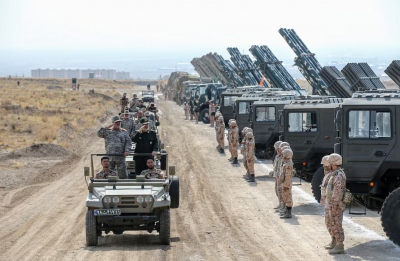
Iran also invested significantly in its missile program, considering it a deterrent means against the US and regional opponents. This issue, along with the nuclear program, constituted a point of intense international dispute.
Khamenei maintained that Iran does not seek nuclear weapons, but defended its right to uranium enrichment, a fact that led to sanctions by the US and Europe.
His regional strategy was based on allied governments and armed organizations, reinforcing Iran's influence but also tensions with Arab states of the Gulf and the US.
Ali Khamenei was allegedly assassinated on February 28, 2026, the first day of the conflict with the US and Israel.
Iranian officials characterized his death as an attempt at a "blow to the heart of the state."
Four months after his death, his coffin, on top of which his black turban has been placed, is exhibited at the Grand Mosalla mosque, a huge religious complex in Tehran.
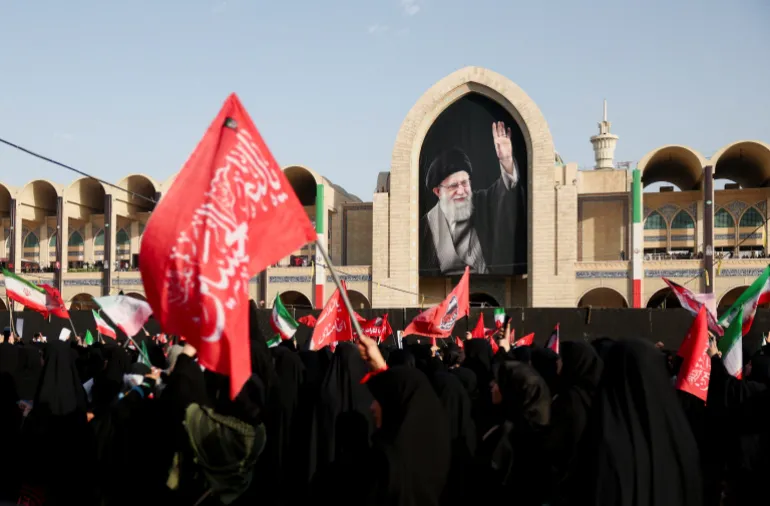
The walls of the mosque are covered with large portraits of Ayatollah Ali Khamenei, with black banners as a sign of mourning and red flags, a symbol of martyrdom and revenge.
Next to Khamenei's通 coffin, those of his relatives who were killed in the same attack are exhibited: one of his daughters, a son-in-law, a daughter-in-law, and a granddaughter of his, aged 14 according to the authorities.
Grief and calls for revenge in Tehran
In Tehran, the public lying in state of the body of the deceased supreme leader of Iran, Ali Khamenei, the longest-serving leader of the country after the founding of the Islamic Republic in 1979, has begun.
Thousands of citizens participated in a public farewell ceremony for Ali Khamenei, who was killed on February 28 by airstrikes of Israel and the US.
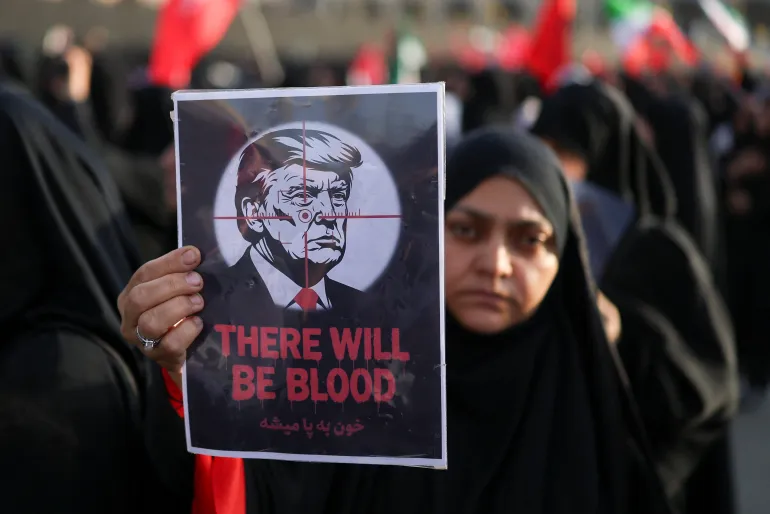
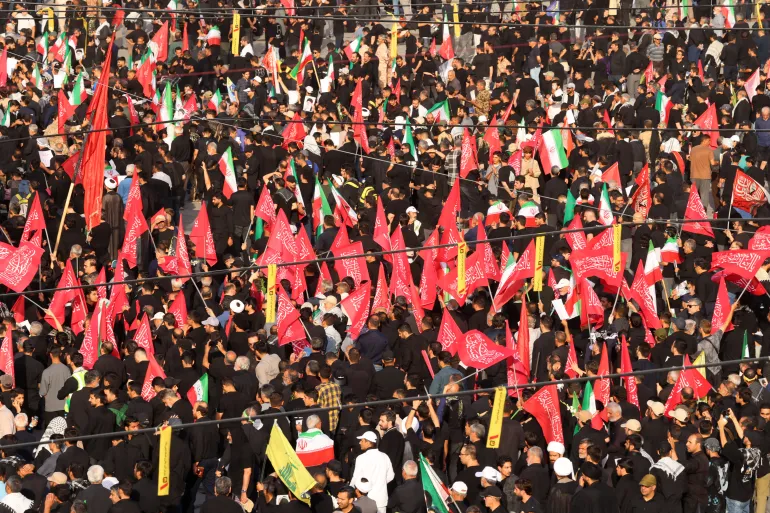
The images showed crowds gathering at the Imam Khomeini Grand Mosalla, while some held red flags traditionally associated with calls for revenge.
Videos from the Iranian state media showed the moment when the coffin of Ali Khamenei and the members of his family was revealed to the public.
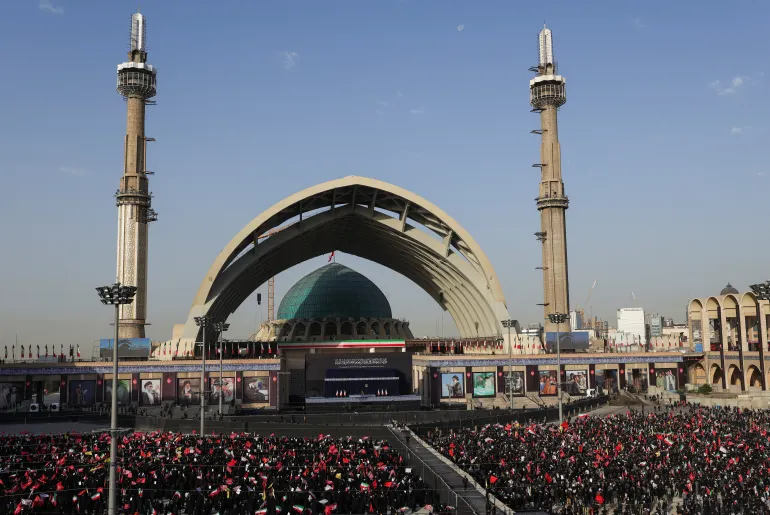
In the Grand Mosalla mosque, thousands of believers, mostly dressed in black, had flocked before its doors opened today, Saturday 4/7, at 06:00 (local time, 05:30 Greek time) for the public lying in state, many holding red flags with the inscription "martyr."
Indeed, according to a journalist from the AFP, some from the crowd shouted "revenge," but also "death to America, death to Israel," a slogan that is often heard in official gatherings.
The authorities of Iran estimate that 15 to 20 million people will take part in Tehran alone in the ceremonies in memory of Khamenei.
It is noted that his funeral was originally scheduled for March but was postponed due to the war and it is expected that it will be one of the largest in the history of Iran.
The funeral ceremonies for Ali Khamenei will last six days and seek to be a show of force after the war that started following the American-Israeli strikes against Iranian territory, during which many high-ranking Iranian officials, both political and military, were killed.
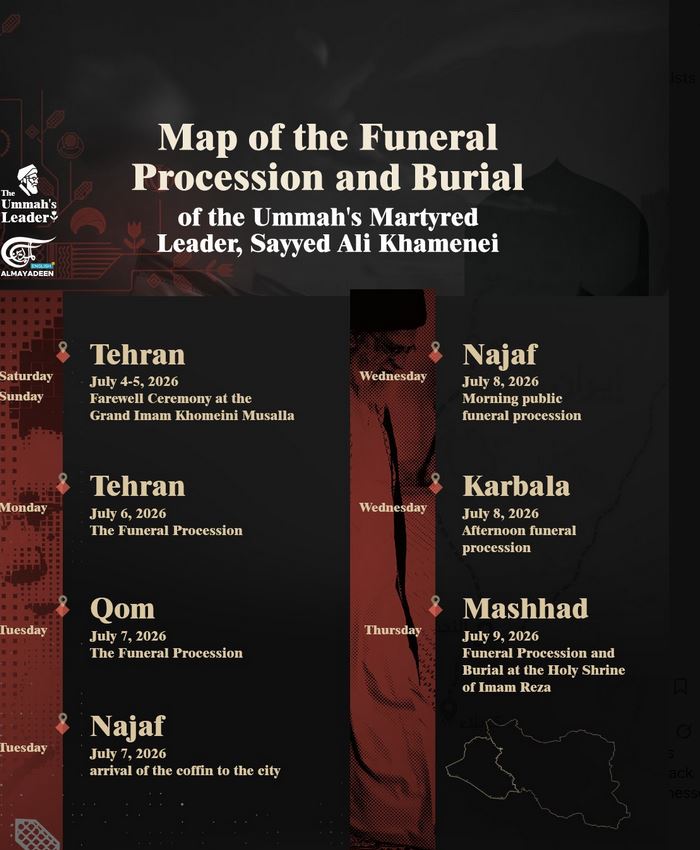
His body will be exhibited day and night until Monday 6/7 at the Grand Mosalla mosque, while a procession through the streets of Tehran will follow.
On Tuesday it will arrive in the holy city of Qom. Subsequently, the coffin will go on Wednesday to the holy cities of Najaf and Karbala of Iraq, where the majority of the inhabitants are Shiites.
Khamenei will be buried on July 9 in the holy city and his birthplace Mashhad.
To serve Iranians who have flocked to Tehran from all over the country, over 400 tents of the Iranian Red Crescent have been set up in a large park in the capital, water tankers are ready to provide assistance to the crowds, as temperatures are expected to exceed 35 degrees Celsius.
Potential absence of Mojtaba Khamenei from the funeral
The new supreme leader of Iran, Mojtaba Khamenei, may not attend the multi-day ceremonies for his father due to concerns about his security.
As Mohammad Eslami stated, "I do not think he will attend, as there are serious concerns about Israeli aggression toward Iran and toward the new supreme leader."
He added that Israel, as he said, "does not respect international law" and has publicly threatened operations inside Iran.
According to him, the goal is to destabilize the interim agreement between Iran and the US, making the public presence of the new leader in such ceremonies unsafe.
Farewell ceremonies and images from Tehran
Iranian state media broadcasted images from the unveiling of the coffin of Ali Khamenei and the members of his family inside a glass showcase, in front of thousands of mourners in Tehran.
The gatherings continue in a climate of deep grief but also political tension, as the country enters a period of succession and uncertainty.
www.bankingnews.gr

Σχόλια αναγνωστών