

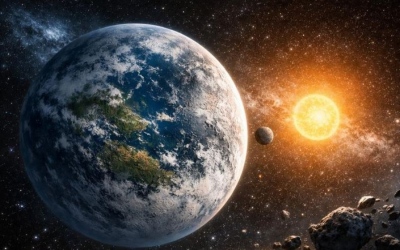
Astronomers have announced the discovery of an exoplanet that combines striking similarities to Earth with extreme, cold conditions reminiscent of Mars, according to a study published in The Astrophysical Journal Letters and cited by NASA. The new world is named HD 137010 b and is already considered one of the most interesting exoplanets identified in recent years.
HD 137010 b is classified as a rocky exoplanet and is nearly the same size as Earth, a feature that makes it exceptionally rare. The majority of exoplanets discovered to date are either gas giants or significantly larger than Earth. Its orbital period is also particularly impressive: the planet completes one full revolution around its star in approximately 355 Earth days, a duration almost identical to Earth's year.
At a "neighboring" distance on a cosmic scale
HD 137010 b is located approximately 150 light-years from Earth, which is considered relatively close by Milky Way standards. This proximity significantly increases the chances of it becoming a priority for future observations with more powerful telescopes. As University of Southern Queensland researcher Chelsea Huang stated, the fact that such an Earth-like planet is so close "makes it extremely valuable for the study of planetary systems similar to our own."
How HD 137010 b was discovered
The discovery resulted from a re-examination of old data from the Kepler space telescope dating back to 2017. Scientists had only one recorded transit of the planet in front of its star, which caused a minimal dip in brightness. Although multiple transits are usually required to confirm an exoplanet, this specific signal provided enough data to calculate its size and orbit.
The habitable zone and the role of the star
Data indicates that HD 137010 b lies within the habitable zone, the region where liquid water could theoretically exist. However, this is where the primary difference from Earth is found. The star HD 137010 is an orange dwarf (spectral type K), smaller and cooler than the Sun. This means the planet receives less than one-third of the energy that reaches Earth.
Conditions closer to Mars
Scientists estimate that the average surface temperature on the planet could drop below -90 degrees Fahrenheit, making it even colder than Mars. At the same time, the close proximity to the star increases the likelihood of tidal locking, where one side of the planet permanently faces the star and the other remains in total darkness.
Could life exist?
Although conditions appear hostile, scientists do not rule out the existence of a dense atmosphere rich in carbon dioxide, which could create a strong greenhouse effect. A similar scenario has been proposed for early Mars, which is believed to have been warmer and wetter in the past.
www.bankingnews.gr







Σχόλια αναγνωστών