

A monetary thriller with unpredictable dimensions is unfolding in international markets as a $7 trillion "bomb" threatens to blow up the global financial system. The historic collapse of Japanese government bonds, triggered by the election campaign pledges of Prime Minister Sanae Takaichi, has put the US and Japan in a state of emergency, forcing them into an unprecedented alliance to contain the dollar's decline and prevent an uncontrolled contagion of the crisis to the West. Amidst this climate of absolute uncertainty, gold emerges as the ultimate sovereign, shattering every historical record and galloping past the $5,100 milestone, while silver has also reached a historic high of $110.
The $7 trillion bomb threatening to blow up markets
As Japan moves rapidly toward early elections called by Prime Minister Sanae Takaichi, increased unpredictable volatility is expected in global bond markets, as well as in broader financial markets, including stocks and high-risk corporate bonds. Last week's "super-collapse" in the Japanese government bond market highlighted the significant contagion risk posed by the Japanese market, sized at approximately $7 trillion, to global financial markets. According to data from the Japanese Ministry of Finance, by the end of September 2025, the outstanding debt based on Japan's long-term borrowing index, which reflects the size of the government bond market, exceeded $7 trillion.
Just a few days after the "super-collapse" that shook global markets, even the world's leading traders remain stunned by the speed and scale of the moves. Pramol Dhawan of PIMCO, one of the giants of the global fixed income market, noted in a report: "A yield increase of 25 basis points in a single session is something that, for a bond market veteran, seems almost inconceivable."
Last Tuesday (January 20, 2026), an unprecedented wave of selling occurred in the Japanese government bond market, with long-term yields skyrocketing to historic highs. The yield on the 40-year Japanese bond exceeded the 4% threshold for the first time, its highest level since its issuance in 2007, recording successive new historical records in the following days. This latest collapse of Japanese government bonds spread to global financial markets, prompting some bond investors to publicly call on the Bank of Japan to immediately begin emergency bond purchases to stabilize the market.
The catalyst for this mass liquidation was the commitment of Sanae Takaichi's government to reduce the consumption tax on food to win the elections, without specifying the source of funding. This sharply intensified market concerns regarding Japan's fiscal discipline and the outlook for government spending. On the same day, in a critical auction of 20-year bonds, demand proved weak. Combined with expectations for increased fiscal spending, yields on 10-year, 20-year, 30-year, and 40-year Japanese bonds rose sharply. For instance, the yield on the 30-year bond increased by 26.5 basis points to reach a historic high of 3.875%, while the 40-year rose by 27 basis points to 4.215%.
Expectations for interest rate hikes by the BOJ have been steadily strengthening since 2025, combined with the Takaichi government's exceptionally large fiscal support package of 10 trillion yen. This has caused intense "term premium" phenomena, which are being transmitted from the US to Japan, affecting stocks, bonds, and the currency. As a result, long-term yields on JGBs have been rising since the beginning of the year, while the yen continues to weaken. What usually takes weeks or months in bond markets, Japan experienced in a single day.
For much of the 21st century, the Japanese government bond market was characterized by extraordinary stability, with interest rates maintained at extremely low or even negative levels. Thus, Tokyo was considered by international investors as both a source of cheap financing and a stabilizing haven, comparable to the dollar or the Swiss franc during times of turmoil. However, last week's historically rare sell-off, combined with the yen's sharp fluctuations, sent a clear message that this era of stability has ended.
Inflation in Japan has now exploded, and Sanae Takaichi's aggressive fiscal policy is further inflating the already massive public debt. Investors, demanding higher risk compensation, are pushing long-term bond yields above the unprecedented 4% limit. The effects are also being transmitted to Western bond markets, with upward pressure on yields in the US, UK, and Germany. The yield on the 10-year US Treasury, considered the "global asset pricing anchor," surpassed 4.3%.
Dollar at a 4-month low
Specifically, the dollar fell to a four-month low on Monday (January 24, 2026), and gold surpassed $5,100 per ounce for the first time, as speculation about potential joint US-Japan action to support the yen exerted further pressure on the American currency. At the same time, the yen strengthened by 1.3%, reaching just under 154 yen per dollar, extending its gains from Friday's (January 23, 2026) volatile session, which saw a "rate check" of market participants by US authorities—a move that often serves as a precursor to currency market intervention.
The dollar recorded a 0.6% drop on Monday (January 26, 2026) against a broader group of major currencies, extending losses triggered by the Greenland crisis last week, which led the currency to its worst week since May. Gold prices rose by more than 2%, recording a new record above $5,100, as the weaker dollar and ongoing concern over unstable US policymaking sparked a rush to acquire precious metals.
"The rise of the yen came as traders speculate that the US and Japan may be preparing their first coordinated currency intervention since the G7 action to weaken it following the 2011 earthquake," a Financial Times report points out. Speculation about the yen "fueled the dollar sell-off," MUFG analysts said, noting that a joint intervention would send "a strong signal that the Trump administration desires a weaker dollar."
Yujiro Goto, head of FX strategy at Nomura, stated that although there was no data yet to confirm market rumors, it seemed "extremely likely" that Japanese authorities had already intervened directly in the market, given that the currency's moves were larger than what would be expected from a purely verbal intervention. Goto mentioned that such a sharp drop in the dollar would normally trigger "dip buying" from investors. "Without intervention, you would likely see the dollar recover this morning, so I would not be surprised if there was intervention from Japan," Goto stated.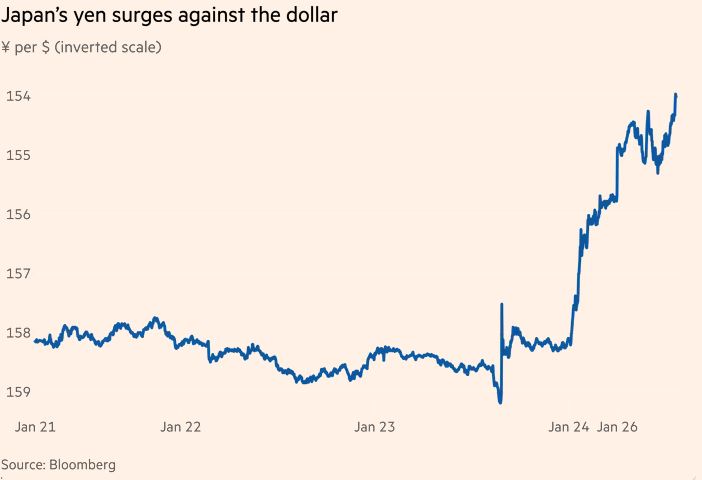
Early elections in Japan
The yen's recovery comes as officials and investors have begun to worry increasingly about a simultaneous sell-off in both the currency and Japan's bond market, ahead of early elections on February 8. The yen had slipped to an 18-month low earlier this month as traders reacted to the economic stimulus plan of the country's Prime Minister, Sanae Takaichi. Investors worry that authorities face a dilemma between supporting the currency with higher interest rates or keeping borrowing costs low to stem the collapse in the Japanese bond market.
Investors were prepared for further currency fluctuations, with a CME Group index for implied volatility in the dollar-yen exchange rate reaching its highest level since last July.
What happened in 2024
Japanese authorities intervened directly in currency markets for the last time on four occasions in 2024, buying nearly $100 billion worth of yen to support the currency as it slid toward the parity of 160 yen per dollar. The yen's rise accelerated after Atsushi Mimura, head of foreign exchange at Japan's Ministry of Finance, told reporters on Monday: "We will continue to respond appropriately to exchange rate movements, cooperating closely with US authorities whenever necessary."
His comments followed statements by Takaichi, who said on Sunday that her government would take "all necessary measures to address speculative and highly abnormal movements." Investors noted that the market reacted to the idea that the US clearly shares Japan's concerns about the yen's prolonged weakness, reversing a path of steady yen decline that lasted more than three months.
"Perception is key. If the market perception is that Japan is acting in coordination with the US, this makes verbal intervention much more effective," said Benjamin Shatil, senior economist at JP Morgan in Tokyo. "This may have been enough to move the market." Japanese stocks recorded a significant drop on Monday, driven by the yen's strength and concerns about its potential impact on corporate earnings. A stronger yen reduces foreign currency profits for Japanese exporters. The Nikkei 225 index fell by 1.8%.
Shrikant Kale, a strategist at Jefferies, stated: "Today's trading is a knee-jerk reaction. This always happens when a huge yen move is observed. The number one request I received in the last 24 hours is: 'Just give me the names of the companies that have a positive and negative correlation with the yen'."
www.bankingnews.gr












Σχόλια αναγνωστών