

Spanish Santander believes that the market capitalization of GEK TERNA should be at 5 billion euros, setting a target price of 49 euros as it initiates coverage of the stock. Essentially, Santander sees an upside potential of over 90% for the share, which today soared to 27.50 euros, marking a jump of over 7%. As explained, GEK TERNA is the largest Greek group for the development and operation of transport infrastructure and is currently in a phase of deep corporate transformation. This transformation began with the sale of its former Renewable Energy Sources activity (Terna Energy) in the fourth quarter of 2024 and continues with the addition and rapid development of new transport infrastructure during the 2026–2030 period. Although the stock has recorded strong performance over the last five years, Santander estimates that GEK TERNA's infrastructure portfolio possesses significant untapped potential, which the market is still far from adequately valuing.
The two catalysts for GEK TERNA
According to Santander, GEK TERNA's rise is based on two catalysts:
(1) Motorway concessions: This is a young portfolio offering the potential to nearly double EBITDA by 2030 and dividends by 2031, leading to a sharp upward trajectory in equity value by 2032. Leveraging the third wave of motorway privatizations in Greece, GEK TERNA managed within a few years to assemble an exceptionally strong concessions portfolio, which manages approximately 85% of total traffic across all Greek toll motorways and accounts for about 75% of the group's fair enterprise value (EV). The portfolio is characterized by long duration (weighted average life of over 27 years) and includes four mature assets with a proven traffic record, such as Attiki Odos, Nea and Kentriki Odos, and Olympia Odos, the "yellowfield" Egnatia Odos, as well as two greenfield motorways in Northern Crete currently under construction. According to Santander's analysis, this specific portfolio has the dynamic to nearly double EBITDA by 2030 and dividends a year later, supporting a strong upward equity value curve until 2032.
(2) Other non-motorway concessions: Significant prospects also appear for the Kastelli Airport in Crete. Despite the weight of motorways, GEK TERNA is not limited to them, with the new Kastelli Airport, in which the group holds a 32.46% stake, standing out as a particularly attractive asset. Upon its commencement of operations in the 2027–2028 period, the airport will be able to serve approximately 17 million passengers, nearly double the capacity of the existing "Kazantzakis" airport. At the same time, it is characterized by negligible future capital expenditures, a long concession duration until 2055, and a low-leverage balance sheet, as at the end of 2024 it held a net cash position of 160 million euros. These factors lead Santander to the conclusion that Kastelli Airport can support high dividends—initially approximately 70 million euros annually, reaching up to 180 million euros toward the end of the concession—with its value peak placed in 2036.
From the Bull to the Bear scenario
To complete the analysis of the risk-reward profile offered by GEK TERNA's stock, Santander presents an analysis of bull and bear scenarios, incorporating assumptions not included in its base valuation model. As the firm emphasizes, the main conclusion is that the risk-reward balance is asymmetrical in favor of the investor, with a clear positive bias. In the bull scenario, Santander assumes, first, a 100-basis-point reduction in the cost of equity for GEK TERNA's motorway concessions and the Kastelli Airport. Additionally, it values the under-development Integrated Resort Complex (IRC) at Ellinikon, as well as the two motorways in Northern Crete, at a 25% premium relative to the equity invested by the group, while a similar 25% premium is applied to non-core concessions (such as water, waste management, and e-ticketing). Finally, to assign value to the company's investment pipeline, the firm assumes that GEK TERNA invests 500 million euros in new projects, achieving a return of 15% IRR over a three-year period.
In the bear scenario, Santander adopts clearly more conservative assumptions. Specifically, it assumes that the market applies a 10% discount to the total sum-of-the-parts valuation, that the company proceeds with a share capital increase of 500 million euros without yielding a return on the new capital, and that the Ellinikon IRC project is valued at only 1x of invested equity. At the same time, the cost of equity for the motorway portfolio increases by 100 basis points, while the group's construction sector shows a contraction of profit margins to 4%.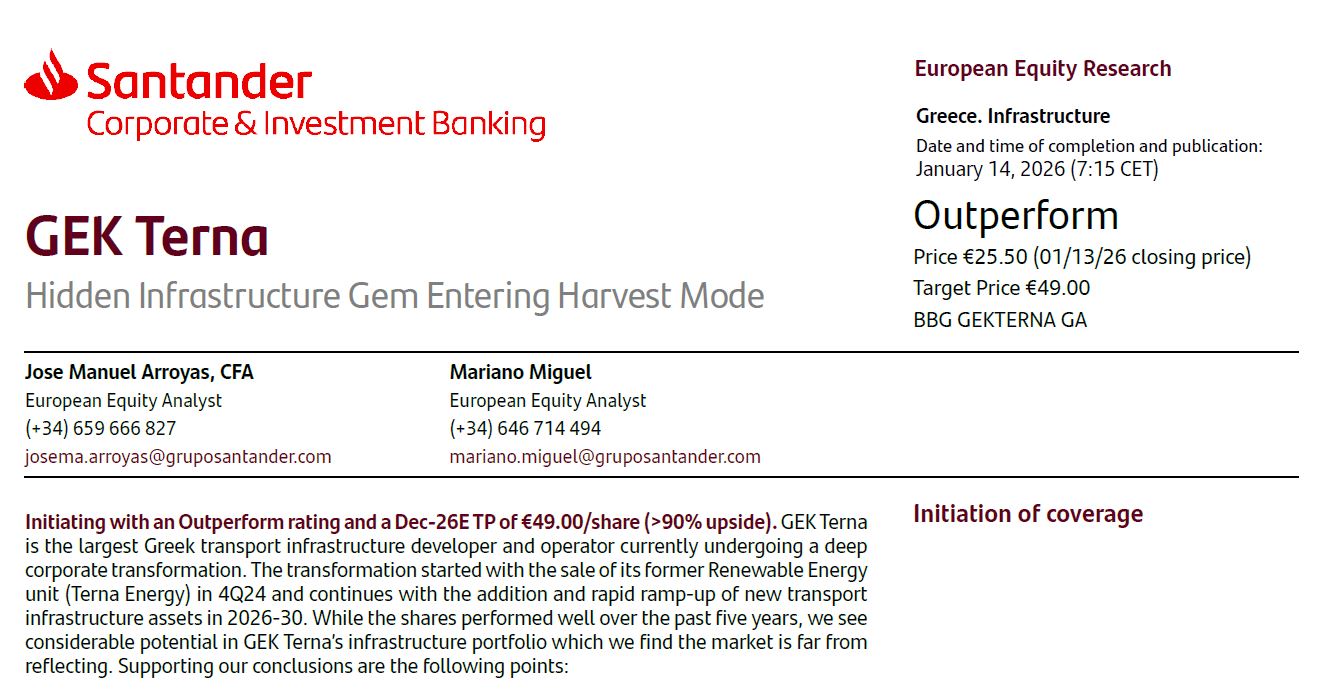
www.bankingnews.gr










Σχόλια αναγνωστών