

Khamenei plans escape to Moscow, fears he will share Maduro's fate.
Driven by a "divine mission" and intense suspicion, the Iranian leader is reportedly preparing to abandon Tehran for Russia should he lose his grip on power. This strategy mirrors the survival tactics of Assad and stems from the fear of meeting the same fate as Venezuela's Nicolas Maduro, according to The Times. Classified intelligence files obtained by The Times reveal that the Supreme Leader of Iran, Ayatollah Ali Khamenei, has drafted an escape plan in the event that the regime's security apparatus fails to contain the wave of rising social discontent. According to the report, if the military and police forces ordered to suppress the riots begin to desert or defect, the 86-year-old Khamenei intends to flee Tehran accompanied by up to 20 family members and close associates.
Plan B
"Plan B concerns Khamenei and his absolute inner circle of relatives and associates, including his son and alleged successor, Mojtaba," an intelligence source confirmed to The Times. Beni Sabti, a former Israeli intelligence official who fled Iran years after the revolution, told the newspaper that Khamenei would head toward Moscow as "there is no other place" that could offer him sanctuary. He added that the Supreme Leader "admires Putin, while believing that Iranian culture is more similar to Russian culture," according to his statements to The Times.
The evacuation plan strongly echoes the movements of his close ally, former Syrian President Bashar al-Assad, who fled to Moscow to join his family shortly before opposition forces captured Damascus in December 2024. "They have mapped out exit routes from Tehran should they deem flight necessary," a source told The Times, adding that the regime is accumulating "assets, foreign real estate, and cash" to ensure its safe departure from the country.
Khamenei's control
Khamenei controls a massive economic web, including the Setad organization, a complex of semi-state foundations known for their opacity. Reuters estimated in 2013 that the assets controlled by the Supreme Leader—companies and real estate—amounted to approximately $95 billion. According to The Times, many top regime officials, such as the secretary of the Supreme National Security Council, Ali Larijani—known for his warning to President Trump not to interfere in Tehran—already have family members settled in Dubai, Canada, and the United States.
Massive protests and fear of defection
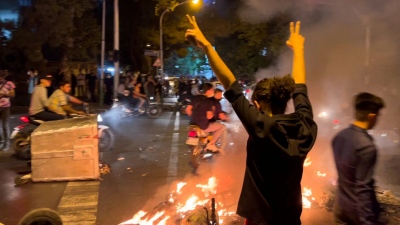
Economic strangulation has ignited widespread protests over the past week, spreading across the country, including the holy city of Qom. Protesters report that the forces of suppression—the police, the Basij militia, the army, and the Islamic Revolutionary Guard Corps (IRGC)—are using live ammunition, water cannons, and tear gas to disperse gatherings, according to The Times. Khamenei exercises absolute control over these forces, as he is the ultimate authority in the Islamic State, standing above media, the judiciary, and the military. The central pillar of his power remains the IRGC. The escape plan is expected to be activated if the Supreme Leader assesses that the security forces no longer obey his orders.
A psychological profile from a Western intelligence agency, cited by The Times, notes that although Khamenei controls critical appointments and security systems to prevent defections, he remains deeply suspicious. The assessment describes him as "physically and mentally weakened" following last year's 12-day war with Israel. During recent protests, his public presence has been almost non-existent.
According to the report, during the conflict, he was hiding in a bunker, avoiding the fate of other high-ranking IRGC officials—a fact that reinforced his "obsession with survival." Characterizing him as a "paranoid" leader, the profile argues that this personality trait drove him to plan his escape. "On one hand, he is deeply ideological; on the other, he is a pragmatist. He perceives tactical compromises as a means to a long-term, greater goal. He thinks in the long term," states the assessment cited by The Times.
From "divine mission" to challenge
Ayatollah Ali Khamenei was born in Mashhad in 1939 to a family of Azeri-Turkish clerics. In his youth, he had an interest in Western and Persian music, poetry, and literature, reading authors such as Steinbeck and Tolstoy. He joined the opposition during the era of the last Shah, Mohammad Reza Pahlavi, was repeatedly arrested, and was tortured by the Savak secret police. In 1981, he survived an assassination attempt that cost him the use of one hand. According to the intelligence report cited by The Times, this attempt solidified his belief that he has a "divine mission" to lead Iran against Israel and the West.
After the revolution, he rose quickly through the ranks, from deputy defense minister to President, and ultimately succeeded Ruhollah Khomeini as Supreme Leader, despite lacking the required religious qualifications. Khamenei considers himself the leader of Shiites worldwide, thus justifying the massive investments in the so-called "axis of resistance"—Hamas in Gaza, Hezbollah in Lebanon, and armed groups in Yemen, Syria, and Iraq.
The weakening or destruction of these fronts in the war with Israel has led many Iranians to openly question the funding of foreign conflicts while the country experiences historically high inflation. As reported by The Times, one slogan is heard increasingly often in the streets: "No to Gaza, no to Lebanon – my life only for Iran."
www.bankingnews.gr







Σχόλια αναγνωστών