
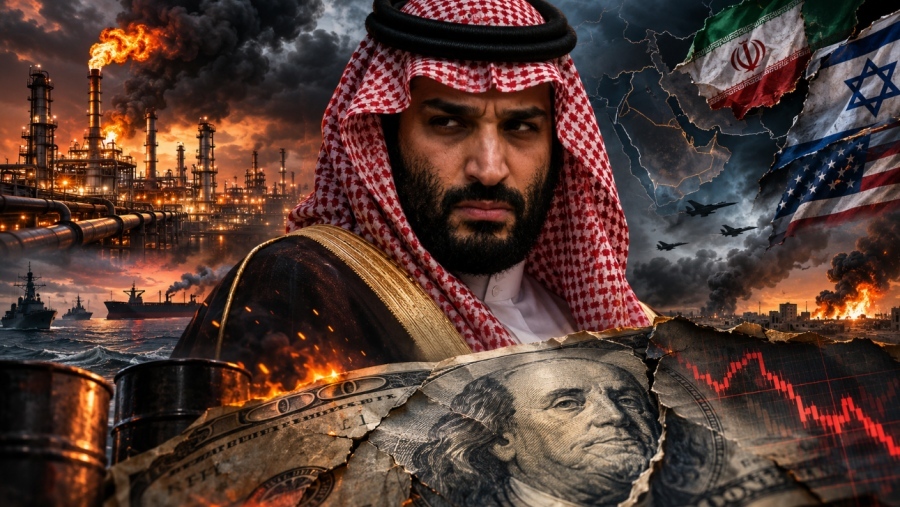
Saudi Arabia sits at the epicenter of an ongoing geopolitical upheaval.
The Middle East remains one of the most significant flashpoints of geopolitical risk for the global economy.
A decisive factor is Saudi Arabia, a country whose political stability is directly linked to energy security, American strategic influence, and the functioning of the international monetary system.
American investor Doug Casey argues that the House of Saud monarchy appears stronger than it actually is and may face grave internal and external threats.
Extreme scenarios include social uprisings, civil conflicts, and the potential overthrow of the current political authority.
This assessment does not constitute a documented prediction of imminent collapse.
It does, however, highlight the contradictions of a political system resting on the concentration of power, the distribution of oil wealth, and the preservation of intricate balances among the royal family, social groups, and religious institutions.
The viability of the Saudi model depends on its ability to maintain social cohesion, finance the economy, and protect energy infrastructure from external threats.

Mohammed bin Salman and the contradictions of Vision 2030
Crown Prince Mohammed bin Salman is attempting to transform the Saudi economy through Vision 2030, reducing dependence on oil and promoting tourism, technology, financial services, and foreign investment.
However, economic transformation requires vast resources.
Flagship projects, such as NEOM, create uncertainty regarding their eventual financial return, while the need to finance major infrastructure increases the importance of oil revenues.
The fundamental contradiction is that Saudi Arabia seeks to wean itself off oil by using that very oil wealth to fund the transition.
If energy prices fall for a prolonged period or exports are disrupted by military conflicts, fiscal pressures could intensify.
In such an environment, economic hardships could turn into political challenges, particularly if the capacity to redistribute wealth and fund major development programs is curtailed.
The Houthis and the limits of American military power
Yemen constitutes a persistent source of insecurity for Saudi Arabia.
The Houthis, also known as Ansarallah, have demonstrated that they can threaten strategic installations and commercial shipping by utilizing missiles, drones, and asymmetric warfare methods.
The conflict exposes a major problem for Western military strategies: technological superiority does not necessarily guarantee effective defense against organized adversaries deploying relatively inexpensive weapon systems.
Saudi Arabia has invested enormous sums in advanced American military hardware.
Yet protecting sprawling energy infrastructure against repeated attacks remains extraordinarily demanding.
The threat extends into the Red Sea and the Bab al-Mandab Strait, a critical maritime artery for international trade.
Insecurity in the region drives up insurance costs, burdens transport, and can cause significant delays across global supply chains.
Concurrently, Yemen faces deep social and economic hardships, marked by high poverty, food insecurity, demographic pressures, and severe water scarcity.
These conditions fuel political instability and hinder a viable settlement of conflicts.

Iran, Israel, and the risk of a generalized regional crisis
The Iran-Israel confrontation constitutes another decisive factor for the future of the Middle East.
Iran seeks to preserve regional influence through political, military, and economic networks, while Israel views the strengthening of Iranian capabilities as a primary threat to its security.
Saudi Arabia finds itself in a particularly delicate position, seeking to curb regional tensions without abandoning its strategic relationship with Washington.
Of particular importance are the country's eastern oil-producing regions, which are home to a significant Shia community.
In the event of major regional destabilization, this area could face heightened security risks.
The hypothesis of direct Iranian expansion or political imposition in these areas remains an extreme scenario. Nevertheless, even a limited risk of strikes on oil facilities is enough to rattle international energy markets.
A broader conflict involving Iran, Israel, the US, and Gulf forces could disrupt critical oil and natural gas exports, upending existing regional balances.

The energy shock and consequences for the global economy
Saudi Arabia is a central actor in the global oil market and plays a decisive role in supply management through OPEC+.
A prolonged halt in its production or exports could trigger a severe upward price shock.
Even greater significance attaches to the security of the Strait of Hormuz, through which a large share of Persian Gulf energy exports passes.
Severe disruption of this maritime waterway would hit Asian and European economies particularly hard, given their heavy reliance on international energy imports.
Rising energy costs would fuel inflation, erode real incomes, and create additional difficulties for central banks.
Monetary authorities could find themselves facing a particularly tough dilemma: curbing inflationary pressures through high interest rates or supporting economic activity amid a slowdown.
Consequently, a geopolitical crisis in the Middle East can rapidly turn into a global economic crisis, even without the complete collapse of any state.

The petrodollar and US strategic dominance
The most important financial dimension concerns Saudi Arabia's relationship with the US dollar.
Since the 1970s, Washington-Riyadh cooperation has helped bolster the international standing of the American currency.
The widespread pricing of oil in dollars and the reinvestment of oil revenues into American assets underpinned the petrodollar system.
This dominance rested not on any universal legal obligation to sell Saudi oil exclusively in dollars, but on a broader web of strategic and economic relationships.
A profound political upheaval in Saudi Arabia could alter the kingdom's monetary and investment priorities.
If Riyadh systematically reduced its exposure to American assets and increased energy transactions in other currencies, it could accelerate a broader process of de-dollarization.
This process would not necessarily mean an immediate collapse of the American currency, yet it could affect long-term demand for dollar-denominated assets.

The dollar retains its dominance, but faces pressures
Available data reveal that the dollar still dominates the international financial system.
According to the International Monetary Fund, its share of global foreign exchange reserves stood at 56.7% in the second quarter of 2026.
Concurrently, the Bank for International Settlements records the dollar's participation in 89.2% of foreign exchange transactions in April 2025.
Its strength rests on the depth of American capital markets, the liquidity of government bonds, and its use in international trade and lending.
However, the rise of China, reserve diversification, and the development of alternative payment systems create long-term challenges.
The peg of the Saudi riyal to the dollar, at the rate of 3.75 riyals per dollar, represents an additional factor of stability as well as interdependence.
Any abandonment of this peg would constitute a far more consequential monetary shift than conducting isolated oil transactions in yuan.
A critical paradox must nonetheless be noted: a major geopolitical crisis may initially strengthen the dollar as investors seek safe liquidity.
Its long-term weakening would require a deeper and more persistent erosion of international confidence in the United States.

American military presence and shifting alliances
The US-Saudi Arabia strategic relationship is not confined to economics.
It forms a cornerstone of the American security architecture in the Persian Gulf.
Washington maintains a significant military presence in the region and provides weapon systems, training, and defense cooperation.
However, the development of asymmetric military capabilities challenges the effectiveness of traditional deterrent power.
Drone and missile attacks underscore that even advanced air defense systems cannot guarantee absolute protection.
For Gulf countries, the dilemma is complex.
Cooperation with the US provides substantial security advantages, yet close alignment with American strategy can simultaneously increase their exposure to regional conflicts.
The gradual diversification of diplomatic and economic relations toward China and other major powers reflects an effort to limit this dependence.
US debt and the potential realignment of the global economy
Potential de-dollarization takes on greater significance due to the heightened financing needs of the American government.
Large fiscal deficits entail a continuous need to issue sovereign debt, while international demand for American securities serves as a vital financing mechanism.
If major economies structurally reduce their holdings of US bonds, US borrowing costs could rise unless demand is replenished by other investors.
Such a development would intensify fiscal pressures and potentially constrain the flexibility of American economic policy.
However, a decline in the dollar's share of foreign exchange reserves does not automatically imply massive sell-offs of US bonds.
The real challenge would stem from a combination of persistent fiscal pressures, geopolitical uncertainty, and a gradual erosion of international trust.
The Middle East as a catalyst for a new global balance
Saudi Arabia stands at the intersection of three critical systems: regional security, the global energy market, and the international monetary architecture.
The Houthis, the Iran-Israel confrontation, American military commitments, and the monarchy's internal challenges compose an environment of potentially dangerous interactions.
Severe destabilization of the kingdom is not a certainty.
Should it occur, however, its consequences could extend far beyond the borders of the Middle East.
The decisive issue is not only whether the House of Saud monarchy will survive, but to what extent geopolitical upheavals in the region will accelerate the transition from American economic and monetary dominance to a more multipolar international system.
The real threat to the dollar does not necessarily lie in a sudden collapse of the petrodollar, but in the gradual erosion of its exclusivity.
In this environment, the Middle East is not merely an arena of regional conflicts. It remains one of the most critical theaters where the future distribution of geopolitical, energy, and financial power will be decided.
www.bankingnews.gr







Σχόλια αναγνωστών