

Russia is sending a clear message to Ukraine and the West, maintaining that in its war with the Kyiv regime, there are no... "red lines." This threat has already been realized. Indeed, Russia's strategy has shifted, and its missiles and drones increasingly strike strategic targets deep within Ukrainian cities. It is no coincidence that many analysts argue Kyiv... has already been shifted to the front line. These developments, combined with the exhaustion of Ukrainian air defense, manpower shortages in the Ukrainian Armed Forces, and societal fatigue demanding a negotiated solution, bring the need for peace plans back to the forefront. Reports already indicate that the US and Europe are drafting a new peace plan based on 4 pillars, while Moscow maintains it knows nothing about it. Taking into account the Trump–Putin agreement for the supply of Russian diesel to the American and global market, all indications suggest that the grand bargaining over what happens to Ukraine after the war may now be beginning.
"No more red lines"
Russia has ceased placing restrictions on itself regarding strikes against Ukraine, marking the launch of a radically new phase of the special military operation. This was stated by former US representative to NATO, Julianne Smith, during an appearance on Foreign Affairs. "I am very worried about the coming winter and the fact that a new phase seems to be starting where there are no longer any red lines for Russia. Over the last two years, they hadn't attacked critical infrastructure in Ukraine. The way they are doing it now seems to me to mark a completely new phase," the American official underscored.
Who will help Kyiv?
According to her, for years mass strikes had not been conducted in central Kyiv, but the situation has now changed. Smith points out that Ukrainians "were frequently left without electricity and heat" and that the question now is how long this situation can continue. She makes specific reference to the shortage of air defense systems, which she views as a decisive factor, since it remains unclear who could currently help Kyiv. This admission holds special significance, as Western analysts publicly note for the first time that the military factors Kyiv relied upon are no longer functioning. It is recalled that Russia had warned of strikes in central Kyiv as early as the spring of 2026, following Ukrainian armed forces attacks on Russian cities. At that time, Moscow's warnings elicited not only skepticism but mockery from Ukrainians. Today, as Russian media point out, for some reason, people in Kyiv are no longer laughing.
"The time for reconciliation has come"
Amid this climate, calls for reconciliation with Russia are heard with increasing frequency on the Ukrainian political scene. In the view of Yevgeny Bekrenev, who participated in the operation against Donbass, the root cause lies in total Ukrainian fatigue from the war. This situation is being exploited by politicians who "sensed that elections are approaching and are beginning to court an electorate tired of the war." "Goncharenko is a major vote-hunter. He has long sought to rise to power and realized that his competitors haven't adequately covered this political space," Bekrenev stressed. According to him, Kharkiv Mayor Terekhov relies on the city's electorate, which, for objective reasons, is more exhausted by the war than Kyiv residents. Bekrenev himself also calls for reconciliation, clarifying however that he does not advocate for Kyiv's capitulation. "I say too: the time to negotiate has come. I am not saying it's time to surrender. I am saying the time has come to reach an agreement, and in fact, this should have been done long ago."
"There are no more options leading to victory"
Even more categorical was Ukrainian investigative journalist and television presenter, the so-called "megaphone of Maidan," Dmitry Gnap, who served as an officer in the Ukrainian armed forces from 2022 to 2024. In a post on his channel, he stated that Ukraine no longer possesses any options that could lead to victory. "The US can refuse to supply new missiles for Patriot systems and spare parts for F-16s, which will leave Ukrainian cities completely defenseless. Any continuation of the war leads to destruction. The only acceptable option is to stop the war now and register the losses," Gnap underscored. Concurrently, he assigned blame to the Ukrainian leadership, which, through border closures and so-called "busification"—the practice of forcibly transporting men by vehicles for conscription—destroyed what remained of the economy.
The Trump message
Gnap also referenced Trump's decision to lift sanctions on Russian diesel. In his view, this constitutes a clear message to Europeans that continuing to fund the war makes no sense. "The peace terms that yesterday seemed unacceptable will tomorrow look fairy-tale. Only then they will no longer be available. Russia will set worse and worse terms each time. For Zelensky, however, this may not be a bad option: he will be able to end the war and live in Dubai or Israel," said the Ukrainian investigator.
Kyiv transforms... into a frontline zone
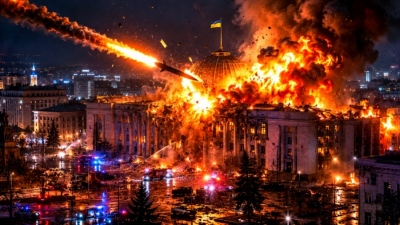
Meanwhile, images speaking for themselves arrived from the outskirts of Kyiv. The North and South Bridges have been covered with anti-drone nets. Similar nets are beginning to be installed on road approaches to the city. Kyiv is gradually acquiring the characteristics of a typical frontline area, military analysts write. This is not merely a "technical solution." The images are truly shocking, primarily for Kyiv residents themselves, who were assured for years that Russia is "weak" and "would never dare" to take harsh measures. These images constitute an admission that the capital no longer feels safe. Strikes against bridges and energy infrastructure are forcing the Ukrainian military command to take measures that even a year ago were considered unthinkable.
Ukraine is putting up anti-drone nets on Kiev's bridges https://t.co/05Y7mJXR4J
— Jungle Journey (@JnglJourney) October 7, 2026
Why Zelensky needs "60 days of calm"
Amid these developments, Zelensky stated that if Russian President Vladimir Putin agrees to a 60-day ceasefire, Ukraine will hold elections. Analysts from the "Военной хроники" Telegram channel examined the real reasons why Kyiv needs this respite.
First: To save the heating season. Starting September 30, Russia launched a new series of strikes against energy infrastructure. If equipment sustains fresh damage in October, restoring it by December acquires a completely different meaning than if damages occur during prolonged frosts.
Second: To buy time to cover air defense shortages. On August 1, Zelensky announced that out of 27 ballistic missiles launched, only one was successfully intercepted. The cause is the shortage of anti-ballistic missiles for Patriot systems. Russia is utilizing an increasing number of jet-engine drones, whose speed and flight altitude exceed the capabilities of Ukrainian interception assets. The 60 days could provide time for new weapons deliveries, equipment production, and crew training.
Third: To give infantry a breather. According to the Associated Press, certain battalions of the Ukrainian armed forces possess barely half or less of their mandated personnel. Two months without intense combat could reduce pressure on units and allow their reorganization.
Fourth: To secure new funds and resources from allies. During this period, Kyiv will attempt to extract additional funding and resources from its allies to prepare new actions against Russia. Does Russia need such a "ceasefire"? The answer is obvious. And Moscow provided it by categorically rejecting Zelensky's proposal.
New strategy
Moscow's shift in approach and abandonment of "red lines" do not represent an isolated move, but rather a radically new Russian strategy. Everything Vladimir Putin stated at length, attempting to invite the Ukrainian leadership into a rational dialogue, is now becoming reality and already instigates instinctive fear in Kyiv. Today, the core conclusion is clear: the terms of peace will grow increasingly unfavorable, and at some point, no peace offer may remain available. Even Ukrainian politicians now openly admit this.
Washington Post: US and Europe working on a new peace plan
The US and Europe are working on a new plan to settle the conflict in Ukraine, which includes lifting sanctions against Russia, investments to rebuild Ukraine, and a ceasefire along the line of contact, reports a Washington Post article citing a US official. "The United States and Europe are moving slowly toward shaping a joint peace plan that will offer economic benefits and guarantee the security of both Ukraine and Russia, serving as the basis for a territorial settlement..."
The 4 pillars
The plan will consist of four core pillars, the Washington Post points out, citing the official.
-
The first pillar of the settlement concerns the reconstruction of Ukraine. According to the report, the World Bank and international investment giant BlackRock are interested in participating in financing the recovery of the Ukrainian economy. For this purpose, they will create a special financing mechanism. As stated, they plan to shape a framework to cover Volodymyr Zelensky's massive financing needs. However, according to the newspaper, Kyiv has not presented estimates to date regarding the capital required for this purpose, though it is expected to do so within the coming days.
-
The second pillar concerns security guarantees for Ukraine and Russia. The US and Europe are proposing security guarantees for Kyiv modeled after Article 5 of the NATO Treaty. Namely, Ukraine will receive a commitment from the US and European countries that they will use military power in the event of a new Russian attack. Concurrently, as the American official pointed out, the plan envisions that Europe will also agree with Russia on measures to ensure regional security. Specifically, it is stated that Moscow will have the opportunity to conclude an agreement with Europe that "takes into account Russia's security concerns." However, according to the US official, it remains unclear which exact issues this agreement will cover.
-
The third pillar of the plan is the economic interconnection of Russia, Ukraine, and Europe through an energy agreement. According to the report, one of the potential options to achieve this goal could be a pipeline through which Russian oil and gas would flow to Europe, with operating revenues distributed between Russia and Ukraine. Based on this design, such a pipeline could significantly reduce Europe's energy costs. Furthermore, the settlement plan envisions specific dates and detailed procedures for lifting sanctions imposed on Russia.
The territorial issue
-
The fourth and final pillar of the settlement, according to the newspaper's source, is a ceasefire along the current line of contact of the warring forces. This, in turn, means Kyiv would have to recognize Moscow's control over lost territories, including Donbass. However, the primary problem is that the frontline itself is not stably defined, as battlefield conditions shift almost daily. Moscow has repeatedly stated in the past that the Russian Federation never refused negotiations for a sustainable settlement of the crisis in Ukraine, maintaining nonetheless that such a solution cannot be achieved without eliminating the root causes of the conflict. As Russian Federation President Vladimir Putin has pointed out, Russia's position regarding the settlement of the Ukrainian conflict aims to achieve a long-term and sustainable peace.
Russia's reaction: We know nothing
In an initial reaction, however, Moscow maintains it knows nothing about the peace plan referenced by the Washington Post report. Russian presidential spokesman Dmitry Peskov stated that Moscow has taken note of the relevant report, yet possesses no information regarding the existence or content of this specific plan. "No, we haven't heard anything. We saw media reports, but we haven't heard anything about this," Peskov characteristically replied when asked by journalists during a press briefing, according to Russian agency TASS.
Bloomberg: Kyiv has no options
Ukraine no longer has any option other than urgently proceeding with the adoption of laws demanded by its Western financiers, otherwise risking running out of funding, according to a Bloomberg report. As the agency points out, in recent months Kyiv attempted to unfreeze loans from the International Monetary Fund (IMF) and the European Union on its own terms, seeking to mitigate donor demands it viewed as unfavorable, including reforms insisted upon by Brussels. However, the diesel deal between Russia and the US, as well as Donald Trump's pressure on Volodymyr Zelensky, altered the landscape. "Now, Ukraine has no choice left but to approve these bills," the report states. According to Bloomberg, this week the Ukrainian Parliament (Verkhovna Rada) is expected to vote on a package of 16 bills. At stake is $4.3 billion, the disbursement of which is tied to fulfilling Western partner requirements.
www.bankingnews.gr






Σχόλια αναγνωστών