

The execution of new attacks against the nuclear facilities of Iran is on the table, with the aim of further burying the country's enriched uranium.
Developments in the Middle East are taking on the dimensions of an unprecedented conflict, with the Trump administration informing Israel that it is sending dozens of additional aerial refueling aircraft to the country ahead of a potential expansion of military operations against Iran, according to three American and Israeli officials cited by Axios on July 17.
Specifically, American generals will supplement the approximately 30 transport planes stationed in Israel with another 12, raising the total number of US aerial assets deployed at Ben Gurion to 42.
This is because, following the presentation of several new military plans at a meeting in the Situation Room on Tuesday July 17, President Trump is considering the possibility of a large scale attack on Iran, which will clearly have a wider scope and a higher degree of risk than current limited scale operations around the Strait of Hormuz.
For its part, the Wall Street Journal reveals Pentagon plans for a landing operation and seizure of 4 Iranian islands in the Persian Gulf, including the islands of Kharg, Abu Musa, Greater Tunb, and Lesser Tunb.
Earlier, analyst Simon Mabon correlated, via Al Jazeera, recent strikes in the Iranian south with an American plan for a ground invasion of Iran.
Nevertheless, the academic at Lancaster university warned that "the potential scenario [of a ground landing in Iran], would be extremely catastrophic and a misreading of the situation on the part of the US."
US escalation in three steps
In particular, among the options being considered at the Pentagon within the framework of escalating the reckless war against Iran are the following:

1) The bombardment of Iranian infrastructure, such as power generation plants.
2) The execution of new attacks against the nuclear facilities of Iran, with the aim of further burying the country's enriched uranium.
3) The bombardment of the underground facility at Mount Pickaxe, which is considered "suspect" as a facility under construction.
It is noted that Trump has not yet made a final decision, but he appears willing to escalate the war in order to cause enough damage to force the Iranian regime to open the Strait of Hormuz and accept nuclear demands made by Trump.
The American president could order an escalation within the coming days, according to American and Israeli officials.
WSJ: US plan to seize four Iranian islands
At the same time, Trump is considering the possibility of expanding the military operation against Iran, with special operations against Iranian islands in the Persian, according to the Wall Street Journal.
The article notes that the measures being discussed at the White House include increasing airstrikes and sending ground troops to seize islands in the Strait of Hormuz.
The US plans to seize the islands of Kharg, Abu Musa, Greater Tunb, and Lesser Tunb, as well as intensify tactical attacks on the energy infrastructure of Iran.
If Donald Trump approves these steps, the US will enter the most dangerous phase of the conflict, the WSJ characteristically reports.

Within this framework, CENTCOM announced the launch of a new wave of strikes against Iran.
"The strikes target Iranian military capabilities used to threaten vessels transiting freely through the Strait of Hormuz, an international maritime route of vital importance to global trade. The US military is holding Iran accountable at the direction of the commander-in-chief," the statement reads.
It is important to emphasize that the White House and the Pentagon are carefully concealing information regarding casualties among American military units participating in the operation against Iran.
To date, Washington has officially confirmed the deaths of only seven American soldiers.
However, Tehran claims that the death toll among American soldiers reaches into the hundreds.
Five strategic ports in Middle East that will turn to ash if US escalates attacks
However, Tehran also appears to be entering the territory of escalation, moving to upgrade the targeted infrastructure it attacks.
Specifically, Iran is preparing to target major ports in the Middle East used by the American armed forces, in response to American strikes against the southeastern Iranian port city of Chabahar, according to a report by Fars News on July 17.
The relevant target list includes the following:

1) Jebel Ali Port, UAE — The most frequently used foreign port by the American Navy, which regularly hosts aircraft carriers and large naval forces.
2) Mina Salman Port, Bahrain — Headquarters of the US 5th Fleet, which oversees naval operations in the Gulf, the Red Sea, and the Arabian Sea.
3) Shu'aybah Port and Camp Arifjan, Kuwait — Forward headquarters of the U.S. Army Central Command and a major deployment and support hub for American forces.
4) Hamad Port, Qatar — One of the largest ports in the Gulf and a key pillar of the logistics chain and commercial network of Qatar.
5) King Fahd Industrial Port, Yanbu, Saudi Arabia — A major export hub on the Red Sea, which allows Saudi Arabia to transport oil bypassing the Strait of Hormuz.
Fars News reported that the strike against Chabahar "essentially presented Tehran with a list of vital commercial ports hosting American interests across the region."
According to the publication, these specific ports constitute critical infrastructure for the military presence and logistics of the United States in the Middle East.
Khamenei advisor drops bombshell: Iran will strike beyond Middle East if US escalates attacks
Iran will shift from defensive to offensive actions if the US continues its attacks against the Islamic Republic within two to three days, stated Mohsen Rezaee, military advisor to the Supreme Leader of Iran, Mojtaba Khamenei.
"If the American attacks continue over the next two to three days, the armed forces of the Islamic Republic of Iran will transition from the phase of deterrence and response to the phase of 'attack and total destruction'," he stated on Iranian state television.
Mohsen Rezaee emphasized that in such a case, Tehran will attack not only American bases located within the conflict zone, but also beyond it.

The latest escalation of the conflict between the US and Iran began on July 8: For the first time since the signing of the memorandum of understanding between Washington and Tehran, American forces launched several strikes on the territory of the Islamic Republic, allegedly in response to an attack against a commercial vessel in the Strait of Hormuz.
On the same day, US President Donald Trump announced the termination of the ceasefire with Iran.
In retaliation, Tehran began striking American targets in the Middle East, including Bahrain, Jordan, Qatar, Kuwait, the United Arab Emirates, and Oman.
CENTCOM: New wave of attacks in Hormuz for seventh consecutive night as explosions hit Bampour and Chabahar
The American military launched a new wave of attacks against Iran on the night of July 17, as announced by the U.S. Central Command (CENTCOM) via the social media platform X.
"CENTCOM commenced today another series of strikes against Iran at 15:00 US Eastern Time (22:00 Athens time – BN), for the seventh consecutive night," the announcement states.
CENTCOM launched a round of strikes against Iran at 3 p.m. ET today for the seventh consecutive night. The strikes are designed to continue degrading Iranian military capabilities at the Commander in Chief's direction.
— U.S. Central Command (@CENTCOM) July 17, 2026
According to the relevant communique, the new wave of operations aims to degrade the military capabilities of Iran.
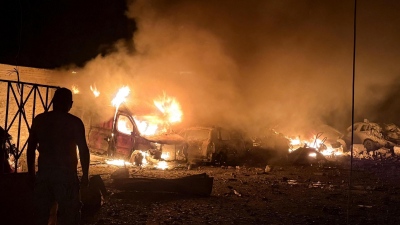
It is reminded that earlier, explosions had been reported in the cities of Bampour and Chabahar, in southeastern Iran.
Relentless strikes rage in Hormuz
It is pointed out that on the morning of Thursday July 17, the American military carried out strikes against Iranian targets in the Strait of Hormuz and on the southern coasts of Iran for yet another day.
The American military bombarded at least seven bridges around the city of Bandar Abbas, which is considered an operations hub for the Islamic Revolutionary Guard Corps (IRGC) in the Strait of Hormuz, according to an American official.

According to the same official, ammunition, supplies, and reinforcements are transported through Bandar Abbas to other points in the straits.
Iran, for its part, intensified its attacks against American bases in Tax, Qatar, Bahrain, Iraq, and Kuwait.
The IRGC also claimed that it attacked an American base in Syria for the first time since the beginning of the war, although American forces had withdrawn from that specific base several months earlier.
Congestion at Ben Gurion becomes political headache for Netanyahu
Meanwhile, the presence of American refueling aircraft has developed into a major political issue in Israel.
The dozens of refueling aircraft remaining at Ben Gurion for months had caused almost complete congestion at the airport.

This was not a problem at the height of the war, when the airspace of Israel was largely closed and many airlines had stopped flights to Tel Aviv.
However, with the airspace now open and Israelis planning summer vacations, the additional presence of American refueling aircraft at the airport could lead to massive flight cancellations.
Israelis call for withdrawal of American aircraft from Tel Aviv
Indeed, three months before the elections, such a development could cause significant political damage to the governing coalition of Netanyahu.
It is no coincidence that the Minister of Transport of Israel, Miri Regev, a close ally of Netanyahu, exerted pressure to move the American refueling aircraft from Ben Gurion International Airport or at least to limit their number.
The Ministry of Defense and the IDF reacted negatively to this proposal.
For its part, the Trump administration requested that the Israeli government facilitate the arrival of the additional refueling aircraft.
Nevertheless, as Axios notes, Benjamin Netanyahu will have the final word on the matter.
www.bankingnews.gr







Σχόλια αναγνωστών