

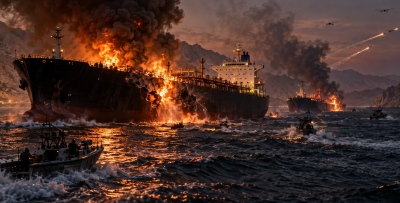
The global energy market stands before an extraordinarily dangerous domino effect. From the Russian refineries targeted by Ukraine to the Saudi East-West oil pipeline put out of operation following attacks by "unknown" drones, the main supply lines of the global oil market have suffered successive blows in recent days. And as the quantities of oil and diesel reaching international markets contract, geopolitical pressure transfers directly to consumers and, by extension, to politics.
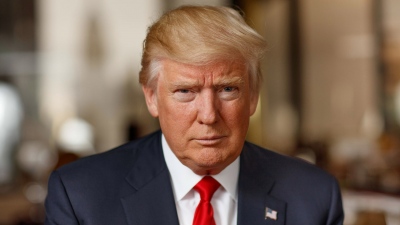
A prime example is Donald Trump, who, less than two months before the midterm elections on November 3, faces record diesel prices. Confronted with this pressure, the US President takes on Ukraine, blaming it for historic diesel prices in the US without factoring into the equation his own failed policies in Iran and the Middle East, which resulted on the one hand in the Straits of Hormuz and Bab al-Mandab being under suffocating pressure, and on the other hand in the strategically vital Saudi pipeline being targeted. However, it is difficult to ignore the bigger picture: at the very moment Trump demands restraint from Kyiv to protect the energy market, the oil market itself is threatened by a far broader war front extending from Russia to the Persian Gulf and the Red Sea.
Trump's message to Zelensky
"Mr. Zelensky needs to do one thing: he needs to stop striking diesel fuel facilities in Russia," Trump declared, arguing that Ukrainian attacks are "hurting the world." His intervention comes at a moment when pressure on fuel prices has turned into a major political headache for Washington. However, this stance stands in sharp contrast to the policy pursued by the US less than a year earlier, when it had enhanced intelligence sharing with Kyiv so it could strike Russian energy targets. The difference? Oil prices were lower back then. Besides, just about a week ago he had argued that gasoline prices would drop when the war with Iran ended, making no mention whatsoever of the war in Ukraine.
Prices alter geopolitical balances as well
The critical point is that halting Ukrainian attacks on Russian refineries does not automatically mean that price pressures will vanish. According to an assessment by Andy Lipow of Lipow Oil Associates, Russia's decision to ban exports in response to Ukrainian strikes has removed approximately 800,000 barrels of diesel daily from the market. At the same time, the closure of the Strait of Hormuz has impacted roughly 1.2 million barrels per day. The crisis, in other words, does not have a single cause and cannot be resolved with a single directive to Kyiv.
Weapon of war
For Kyiv, strikes deep inside Russian territory are not merely an energy calculation. They constitute one of the few means available to impose costs on the Russian war machine, particularly during a period when Ukraine faces critical shortages in air defense. Attacks on refineries and energy infrastructure hit the resources sustaining the Russian war effort, while Ukraine faces relentless waves of Russian drones and missiles that it struggles to counter. In this light, Trump's request to Kyiv transforms into something larger than an intervention over diesel prices: it directly touches upon how Ukraine attempts to exert military pressure on Russia.
The Kremlin sees an opportunity
Moscow did not leave the American intervention unexploited. Trump claimed on Truth Social that Russia and Ukraine had agreed to halt attacks on each other's energy facilities. However, as developments themselves proved, no such agreement existed. Kremlin spokesman Dmitry Peskov was quick to label the proposal a "very good idea," while stating that Moscow is in contact with the US side. Yet the true gain for the Kremlin lay elsewhere.
From refineries to sanctions
Peskov attempted to pivot the discussion. He argued that Russia is already close to fully covering its domestic market and that the primary problem is not production, but the access of Russian oil products to global markets. And then he moved to the core demand: the lifting of sanctions. "Only then will the world be adequately supplied with these oil products," Peskov noted. With one move, the discussion surrounding Ukrainian attacks on refineries shifted to the domain where Moscow has long sought changes: the Western sanctions regime. If nothing else, the Kremlin saw a window of opportunity. It is noted that earlier this year the US had temporarily lifted certain sanctions against Russia due to the fallout from the war in the Middle East.
Pressure on Kyiv builds
For Zelensky, the shift in climate is abrupt. Just a few days earlier, foreign policy envoys from Trump were in Kyiv, on a visit that had raised expectations for a new diplomatic momentum. However, warning signs had preceded this. The American envoys had visited Russia first. Trump had telephoned Putin, but not Zelensky. And while the supply of Patriot missiles remains under discussion, the US President mentioned that granting Ukraine permission to produce a "less advanced version" of Patriot missiles is being considered.
The attack on the East-West pipeline
While Washington focused on Russian energy assets, a second and potentially far larger problem was emerging thousands of kilometers to the south. Saudi Arabia announced the closure of the East-West oil pipeline following drone attacks which, according to Riyadh, originated from inside Iraq and caused injuries and damage. No organization has claimed responsibility so far, while Trump directed suspicion toward pro-Iranian groups operating in Iraq. Tehran categorically rejected the accusation. The problem is that this is not just any pipeline.
The energy bypass of the Persian Gulf
East-West transports Saudi crude oil from the eastern side of the country to Yanbu on the Red Sea, effectively bypassing the Persian Gulf. Amid the war between the United States and Iran, the pipeline evolved into a vital alternative route for millions of barrels of oil. According to Capital Economics, its shutdown could remove a volume equivalent to up to 4% of global oil supply from the market. The operational stoppage, which could last weeks—as the extent of the damage has yet to be clarified—further burdens an already strained global oil market. The magnitude of the risk is obvious: when traditional routes are already restricted, the loss of the primary bypass can act as a force multiplier.
The noose tightens in the Red Sea as well
The threat becomes even greater because the Red Sea no longer offers a safe exit either. The Houthis seized the port city of Mocha and Perim Island at the entrance to the Bab al-Mandab Strait—the maritime artery that in previous months acted as an alternative to the Strait of Hormuz for Saudi exports of crude and refined products. Thus, both major relief valves of the crisis are coming under pressure simultaneously: the maritime passage in the Red Sea and the pipeline that terminates there. Markets reacted immediately. Brent and WTI crude contracts surged over 3%, reaching $108 and $103 per barrel respectively, with prices today, Wednesday 16/9, standing above $104 per barrel for WTI and $108 per barrel for Brent. "It would be truly catastrophic if the East-West pipeline cannot be repaired and brought back into operation quickly," Bob McNally, president and co-founder of Rapidan Energy Group, told CNN. "It is by far the most important route through which Saudi Arabia could redirect crude oil flows."
Six million barrels per day
Despite the price spike, the oil market has demonstrated remarkable resilience during the war in the Middle East. Some oil volumes managed to pass through the Strait of Hormuz, certain countries increased production, and many tapped into strategic reserves. Simultaneously, global oil demand has softened. However, much of this resilience can be attributed to the alternative solution provided by East-West, the significance of which is reflected in the numbers. According to Richard Bronze of Energy Aspects, the pipeline transported an average of roughly 6 million barrels of crude daily during the war, with a maximum capacity of around 7 million barrels. And it did not only serve crude exports. It also fed refineries on Saudi Arabia's west coast, which produce and export refined products like diesel fuel. Here, the two fronts of the energy crisis intersect once again.
Diesel is the most vulnerable spot
Refined product markets are smaller and consequently more susceptible to sudden disruptions. Right now, they are being squeezed from two directions: by Ukrainian attacks on Russian refineries and by the threat of constrained Saudi flows through East-West. The average diesel price in the United States surpassed $6 per gallon. According to Andy Lipow, a prolonged outage of the Saudi East-West pipeline could push it above $6.50. At that point, the energy problem ceases to be a distant geopolitical story. It hits the American consumer directly.
The clock is ticking in Yanbu
Crude inventories in Yanbu are estimated at approximately 15 million barrels. Based on the current withdrawal rate, Johannes Rauball of Kpler estimates that storage tanks could empty in about four days, while the disruption to pipeline flows is expected to last around a month. Another estimate by Rystad Energy puts inventory depletion at five to seven days. A month-long disruption could, according to Rystad, strip up to 120 million barrels of oil exports from the market.
The difficult equation
In reality, both narratives converge on the exact same question. The West wants to limit Russia's capability to fund and sustain the war, without triggering an energy shock that would harm its own economies. Ukraine is trying to strike one of the key resources of the Russian military machine. And at the same time, the war with Iran has already curtailed critical Middle Eastern oil flows. As long as energy arteries remain open, this balance can be maintained. When they begin closing one after another, military decisions, sanctions, and diplomatic pressure instantly manifest as a price per barrel. And then the real confrontation is not fought solely on the fronts of Ukraine, the Persian Gulf, or the Red Sea. It is fought at the gas pump. As Richard Bronze warned regarding the prospect of a prolonged loss of East-West, a crisis that had unfolded slowly until now could transform into a "rapid ignition."
www.bankingnews.gr









Σχόλια αναγνωστών