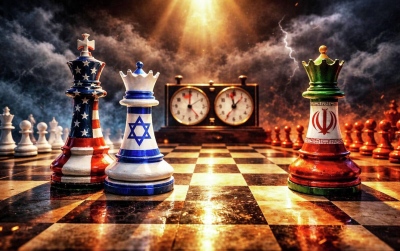
The war crisis between the United States and Iran reveals in the rawest way a reality that for decades has been hidden behind grand words about “democracy,” “security” and “stability.”
Wars for Washington are not only geopolitical tools, they are enormous business opportunities.
At a time when the Middle East is once again sinking into tension, energy prices are skyrocketing and millions of people are living under the fear of a generalized conflict, some people in the United States are celebrating.
War industries, drone companies, lobbyists, funded think tanks and political circles close to Donald Trump see the conflict not as a tragedy but as a golden opportunity for profit.
And this is precisely the most worrying thing: the war economy appears to have been transformed into a central pillar of the American system of power.
The Lockheed Martin and the “golden window” of war
The statement by the chief executive officer of Lockheed Martin, Jim Taiclet, is revealing.
The head of one of the largest defense giants in the world described the Trump administration as a “golden opportunity” for the weapons industry.
He did not speak about peace.
He did not speak about stability.
He did not speak about human lives.
He spoke about “demand.”
And that “demand” is war.
The administration of Donald Trump has already become involved in multiple fronts: support for military operations by Israel in Gaza and Lebanon, clashes with the Houthis, escalation against Iran, military tension in the Straits of Hormuz.
Every missile launched means a new contract.
Every crisis means new funding.
Every military operation means billions for the war industry.
Lockheed Martin has already secured huge agreements with the Pentagon for missile replenishment and increased production of the THAAD systems.
The American state essentially operates as a guaranteed customer of an industry that lives and develops through war crises.

Jim Taiclet
Donald Trump and the family network of profitability
Even more shocking is the fact that the close circle of Donald Trump himself appears to benefit financially from the war escalation.
The sons of the American president, Eric Trump and Donald Trump Jr., are connected to the drone company Powerus, which secured a contract with the American Air Force for interception drones.
At the same time, the company is reportedly in talks with the United Arab Emirates for the sale of drones that would be used against possible Iranian attacks.
The message is extremely dangerous: families of politicians who make decisions about war are at the same time in a position to reap financial benefits from the conflicts.
This creates a huge issue of conflict of interest and moral corruption.
The picture becomes even darker when taking into account that Keith Kellogg, former special envoy of Donald Trump for Ukraine, also joined Powerus as an advisor shortly after leaving his government role.
The well known “revolving door” between government, the military and the war industry continues to operate without any substantial control.

Donald Trump Jr and Eric Trump
The think tanks of war
The American war machine does not operate only through weapons and contracts.
It also operates through a huge network of analysts, think tanks and “experts” who shape public opinion.
Matthew Kroenig of the Atlantic Council described the cost of war with Iran as a “very good investment.”
This statement captures the deep inhumanity of a system that treats conflicts like an economic project.
For these people, bombings are numbers, the dead are statistics and the destabilization of entire regions constitutes a “management cost.”
The Atlantic Council has received nearly 13 million dollars from arms companies since 2019, reveals Stavroula Pabst in Responsible Statecraft.
This raises serious questions about how independent the “analyses” are that constantly promote increasingly aggressive strategies.
When think tanks are funded by the same companies that profit from wars, then the line between analysis and propaganda disappears.

Wall Street bets on war - Huge profits for the Polymarket linked to Trump’s son
The situation becomes even more cynical with the revelation that enormous amounts of money are being wagered in markets on war developments.
Platforms such as Polymarket and Kalshi appear to have allowed investors with insider information to reap enormous profits from fluctuations in oil prices before critical announcements by Donald Trump.
Hundreds of millions of dollars were placed in bets shortly before decisions by the American government that directly affected international energy markets.
The question is extremely serious: was there a leak of insider information from government circles?
Even if such a thing is not proven, the very existence of a system in which financial players can become rich from war crises shows the scale of moral decay.
Particular sensation is also caused by the fact that Donald Trump Jr. sits on the board of Polymarket.

The weapons lobby and political buyouts
War industries are not satisfied only with state contracts.
They invest enormous sums in political influence.
Only within the first months of the year, political committees connected with major defense companies channeled nearly 5 million dollars into election campaigns and party mechanisms in the United States.
At the same time, dozens of companies registered as lobbyists on defense and energy matters after the beginning of the crisis.
The system operates cyclically: weapons companies fund politicians, politicians approve enormous military budgets and then the same companies win even more state contracts.
The losers in this process are taxpayers and societies that pay the cost of wars.
Trump and the politics of aggressive profitability
Donald Trump was often presented as a politician who would avoid new wars.
However, reality shows something different.
His administration strengthened military tensions, increased defense spending, escalated the conflict with Iran and created conditions that directly favor the war economy.
The image taking shape is that of a system where war functions as a mechanism for generating wealth and political power.
American foreign policy no longer appears to be guided only by geopolitical interests but also by a vast web of economic interests that depend on maintaining tension.

Iran as an obstacle to American dominance
Within this framework, Iran is treated by Washington not simply as an opponent but as an obstacle to American hegemony in the Middle East.
Tehran refuses to submit to American pressure, maintains strategic relations with China and Russia and continues to function as an independent geopolitical pole.
This explains why American policy toward Iran is characterized by constant aggression.
This is not only about the nuclear program.
It is about control of the region, energy and geopolitical balances.

War as a massive profit industry
The crisis between the United States and Iran reveals a dark reality: war has been transformed into a massive profit industry.
War companies, political lobbies, investment funds and circles of power appear to earn billions through tension, insecurity and military escalation.
Donald Trump and his environment appear deeply connected to this structure of interests, while societies pay the price through economic instability, energy crisis and the risk of generalized war.
What is most worrying, however, is that the American system seems to have built an entire economy around conflicts.
And when war is transformed into a business, then peace ceases to be a real priority.
www.bankingnews.gr









Σχόλια αναγνωστών