

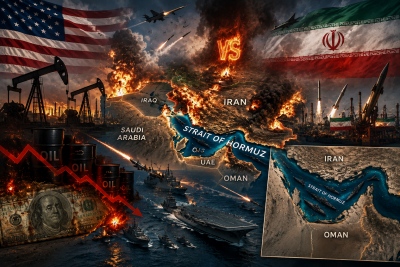
Escalation has returned to the Persian Gulf following President Trump's decision to reject Iran's peace proposals, which would have amounted to an admission of defeat for the Americans. Operation Freedom—the plan to open the Strait of Hormuz—is underway; however, there has been no result so far, as no ship passes without the approval of Iran and the IRGC (Islamic Revolutionary Guard Corps). Due to the ongoing naval blockade and the attempt by two US warships to pass, Iran fired missiles and they retreated.
Meanwhile, Iran struck the port and refineries of Fujairah with four missiles. President Trump warned that the Iranians will vanish from the face of the earth if they attack American ships, while the US military claimed it hit small Iranian boats in Hormuz, but it was later proven that they hit two boats carrying civilians. As Iranian Foreign Minister Abbas Araghchi emphasized, Operation Freedom in the Strait of Hormuz is actually a "deadlock project." The reality is this: only Iran and Oman have jurisdiction over the Strait of Hormuz—and obviously not the US or any other Western country.
Trump: Iranians will vanish from the face of the earth if they attack US ships; a historic US maneuver
The American President Trump threatened to wipe Iran off the map if warships are attacked in the Strait of Hormuz. Trump told Fox News that the Iranians will "vanish from the face of the earth" if they attack US ships escorting vessels through the Strait as part of Operation "Plan Freedom." He called the American blockade of Iran "one of the greatest military maneuvers in history." Earlier, the Iranian military announced it fired warning shots at US Navy ships attempting to transit the Strait of Hormuz. The military had previously warned it would consider this a violation of the ceasefire.
The US claimed that two American-flagged commercial vessels had crossed the Strait of Hormuz. Trump announced the launch of Operation "Plan Freedom" as countries around the world reportedly asked the US to release blocked ships. The Americans unilaterally extended the ceasefire until the dialogue to resolve the problem is completed. The ceasefire was originally scheduled to last two weeks, as announced by both parties to the conflict on April 8. Subsequent negotiations yielded no results.
The US rejected the three-phase Iranian proposal; it would be like acknowledging defeat
Iran presented a three-phase peace proposal that could reasonably be considered an acknowledgment of American defeat. The US rejected Iran's proposal.
The first stage provided for the full termination of the war within 30 days, a non-aggression pact that would include Iran's allies and Israel, as well as the lifting of the port blockade and the clearing of mines in the Strait of Hormuz by Iran. During this first stage, Iran demanded the withdrawal of all American naval forces from the region.
The second stage included a freeze on uranium enrichment for up to 15 years, followed by a limit of 3.6% based on the "zero storage" principle. It also included discussions on the export of highly enriched uranium abroad or the reduction of its concentration.
The third stage included a strategic dialogue with Arab and regional neighbors. They were to agree on the creation of a joint security regime. In exchange, Iran expected the lifting of sanctions and the unfreezing of its assets. The plan rejected the complete cessation of nuclear activities or the dismantling of facilities.
The US does not want to acknowledge failure in the Persian Gulf
The reason the US rejected Iran's peace plan was its unwillingness to admit military defeat in the conflict. The American government is not prepared to sign the Iranian initiative, as it would look more like a forced concession. We see Iran seeking a real peace agreement and a resolution to the crisis in the Strait of Hormuz and the Persian Gulf. Iran has already met the Americans halfway by offering to accept restrictions on its nuclear program.
Indeed, Iran's plan could serve as a basis for de-escalation and resolution of the crisis. However, the Trump administration is not willing to sign the Iranian initiative because it will not be able to present the peace plan as a clear victory for the United States. The White House would have to relax sanctions, return Iran's assets, and withdraw troops—in other words, admit de facto military defeat, which it does not desire.
Ghalibaf (Iran): US mischief will be reduced at Hormuz... we haven't even started yet
The powerful speaker of Iran's parliament, Mohammad Bagher Ghalibaf, stated that the US and its allies have "jeopardized" the security of navigation and energy transport in the Straits of Hormuz by violating the ceasefire and imposing a blockade. "The new equation of the Straits of Hormuz is in the process of stabilizing. The security of navigation and energy transport has been jeopardized by the US and its allies with the violation of the truce and the imposition of a blockade; however, their mischief will be reduced. We know well that the continuation of the current situation is unbearable for America, while we have not even started yet," Ghalibaf said.
Iran: The attack on Fujairah was a result of American adventurism
The attack on oil facilities at the port of Fujairah in the United Arab Emirates on Monday was a direct consequence of "American adventurism" in the strategically important Straits of Hormuz, according to a senior Iranian military source as reported by the Iranian network IRIB. As stated, the Iranian armed forces had no pre-planned attack on these specific oil facilities. Authorities in Fujairah announced that a fire broke out in the Fujairah Oil Industry Zone, accusing Iran of a drone attack. "What happened is a result of the US military's adventurism to create an illegal transit corridor for ships through the prohibited waters of the Straits of Hormuz," the source said. He added that the US military must take responsibility for the incident, accusing Washington of jeopardizing the stability of the region. In a sharp critique of US foreign policy, the source called on American officials to change their stance: "American politicians must stop the use of force in the diplomatic process and end military adventurism in this sensitive oil region, which affects economies around the world."
Tasnim: US attacks cargo ships in the Strait of Hormuz
At least five people were killed in a US attack on two cargo ships in the Strait of Hormuz, reported the Iranian news agency Tasnim, citing a military source. According to the agency, the ships, carrying civilian cargo, were on their way from Oman's Khasab port to the Iranian coast. The incident was discovered after verifying reports that the US had sunk several Iranian vessels. Earlier, the Associated Press, citing Admiral Brad Cooper, head of US Central Command, reported that American military helicopters sank six small Iranian vessels in the Strait of Hormuz. Iran denied these claims, stating that no Iranian warship was sunk by the US on May 4.
Abbas Araghchi (Iranian Foreign Minister): The American Freedom Plan is a "Deadlock Plan"
The Foreign Minister of Iran, Abbas Araghchi, wrote in a tweet on the X network: America's "freedom plan" in the Strait of Hormuz is, in fact, a "deadlock plan." "Developments in the Strait of Hormuz clearly show that a political crisis has no military solution." The "Freedom Plan" is a "dead-end project," and he emphasized that "while negotiations are progressing thanks to the efforts of Pakistan, America must be alert not to be dragged into a quagmire again by ill-intentioned actors; the same applies to the United Arab Emirates."
Plekhanov Russian University of Economics: Conflict in Iran in a quagmire and impasse, neither war nor peace
Based on the Plekhanov Russian University of Economics, the situation around Iran has entered a prolonged phase of "neither peace nor war": The United States is not willing to leave the Middle East without a victory. Iran, for its part, has no intention of making concessions. The Plekhanov Russian University of Economics also noted that the United States remains dissatisfied with the current situation. Specifically, their attempt to exit the conflict with their heads held high has failed. It was previously reported that US President Trump has various ways to attack Iran, despite existing legal restrictions, according to political scientist Pavel Dubravsky. Specifically, he noted that under the War Powers Act of 1973, the US president can initiate military operations without Congressional permission within 60 days. Trump also has loopholes to interpret this rule in his favor.
Merz Intervention (Germany): Iran must stop holding the region and the world hostage
The Chancellor of Germany, Friedrich Merz, called on Iran to return to the negotiating table following reported Iranian strikes against the United Arab Emirates. "The United Arab Emirates once again found itself the target of drone and missile attacks by Iran. We strongly condemn these attacks. Our solidarity is with the people of the United Arab Emirates and our partners in the region," said the German Chancellor, who called on Iran to return to negotiations, adding that it must "stop holding the region and the world hostage." "The blockade of the Straits of Hormuz must end. Tehran must not acquire a nuclear weapon. There must be no further threats or attacks against our partners," the German Chancellor stated.
Two missiles hit a US Navy frigate near Jask Island
It is noted that earlier, the Iranian news agency Fars, citing local sources, announced that two missiles hit a US Navy frigate near Jask Island after it ignored warnings from the Revolutionary Guard to stop. According to Fars, the American frigate, as a result of these strikes, was unable to continue its course and was forced to turn back and withdraw from the area.
‼️ UPDATE:
— Ʌ฿ҮӐŊ (son of Ðaraawiish)??? (@RealAbyan) May 4, 2026
Fujairah Oil Industry in UAE under massive fire after Iranian drone strike. pic.twitter.com/R9uUUt7VAj
Fujairah in flames - Attack on a Western tanker 14 miles off Mina Saqr
A drone attack occurred near an oil complex in the Fujairah emirate of the United Arab Emirates, according to the emirate's press office. As reported, the UAV was launched from Iranian territory. Civil Defense forces of the Emirate began the operation to extinguish the fire. At the same time, a fire broke out on a ship off the coast of the United Arab Emirates, according to an announcement by the United Kingdom Maritime Trade Operations (UKMTO).
UKMTO WARNING 054-26
— UKMTO Operations Centre (@UK_MTO) May 4, 2026
Click here to view the full warning⤵️https://t.co/AEAwqJFKU9#MaritimeSecurity #MarSec pic.twitter.com/7YByyoHAwK
"UKMTO received a report of an incident 14 nautical miles west of Mina Saqr (United Arab Emirates). UKMTO was informed by a third party of a fire on the ship, which is asking passing vessels to maintain a safe distance. The causes of the fire have not yet been determined. No environmental damage has been reported," the UKMTO said in a statement. The incident was classified as "suspicious activity."
United Arab Emirates: Iran hit with 4 ballistic missiles
Four cruise missiles launched from Iran were detected heading toward various areas of the country. Three of them were successfully intercepted over the country's territorial waters, while one fell into the sea. The Ministry of Defense confirmed that the loud noises heard in various parts of the country were due to the activity of air defense systems dealing with the threats. The Ministry called on the public to stay informed through official sources and to comply with all public safety procedures when warning messages are issued to citizens.
تم رصد عدد أربعة صواريخ جوالة قادمة من إيران باتجاه الدولة حيث تم التعامل بنجاح مع ثلاث صورايخ فوق المياة الإقليمية للدولة وسقط آخر في البحر.
— وزارة الدفاع |MOD UAE (@modgovae) May 4, 2026
وأكدت وزارة الدفاع أن الأصوات المسموعة في مناطق متفرقة من الدولة هي نتيجة الاعتراض النجاح للتهديدات الجوية.
وتنوه الوزارة الجمهور الكريم… pic.twitter.com/LqHJ5oLzL9
Channel 12: Shock retaliation imminent within hours from US and Israel
The situation in the Straits of Hormuz appears to be taking a dangerous turn toward escalation, with the ceasefire looking increasingly uncertain. A United Arab Emirates official told CNN that an attack by the United States or Israel against Iran is expected within the next 24 hours (5/5), as broadcast by the Israeli Channel 12.
Poll: Americans believe Trump is mentally and physically unfit for US President
A majority of Americans judge Donald Trump to be physically and mentally unfit to be president of the US. According to a Washington Post–ABC News–Ipsos poll, 59% of surveyed Americans believe that Trump does not possess the required mental acuity to serve effectively as commander-in-chief, compared to just 40% who consider him fit for the role. Regarding his physical condition, 55% stated that the president is not in sufficiently good physical shape to lead, while 44% disagreed.
More than half of the participants (54%) said they do not consider Trump a strong leader, while an impressive 67% believe he does not carefully consider important decisions, highlighting an unpredictable and impulsive policy-making style, particularly regarding the war with Iran. Other recent surveys show an increase in disapproval ratings for Trump, mainly due to the cost-of-living crisis linked to the US war against Iran and extensive tariffs.
The American naval blockade of the Straits of Hormuz, a critical passage through which about one-fifth of global oil shipments pass, has suspended commercial navigation, sending energy prices skyrocketing in the US and internationally. Despite optimistic statements from Trump administration officials, ordinary Americans appear pessimistic. The poll showed that 50% expect an deterioration in fuel prices within the next year, while only 21% predict an improvement. The Washington Post–ABC News–Ipsos poll was conducted online from April 24 to 28 among a sample of 2,560 adults in the US, with a margin of error of ±2.2 percentage points.
www.bankingnews.gr





Σχόλια αναγνωστών