

The situation in the war involving Iran appears to have gone beyond any thriller movie scenario.
Since June 2025, the military attacks of the United States and Israel on Iran have escalated geopolitical tension to unprecedented levels.
The launch of the operation “Epic Rage” on February 28, 2026 further intensified the already severe tension.
The specter of a general war and a nuclear threat has become a daily reality, while the truth about Iran’s nuclear program remains uncertain.
The plan of the United States and Israel includes two seemingly unlikely objectives: the overthrow of the hardliners and the installation of a moderate regime, as well as the complete neutralization of the Iranian nuclear program.
However, despite the air raids and the assassinations of top scientists, reality is more complex and dangerous than expected.
The nuclear program and the uncertainty
The assessment of experts regarding Iran’s nuclear capabilities remains extremely difficult.
Since the attacks on Natanz, Isfahan, and Fordow in 2025, the amount of uranium that remains active and accessible is uncertain.
Before the raids, the Iranian stockpile included approximately 440.9 kilograms of uranium enriched to 60%, close to the level that could reach weapon grade.
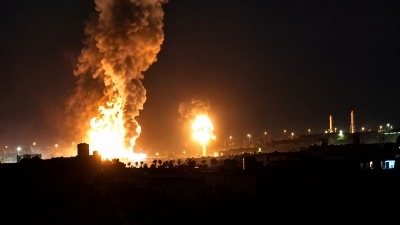
The American strike with the GBU-57 Massive Ordnance Penetrator in March 2026, a 30,000 pound bomb designed to penetrate 60 meters of reinforced concrete, hit the Taleghan-2 facility in the military complex of Parchin.
Satellite images show significant damage, but the truth about how much uranium remains safe or destroyed is uncertain.
The International Atomic Energy Agency (IAEA) notes that a large portion of the stockpile is likely still located in Isfahan, while other parts may have been destroyed.
Some experts estimate that a large portion of the uranium is hidden underground, inaccessible even to the most advanced air strikes.
The unlikely prospect of special operations
Against this background, the idea that American commandos could extract the uranium from Iran resembles a science fiction scenario.
The terrain and the underground facilities in Fordow have been excessively reinforced, with depth reaching 100–130 meters inside mountains, designed to withstand GBU-57 and other bunker-buster type bombs.

The execution of such a mission would require absolute secrecy, precise coordination, high technology, and success in a series of extremely dangerous actions: low helicopter flights to avoid radar detection, simultaneous air support, and lightning neutralization of the existing security forces.
A success would mean that commandos would enter the underground facilities and leave with uranium capable of being used for weapons, something considered practically impossible due to the multiple layers of protection and the technological complexity.
The risk of human losses and the possibility of a nuclear type accident make the mission almost unimaginable.
Many military analysts describe the American or Israeli commandos who would undertake such an operation as “already dead.”
The attacks and the strategic failure
The strategy of the United States and Israel has already caused destruction in Natanz, Isfahan, and Fordow, while the International Atomic Energy Agency recorded violations by Iran.
However, even after the bombings of 2025 and 2026, the country retains much of its technological capacity for uranium enrichment and weapons development.
Experts emphasize that the physical destruction of facilities does not equal neutralization of capability.
American General Dan Caine admitted before senators that the United States does not possess the military power to destroy the underground facilities in Isfahan, where a large part of the uranium is likely stored.
The combination of underground facilities, advanced air defense systems, and technical complexity makes the effort to remove uranium from Iran extremely difficult.

The strategic challenges of intervention
It is not clear whether the mission would be exclusively American, Israeli, or joint.
At the same time, its execution would take place only when the United States and Israel judge that the Iranian armed forces can no longer seriously threaten the involved troops.
During a briefing to Congress, United States Secretary of State Marco Rubio avoided giving clear answers about who would undertake the action: “Someone has to go and take it,” he said, without specifying who.
However, an Israeli official stated that Trump and his team are seriously examining the possibility of sending special operations units for specific missions.
An American source revealed that there are two options: removal of the uranium from Iran or dilution of the uranium on site by specialized scientists, possibly with the participation of the IAEA.
The problem, as the same sources point out, is purely operational: “The first question is, where is it?
The second, how do we get there and how do we obtain physical control?”
The decision to transport the uranium would rest with the President and senior officials of the Department of Defense and the CIA, showing the deep military operational involvement of the American administration.

The dangerous American rhetoric
Trump himself stated that the presence of ground forces is possible, “but only for a very good reason.”
Specifically, regarding the possible seizure of nuclear material he said: “We might do it later.”
The White House spokesperson Karoline Leavitt emphasized that Trump “smartly keeps all options open.”
At the same time, beyond the uranium, there were discussions about the seizure of the island Kharg, which was bombed, a strategic terminal responsible for about 90% of Iran’s oil exports, highlighting the extensive strategic agenda of the United States.
What emerges from the data is that the United States and Israel are investing in excessive military involvement, aiming for complete control of Iran, disregarding escalation and the consequences for regional stability.
The idea of sending special forces into a country that has not directly threatened the United States indicates geopolitical arrogance and military aggressiveness that risks turning the Middle East into a continuous battlefield.
The threat of international instability
At the same time, Iran maintains a vast arsenal of ballistic missiles capable of striking the United States, Europe, and neighboring countries in the Middle East.
The risk that a political collapse or civil war could lead the uranium into the wrong hands is real, while international energy markets are already shaken by the closure of the Strait of Hormuz.
Any attempt at special operations therefore concerns not only the immediate prevention of a nuclear threat, it includes extreme geopolitical risk, possible escalation of war, and enormous consequences for the international economy.
The removal of Iranian uranium by special forces of the United States or Israel, despite spectacular strategic and technological capabilities, remains almost unimaginable.
The underground facilities, the complexity of the nuclear program, and the military defense of Iran make any such attempt extremely dangerous, practically impossible, and filled with thriller-like tension.
The only certainty is that the escalation of military operations and the ongoing threat surrounding Iran’s uranium remains one of the most dangerous scenarios for the Middle East and the entire world.
www.bankingnews.gr






Σχόλια αναγνωστών