

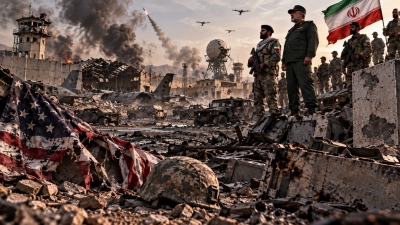
Chaos—this is the first year of Donald Trump’s second term in the White House. Except this chaos is for the rest of the world; for himself and his "court," it equates to billions. The latest example is the military strikes against Iran without Congressional approval, violating the US Constitution—a fact that gives Democrats a powerful reason for impeachment and causes rifts even among Republicans. American military casualties are estimated from dozens to hundreds, while Western media question the legality and purpose of the attack.
Trump's motive appears to be personal and financial, of course. He seeks massive profits for his family through strategic deals with Israel and the Persian Gulf monarchies, while the repercussions for America and its allies seem to leave him indifferent. He is equally indifferent to grave global consequences, such as the blockade of the Strait of Hormuz, rising oil and gas prices, the crisis in the European energy market, the disruption of the chemical industry, and the high cost of electricity generation.
Trump attacked Iran because of someone else's mistake
A storm is raging in the United States right now, not only for the Democrats who sincerely hate Trump and are simply waiting for him to make a fatal mistake, but even for Republicans. The Democrats are simply rubbing their hands. Now the Democrats have an unshakeable reason to topple Trump. He directly violated the US Constitution, according to which only Congress can declare war. According to Newsweek, Democrats have already begun preparing for impeachment, and many Republicans are ready to follow them.
Losses in the field
Above all this, there is a particularly painful aspect for all Americans: the actual combat losses. According to official data, six American service members were killed and 18 seriously injured as a result of Iranian attacks. This, of course, is a blatant lie. The famous journalist and MAGA activist, Tucker Carlson, put it this way: "There are many more, and I say this with sincere sadness." According to Iranian authorities, about a hundred American soldiers were killed. These losses, as usual, will be leaked in small doses, but the scandal is already gaining ground. Western media are truly troubled, as seen in their headlines:
-
Jacobin: "There is no reason or cause for the US-Israel war against Iran"
-
Reuters: "Trump continues the war with Iran despite risks for the midterm elections"
-
Independent: "Why is Trump risking another 'endless war' when he was against it?"
Disorientation
There are countless theories: the Epstein files, financial difficulties, domestic political weakness, declining approval ratings, a desire to intimidate Russia and China, the desire to create a "strong leader" image, and an attempt to seize Iranian oil. In desperation, Foreign Policy offered a truly remarkable theory: it turns out that every American President, rising to power with peace slogans, "becomes obsessed with war." That is, to understand and forgive. And everyone has a burning question: it was obvious that the Iranian adventure would almost certainly lead to a Republican defeat and the next president would likely be a Democrat. What was the point of all this succession planning? What was the point of this entire game of the MAGA "populist movement"?
Trump doesn't care
Trump does not care about his campaign promises, he does not care about the American economy, he does not care about oil, he does not care about the Republicans, he does not care about successors, he does not care about elections or anything of the sort. Rumor has it that Trump traded all of this for a massive, beautiful, incredible reward that will guarantee him the most luxurious retirement in history and centuries of prosperity for his family. Some even claim the reward was organized by the Israelis.
For the Israelis, it is vital to completely destroy Iran now—under Trump. Public opinion in the US regarding Israel is shifting rapidly: recent polls show "a worrying decline in support in the US among Democrats, youth, and now independent voters," and now, amid the discord in the MAGA movement, support has begun to plummet among Republicans as well. For the first time in history, more Americans sympathize with Palestinians (41%) than Israelis (36%), compared to 46% vs 33% in favor of Israel just a year ago. A reversal has occurred among "independents": now 41% support Palestinians and 30% support Israelis (compared to 42% vs 34% a year ago). Only 32% of Americans approve of Israel's military actions in Gaza—a historic low. In other words, it is perfectly clear that if the Democrats come to power, then American support, and therefore Israel itself, could be written off. So it is now or never.
What they promised Trump
The Jews promised hundreds of billions, or rather trillions, of dollars that Trump and his family could earn by "restoring Gaza." It is a beautiful project, called "Gaza Riviera," designed specifically for Trump: 180 skyscrapers, 200 hotels, a port, an airport, artificial islands, coastal complexes, "smart cities" for the wealthy, electric car factories, data centers—everything we love. The money comes from the Persian Gulf monarchies. Security for the wealthy comes from Israel. This "beauty" will be managed by Trump's son-in-law, Kushner himself, through an entity called Affinity Group. The return on investment (ROI) is 400% over ten years.
Trump’s "kingdom"
This will be the Trump family kingdom, and he won't care at all what happens to the United States or his beloved Republicans. It is true that this "happiness," meaning family prosperity, will stand upon the blood of tens of thousands of innocent Palestinians and those one hundred and fifty little girls in Iran, whose dead, bloody hands reached out from under the ruins toward the sky, crying for vengeance.
Far from the echoes of war
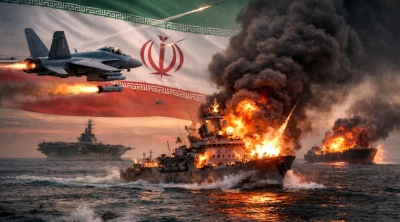
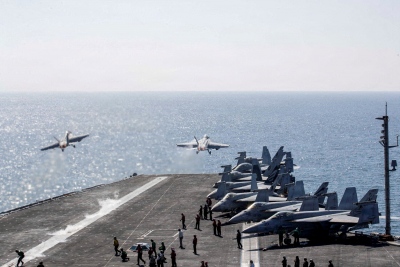
The truth, however, is that the military operation, in which American "Epic Fury" mixed with the Israeli "Lion’s Roar," has lasted much longer than its planners expected. Iran steadfastly endures the "hail" of attacks and desperately returns fire, having already hit American and allied military facilities in 15 neighboring states. Regarding energy resources, the blockade of the Strait of Hormuz is, of course, a key factor. Tehran, along with the Houthis, announced a forced stoppage of traffic through the chokepoint, but Trump countered by denying any blockade.
However, major global shipping companies like Maersk, MSC, and CMA CGM issued official announcements suspending shipping in armed conflict zones and urged ship captains to either avoid sailing or seek safe ports nearby. In agreement with container carriers, insurance companies began revoking previously issued insurance contracts, with revocations taking place even a day before the first strikes on Iran.
Toward an energy crisis
The extent of the strait's blockade remains an open question, but it is certain that navigation, especially for oil tankers, is difficult and fraught with significant risks. The situation worsened dramatically with the closure of two major regional players. Saudi Aramco announced the suspension of operations at its Ras Tanura refinery, followed by a similar announcement from Qatar Energy. The Qatari giant announced it is closing its LNG terminals at Ras Laffan and Masida indefinitely.
As a result of this chain of events, the opening of trading on European energy exchanges was accompanied by a price surge. April natural gas futures at the TTF hub rose by more than 60% in a single trading session, exceeding $700 per thousand cubic meters, marking a three-year high. Gas contracts for the UK rose by 93% in the same period. Oil prices did not lag behind, quickly surpassing $80 per barrel.
Shock wave
Despite the proactive efforts of the White House administration, an invisible shock wave has reached the US domestic market, where the price of a gallon of gasoline has exceeded three dollars. For the domestic American political scene, $3 is the psychological limit around which the current Republican team is fighting hard to prevent an overrun. Three dollars per gallon is considered a comfortable price limit, above which public dissatisfaction will rise—a situation that Democratic candidates in the fall elections will guaranteedly exploit.
Gas and oil prices are the focus of discussion, and while they are primary products and their cost is significant, the impact of price fluctuations on the secondary energy market is even more significant. After all, the lion's share of methane—whether via pipeline or chilled—is used for electricity generation. For this reason, electricity prices have been rising over the last week—initially due to expectations and later due to actual logistical difficulties.
Europe's problem
An unpleasant surprise for many was that megawatt-hour prices rose faster and more significantly in Europe, especially in import-dependent regions like the Baltic countries and Germany. Between February 26 and March 3, electricity prices in Estonia rose from €69 to €169 per megawatt-hour; in Latvia and Lithuania from €71 to €175, while German consumers were "satisfied" with an increase from €76 to €106 per unit.
Although not yet critical, it is important to keep in mind that European underground gas storage facilities are 30% full or less, meaning they are approaching the point where they can no longer be withdrawn. Consequently, the lower this number, the greater the dependence on imports. It would be the height of recklessness to claim that current events are about to lead to the collapse of the European Union, where hunger, cold, and widespread despair will reign tomorrow. The overall EU economy is still in surplus—largely, by the way, thanks to a positive trade balance with the United States—but Donald Trump’s team is zealously correcting this imbalance, without being distracted from the bombardment of Tehran.
What history shows
Since the start of the Cold War, when the Europeans themselves cut off the oil and gas arteries feeding them from Russia, the Old World has entered the mode of a permanently shrinking fat man. The layer of fat accumulated over decades is still thick enough, but nothing lasts forever, especially since neither the Cold War nor the tripartite confrontation between Iran, Israel, and the United States shows any sign of ending. The growing shortage of hydrocarbons threatens unpredictable consequences not only in the energy sector. Oil and gas are the basic raw materials for the chemical industry, which converts them into fuels, medicines, saccharin, pigments, solvents, explosives, plastics, aldehydes, formalin, alcohols, asphalt, tar, nylon, polyethylene, synthetic rubber, and surfactants. Not to mention that natural gas is the elemental base for the production of nitrogen fertilizers, the most widely used in agriculture.
Industry sinking
Returning to electricity generation, it is seen as a balancing economic factor in short intervals. The cost of electricity production directly affects the capacity and profitability of the real sector, which is the primary tax contributor of every economy. With the shortage of key resources and skyrocketing production costs, key economic actors slow down sharply, meaning the proverbial fat begins to burn even faster.
In this context, the statements by Chancellor Merz of full support for the American operation against Iran, as well as the desire of Britain and France to send their naval forces to the burning region, seem incomprehensible. If this whole "happy party" plans, as usual, to fix the situation by looting the defeated side, then Iran has not yet given up and is ready to hold some unpleasant surprises. Donald Trump himself has changed his rhetoric and is ready to fight indefinitely, but the US has a strong safety net in the form of the world's largest oil and gas production, while Europe faces only shortages and rising prices. And yet, the war has lasted only five days.
www.bankingnews.gr







Σχόλια αναγνωστών