

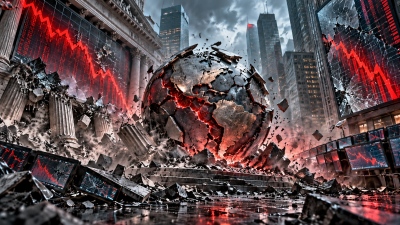
Kenneth Rogoff, former IMF economist and professor at Harvard, warns in an article published on Project Syndicate that 2026 could bring a “Great Crash” to the global financial markets.
According to Rogoff, the massive investment in artificial intelligence, despite its impressive capabilities, conceals significant risks and may lead to a sudden collapse, triggering chain reactions in the economy and stock markets.
Investors are being urged to reassess their strategy and prepare for a period of extreme volatility.
In particular, Rogoff, former chief economist of the IMF, points out that the biggest surprise of 2025 was not the surge in asset prices, but the almost complete indifference of investors to risk.
A brief shock was observed only in April, following the announcement of “Liberation Day” by US President Donald Trump.
Now, the big question is whether 2026 will break this spell of euphoria.
After three years of exceptional returns, one would expect markets to begin worrying about the inevitable correction that follows periods of continuous ascent.
Artificial intelligence promises a great deal for companies, though not always for workers.
However, the history of transformative technologies, from railways and internal combustion engines to the internet, shows that early participants often collapse spectacularly, giving way to second generation companies that “get it right”.
Even companies that dominate for a period, such as IBM, do not reduce uncertainty, their longevity is never guaranteed.
As investors try to assess how AI will affect growth and corporate profits, the chances of a global stock market crash appear alarmingly high.
Does this mean one should sell? Not necessarily.
Stock prices can continue to rise even after warning signs appear.
The same happened in 1996, when the then chairman of the Federal Reserve Alan Greenspan, drawing on data from future Nobel Prize winner Robert J. Shiller, warned of the market’s “irrational exuberance”, Rogoff notes.
Bubble dot-com
The dot-com bubble eventually burst in 2000, after stock prices had already doubled. The same could happen today.
Geopolitical uncertainty is intensifying as we head toward 2026.
Even if Ukraine and Russia reach a ceasefire, the eastern borders of Europe will likely remain “hot” for years.
At the same time, China is expanding its naval fleet at a rapid pace, while America, even if it purchases one million drones, will hardly be able to compete with Chinese production.
On the political front, the return of Trump to the White House is expected to cause new turbulence.
If his health allows it, 2026 is expected to be just as dynamic, or authoritarian, depending on perspective, as 2025.
By contrast, Joe Biden presented himself as a reformist president, but his policies largely remained predictable, with the exception of his approach to open border issues.
The end of Jerome Powell’s term as chairman of the Fed adds further uncertainty.
Trump has stated that he expects Powell’s successor to cut interest rates, even at the risk of increasing inflation.
Investors who tried to hedge against volatility failed in 2025, and 2026 appears even more dangerous, as global equity valuations and borrowing drift away from economic fundamentals.
Trump’s tariffs and immigration policies will become more strongly felt, while the dismantling of key reforms could cause serious long term damage.
When growth slows and inflation rises, today’s euphoria can disappear quickly.
The European Union faces its own critical moment. The best case scenario would be a decisive move toward fiscal union, at least among some member states.
If this does not happen, reform will require changes to decision making rules.
According to Rogoff, if Europe manages to organize its geopolitical action, the euro could acquire a more significant role in global financial markets.
Japan remains an unknown, as no one knows how far the Bank of Japan will go with interest rate increases or how the unwinding of the yen carry trade will unfold.
A stabilizing factor could be a possible depreciation of the dollar, which remains overvalued despite recent cuts.
Many investors may wake up in 2026 to a far more volatile global economy than the one they experienced in 2025.
When this shift in mindset hits, volatility may become self reinforcing, creating new challenges for the markets and the global economy, Rogoff concludes.
www.bankingnews.gr






Σχόλια αναγνωστών