

Greece is preparing diplomatic moves following the discovery of a Ukrainian MAGURA naval drone loaded with explosives off Lefkada, however, the Mitsotakis government can no longer pretend that this is an ordinary incident, stresses the Russian medium based in Athens, Rua.gr.
What started as a strange discovery by fishermen inside a sea cave has now officially turned into a national security issue and a case for the Greek Ministry of Foreign Affairs, the Russian-language medium points out characteristically.
The Greek Minister of Foreign Affairs, Giorgos Gerapetritis, arriving at the meeting of the EU Foreign Affairs Council in Brussels, characterized the case as a "particularly serious development."
He stated that an investigation by the General Staff is underway to ascertain the technical characteristics of the device and the circumstances of the incident.
As soon as the investigation is completed, the Greek government will proceed with the necessary diplomatic actions.
The Greek Minister of Foreign Affairs did not officially name the country to which the demarche will be addressed.
However, after the reports that the recovered device was a Ukrainian MAGURA sea drone, the political target becomes quite obvious.
Otherwise, the diplomatic demarche would have to be addressed to a... sea cave, something rather bold even for modern European diplomacy.
The minister himself underlined: "Greece will not allow the escalation of military actions in the wider Mediterranean, particularly in the direction of Greece."
He added that such incidents constitute a serious risk to the freedom of navigation, the safety of citizens, and the environment.
According to him, Greece will take all necessary measures so that the Mediterranean does not turn into a theater of military operations.
From "unknown device" to Ukrainian MAGURA
Until their latest statements, the authorities were trying to maintain a cautious line: that the device found off Lefkada was still being examined, that its origin is being investigated, and that its technical characteristics are being verified.
But this argumentation looked less and less convincing.
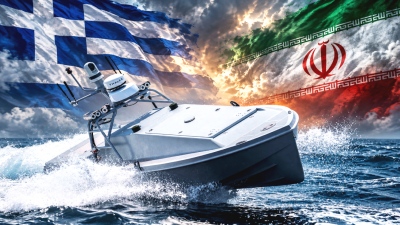
According to reports in the Greek press, the drone was a Ukrainian MAGURA sea drone, an unmanned offensive surface vessel used in operations against Russian targets at sea.
A USV drone was discovered off the coast of Lefkada by local fishermen earlier today. The sea drone has been retrieved by the Hellenic Coast Guard, with assistance from Armed Forces personnel, as authorities investigate how and why it reached Greek waters. pic.twitter.com/JnPD7RMEgU
— Daphne Tolis (@daphnetoli) May 7, 2026
The drone was spotted by fishermen in a sea cave off Cape Doukato, south of Lefkada.
According to information, its engine was still running.
The fishermen secured the drone and towed it to the port of Vasiliki, where subsequently the Coast Guard, the Navy, the Greek Ministry of National Defense, and EYP took over the investigation.
This alone looks like a failure of the control system.
A military naval drone appeared near a Greek island and the first to spot it were not the intelligence services or the navy, but ordinary fishermen.
If the device was in a combat state, a tragedy could have occurred before the state could follow its usual procedure: first not to understand what is happening, then to investigate, and then to assure that everything is under control.
100 kilograms of explosives and the question of the target
Initially, reports spoke of a payload of up to 300 kilograms.
Later, Greek media began to speak of approximately 100 kilograms of explosives, which were neutralized with a controlled explosion.
This revision does not make the incident less dangerous.
One hundred kilograms of explosives off a Greek island is not a technical detail nor a reason for reassuring press releases...
According to the reports, the device was designed to strike its target using a "kamikaze" method, meaning to collide with a ship and explode.
Ukraine has already used this type of sea drone against Russian ships and vessels linked to Russian maritime exports.
Therefore, the baseline scenario was a potential attack on a Russian ship or tanker linked to the so-called "shadow fleet".
In this context, ship-tracking data acquire particular significance.
According to information discussed in the Greek press and based on data from MarineTraffic, a Russian tanker indeed crossed this specific sea route during the period in question.
If this is a coincidence, it needs explanation.
If it is not, even more so.
The key question now is not "what kind of drone is this?".
This question has essentially already been answered.
The main question is: where did it come from, who directed its course, if the target was predetermined, why the device ended up near Lefkada, and what the Greek authorities knew before the fishermen found it.
Athens can no longer hide behind "we do not know"
The statement of Gerapetritis essentially means that the government can no longer hide behind the argument "we do not know to whom the device belongs."
If diplomatic moves are being prepared, this means that Athens already possesses sufficient indications to consider the incident not a random discovery, but an event linked to actions of a foreign state.
Until then, the government line was extremely awkward.
On the one hand, the authorities could not openly recognize the Ukrainian connection very quickly, so as not to cause a diplomatic crisis with an ally country. On the other hand, they could not indefinitely pretend that the offensive drone full of explosives found off a Greek island came from a world of unknown objects, where everything is "under examination" and nothing is named.
Now the question is put bluntly.
If the Ukrainian MAGURA ended up off Lefkada without the Greek authorities knowing it, this constitutes a serious failure of maritime control.
If the Greek authorities knew more than they were willing to admit publicly, then this is no longer a random discovery but a silent involvement of the country in a foreign war.
In both cases, the government is obliged to give answers.
Who first spotted the device?
Why was it not detected by military surveillance systems?
How did it end up inside a sea cave?
Had it suffered a malfunction?
Had it lost control?
Was it waiting for a target?
Was it part of a swarm of drones?
Why were the first people to come face to face with a potentially explosive military object civilian fishermen?
The Mediterranean as a new war zone
Particularly worrying is that Gerapetritis directly linked the incident with the risk of the Mediterranean turning into a theater of military operations.
This is no longer a simple diplomatic warning.
It is an admission that the war between Ukraine and Russia is gradually expanding to sea lanes, energy routes, and regions that until recently were considered peripheral to the conflict.
For Greece, this prospect is particularly dangerous.
The country possesses a vast coastline, dozens of islands, a strategic position in the Eastern Mediterranean, and one of the most important merchant fleets in the world.
Any expansion of military operations to sea routes near the Greek islands would constitute a threat not only to foreign policy, but also to the economy, shipping, tourism, ports, and the safety of citizens.
Ukraine may consider attacks on Russian tankers part of the war against Moscow's sources of revenue.
Russia may consider such actions an escalation of the conflict.
However, in this scenario Greece risks turning not into part of the solution, but into a region neighboring operations whose consequences it will need to explain to Greek society.
This is precisely why the statement of Gerapetritis matters.
It shows that Athens has begun to realize the magnitude of the problem.
But understanding is not an answer.
The answer will require specific actions: diplomatic interventions, official explanation of the drone's course, threat assessment, parliamentary control, and measures to prevent a repetition of a similar incident.
The trace... from Libya and the question of the route
However, the fact alone that the Ukrainian MAGURA was spotted off Greece does not automatically mean that it was launched from Greek territory.
Libya remains one of the most serious alternative theories.
International publications have already referred to the presence of Ukrainian specialists in naval drones in the areas of Tripoli, Misurata, Zawiya, and generally on the Libyan coasts.
The Libyan direction has already been linked to attacks against Russian ships in the Mediterranean.
If the drone near Lefkada came from there, this does not remove questions for Athens.
On the contrary, it shows that the war at sea has already expanded far beyond the Black Sea and is now moving along routes used by merchant ships, tankers, and Greek financial interests.
There are also other potential scenarios: loss of control, technical malfunction, navigation failure, deviation from a group of drones, attempt to conceal, or even a provocation against Greece.
But any of these possibilities requires not silence, but an investigation with public findings.
Because a military drone loaded with explosives off a Greek island is not an abstract theory, but a real object that was already spotted, towed, and neutralized.
It will not be possible for silence to fall
Unlike other cases where allied discipline allows an awkward incident to be buried quickly, the case of the MAGURA off Lefkada is too dangerous to be hushed up.
This is not an abstract episode of a war somewhere on the fringes of Europe, but a Ukrainian offensive naval drone loaded with explosives near a Greek island and next to international shipping lanes.
For Greece, the sea is not a geographical background, but the foundation of security, trade, and the economy.
Therefore, any military object appearing near the islands without a clear explanation automatically turns into a political issue.
Who sent it? Where did it come from? Why did fishermen find it? Was there a target in the area? And what did the Greek security services know?
After such incidents, the authorities cannot limit themselves to the usual formula of the "investigation currently underway."
Because if today an offensive drone ends up off Lefkada, tomorrow a similar "accident" may happen near another island, port, or trade route.
And an accident with explosives usually requires explanations, not silence, the Russian medium concludes, echoing the intense concerns of Moscow.
The Russians link the case of Greece with... Latvia
Almost simultaneously with the incident in Lefkada, a similar event occurred in Latvia, the Russian Rua highlights meaningfully.
According to international agencies, two drones, which had probably been launched from Ukraine against Russian targets, entered the airspace of Latvia from Russia and crashed on Latvian territory.
One of them exploded near an oil storage facility in Rēzekne, causing damage to the tanks.
The Latvian Minister of Defense, Andris Spruds, stated that the drones, according to the first information, were Ukrainian and were intended to strike targets in Russia.
He also admitted that such aircraft must be shot down and assumed political responsibility for the actions of the military and the Ministry of Defense.
This is a critical point: the Latvian side essentially recognized the Ukrainian origin of the drones, simultaneously transferring the political weight to the issue of air defense and airspace security.
Subsequently, the Ukrainian Minister of Foreign Affairs, Andriy Sybiha, stated that if it is confirmed that the drones were Ukrainian and were deliberately diverted by Russian electronic warfare systems, Kyiv will apologize to Latvia.
The scenario looked almost like a template of a new type of war: the drone was Ukrainian, the target was Russian, the damage was caused in an ally country, and the explanation was attributed to Russian interference in its course.
For the Greek case, this has significance not as direct proof, but as a warning.
Modern drones operate increasingly frequently in swarms, deviate from their course, lose control, end up in third countries, and create political consequences where no one officially expected them.
The narrative of coincidences was buried at the Port of Vasiliki
That is why the Ukrainian MAGURA near Lefkada cannot be dismissed as a simple coincidence without a clear explanation.
The only difference is that in the case of Greece we are not talking about an aerial drone over a border zone, but about a naval offensive drone loaded with explosives near an island and next to shipping routes.
And here there is no longer any way to hide behind diplomatic formulations about an "investigation currently underway."
The question is all too simple: who is responsible for the fact that someone else's war reached the Greek shores?
The key conclusion is unpleasant but obvious: the war in Ukraine has long since crossed Ukrainian borders.
It now moves through sea routes, energy flows, "shadow fleets", bases, drones, and zones where legal responsibility becomes as murky as the waters after an explosion.
And now such a drone ended up near Lefkada.
For Athens, this is not a reason to pretend that nothing happened.
It is a reason to explain how close someone else's war has come to the Greek shores...

www.bankingnews.gr





Σχόλια αναγνωστών