

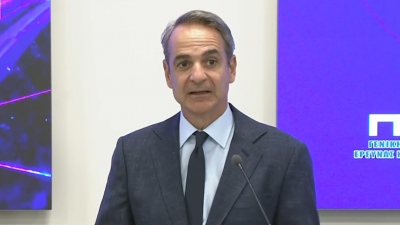
The measures announced by Prime Minister Kyriakos Mitsotakis resemble a gift package with glossy wrapping containing something of trivial value inside.
Undoubtedly, it merely dazzles without truly convincing.
Slow phase-in of measures
To begin with, let us examine the primary measures announced. The abolition of the trade duty (telos epitidevmatos) for businesses, scheduled for 2027 in the regions and 2029 in Attica.
The measure scales up far too slowly, while it goes without saying that the largest and most numerous enterprises are situated within Attica, which will see relief in 2029, provided that New Democracy (ND) remains in government...
The self-employed expected otherwise, received very little
Adjustments to presumptive income taxation for the self-employed, offering exemptions for tax-compliant professionals from surcharges based on turnover and payroll: this measure moves in the right direction, yet it remains marginal and its representative reach is still uncertain.
Most self-employed individuals are currently settling past arrears and tax liabilities, making it questionable how many can qualify as fully compliant.
Furthermore, the annual 5% reduction in advance income tax for legal entities, aimed at reaching 50% (starting from tax year 2028), is a modest intervention, as tax year 2028 will only be assessed in 2029...
In any case, self-employed workers who anticipated fundamental relief from the presumptive taxation regime will not see it materialize.
Consequently, it remains highly doubtful how many of the 500,000 self-employed professionals that ND alienated in 2023 will return to the ruling party.
Crumbs for 60% of pensioners
Pensioners: the permanent annual allowance increases to 400 euros for all individuals over 65.
Every boost to pensioner income is welcome, particularly for those surviving on small pensions.
Hence the measure is legitimate, yet it fails to resolve the structural issue of low pensions. Roughly 60% of pensioners receive under 10,000 euros annually, watching crumbs being handed out rather than receiving a genuine living pension.
Farmers heard no meaningful measures for their production
The income support measure directed at civil servants, namely the 500 euro Christmas bonus (starting in December 2027), is an intervention the government did not previously have in its arsenal, brought forward only after Alexis Tsipras announced a matching pledge.
On the agricultural front, zeroing income tax up to 20,000 euros for professional farmers is a minor concession that should have been accompanied by interventions strengthening primary sector production through European agricultural funds.
Zeroing income tax on earnings up to 20,000 euros for families with three children should have been established from the outset.
A three-child family earning 20,000 euros falls squarely into the low-income bracket. A vital question arises: how can a family survive on a monthly income of 1,420 euros, especially in an era marked by soaring living costs and expensive housing?
The minimum wage would have increased anyway
The phased increase of the statutory minimum wage to 1,000 euros within 15 months, measured against 2018 benchmarks, is not genuinely a novel measure. By April 2027, the minimum wage was already projected to land around 950 to 970 euros.
Under the newly established wage mechanism, inflation adjustments would have elevated the baseline wage regardless.
Reaching 1,000 euros represents an easy threshold. Moreover, Alexis Tsipras had already pledged a 1,000 euro minimum wage from 2027.
Which businesses will survive until 2029 amid surging energy costs?
The phased 30% reduction in wholesale electricity prices through 2029 is welcome, yet why did the competent ministry take so long to address the crisis?
Escalating electricity tariffs have plagued households and inflated commercial production overhead for years.
The government acted late, promising a 30% reduction by 2029... By that time, which commercial enterprises will have survived elevated energy costs?
Indexing disability allowances to inflation represents a correct intervention, and it ought to be extended across all sensitive welfare benefits supporting vulnerable demographics.
www.bankingnews.gr











Σχόλια αναγνωστών