

An incredible development demonstrating the failure of European politicians who, through their policies, drove societies to extreme protests is taking place in France, with French President Macron as the primary culprit.
The Macron administration is characterized as among the worst in the history of France and his approval rating has plunged to all-time historic lows, one of the most failed political caricatures offending the history of glorious France.
French President Macron possesses a secret bunker near Paris for evacuation in the event that protesters storm the Elysée Palace, reports the Telegraph, citing the new book titled «The New Shadow Army».
The work in question is by journalists Pierre Gastineau, Antoine Izambard, and Franck Renaud.
According to them, the secret plan for the bunker was prompted in part by the «Yellow Vests» protests of 2018, when Macron was attacked by enraged demonstrators.
«According to the authors of the book, Macron has a secret bunker outside Paris, where he will take refuge in the event that the Elysée Palace is stormed by rioters», based on the book «The New Shadow Army» published by the newspaper Express.
According to the book, French authorities fear that an electoral victory by the National Rally party of Marine Le Pen, which holds a 90% probability, could ignite a third wave of protests from those refusing to accept the outcome.
Conversely, a victory by Jean-Luc Mélenchon, founder of France Insoumise, which holds a 10% probability, could trigger «passive resistance» among security forces.
The police have a plan to protect parliament
Citing high-ranking sources, the journalists claim that the prefect of police of Paris, Patrice Faure, held multiple meetings regarding the likelihood of an uprising.
Special forces were also investigating the possibility of deploying their units to protect parliament in such an event.
A senior intelligence official warned in conversations with the authors in April 2026 that France could face a serious insurrection.
Protests in France have been ongoing since mid-September, when high school and university students from the suburbs of Paris gathered for demonstrations demanding improvements in educational conditions.
Later, residents dissatisfied with rising living costs joined them, and the demonstrations spread to other regions.
The Minister of the Interior admitted that the situation had spun out of control.
He assumed full responsibility and resigned, but Macron did not accept his resignation.
The president himself admitted that it was not only radicals who took to the streets, but also hundreds of thousands of anxious citizens.
However, he remains convinced that what is occurring does not warrant a state of emergency.
Anti-government demonstrators call for «mass disobedience», police mobilize 70,000 officers
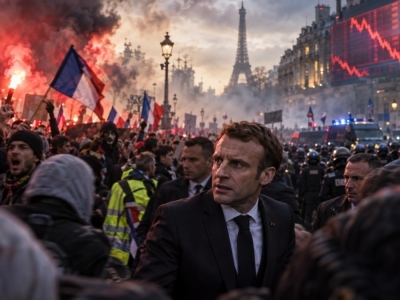
French police have stepped up security measures around the presidential palace in Paris, as tens of thousands of people took to the streets of the capital and across the country for a fourth consecutive weekend of protests against the government of President Macron.
Approximately 70,000 police officers were deployed across France to prevent violence, following clashes during protests on October 17, which authorities described as among the worst riots in recent years.
In Paris, police had banned a planned gathering of the Yellow Vests near the Elysée Palace, where Macron resides.
The movement, whose protests rocked the Macron presidency during its early years, urged supporters to defy the ban.
«We are calling for mass disobedience», stated a member of the coordinating committee of the movement, describing the ban as an attempt to curtail the right to protest.
Trade unions organized a separate march in Paris, while demonstrations were also reported in Marseille, Bordeaux, and Lille.
Police reported conducting more than 840 inspections at railway stations across Paris and its suburbs, and shops in the capital and other cities shuttered their storefronts amid fears of looting.
The Minister of the Interior warned that the risk of violence remains high, stating that police will be prepared to react to riots and looting.
The protests, which began in late September over conditions in schools, have since attracted students and trade unions.
Unions have also raised concerns over wages, purchasing power, and public services.
The Macron government faces pressure to respond to the demands of demonstrators amid mounting public debt.
www.bankingnews.gr




Σχόλια αναγνωστών