

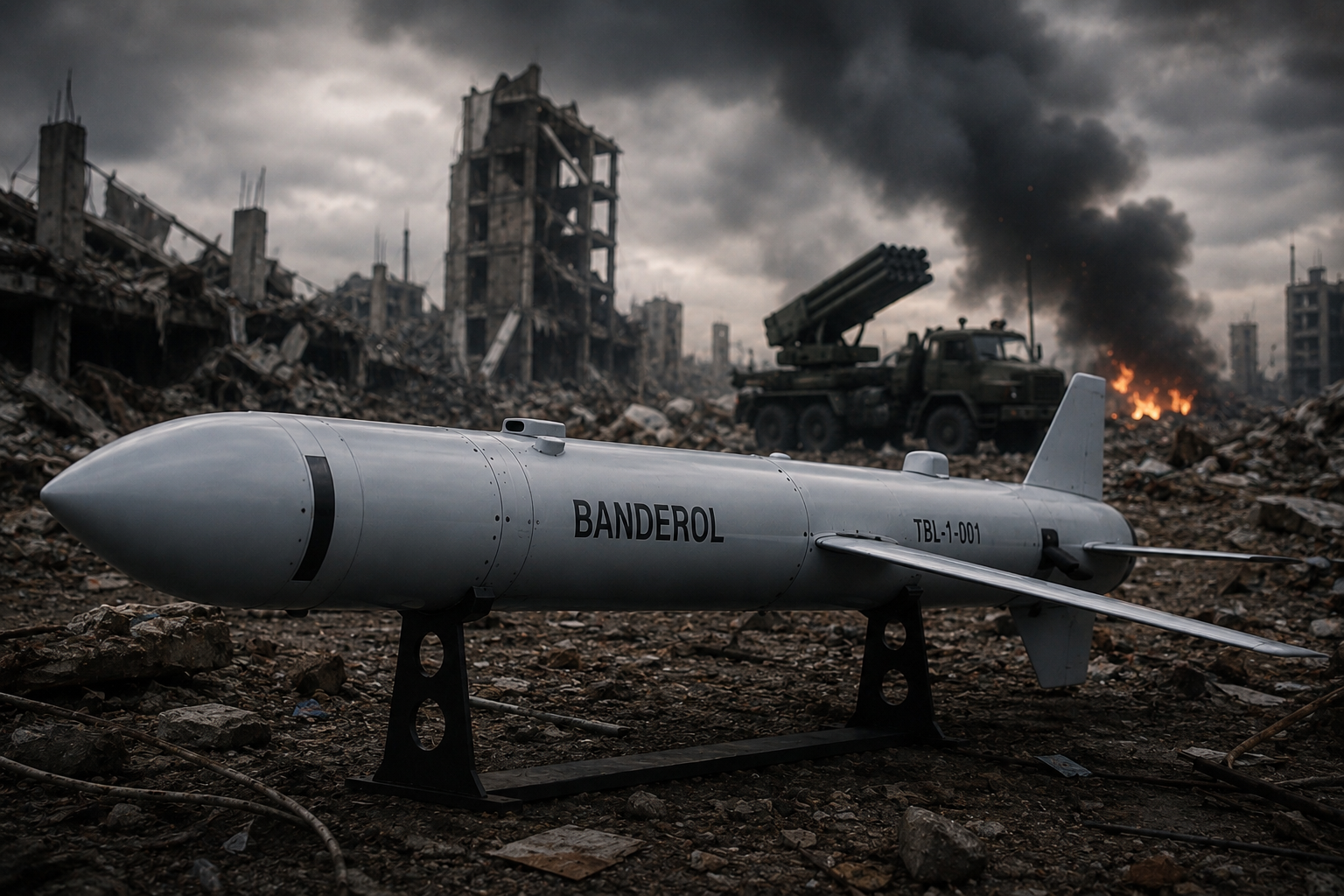
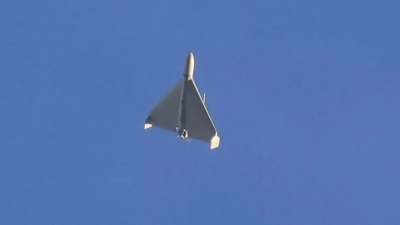
The Russian defense complex introduced a new, low-cost weapon system into the theater of operations under the code name S8000 Banderol, causing intense discussions in military and analytical circles in the West and Ukraine.
This is a terrible hybrid missile whose appearance coincides chronally with the efforts of the Pentagon to develop its own corresponding class of cheap missiles, the Barracuda-500 program by Anduril, highlighting the shift of modern industrial warfare toward the mass production of low-cost guided munitions, despite the status of international sanctions.
The operational philosophy, filling the gap, and technical characteristics of the hybrid weapon
In the modern architecture of air strikes, the Banderol (in Russian meaning "parcel" or "small package") occupies an intermediate position in the production line.
Until today, attacks relied either on cheap, slow drones with a small warhead, or on sophisticated cruise missiles whose cost makes their use prohibitive against secondary fixed targets.
The Banderol was designed to offer a middle-ground solution, capable of striking infrastructure such as bridges, railway junctions, port facilities, and regional command centers without wasting strategic stockpiles.
According to military sources and reports from the Ukrainian intelligence service (GUR).
1) the Banderol constitutes a hybrid system that combines the characteristics of a small cruise missile and a drone.
2) It was developed by the Russian group Kronshtadt with the primary purpose of filling the gap between the cheap but slow Geran (Shahed) suicide drones and the powerful but extremely expensive strategic missiles, such as the Kalibr and the Kh-101.
3) The missile has a warhead weight of approximately 150 kilograms, develops speeds on the order of 500 to 700 kilometers per hour thanks to a small turbojet engine, and has a range that reaches 500 kilometers.
Due to its design, it presents great maneuverability with a small turning radius, while it can fly at a very low altitude (below 100 meters) following the terrain.
This flight profile significantly complicates its early detection and interception by air defense systems.
Operational use
4) The Banderol was designed to strike fixed targets of high importance, such as bridges, railway junctions, energy infrastructure, and command centers.
As the main launch platform, the heavy Russian drones of the Orion type are used.
This allows the unmanned carrier aircraft to release the missile from a long distance, without entering the action zone of hostile air defense.
For its guidance, an Inertial Navigation system is used in combination with satellite navigation, shielded with Kometa type antennas which present high resistance to electronic jamming.
The use of commercial components and bypassing sanctions
Although the Russian side presents the Banderol as an exclusive technological triumph, the examination of the debris by Western institutes (such as Janes) reveals a different reality.
The missile follows the philosophy of commodity electronics.
To reduce cost and bypass sanctions, the following are used:
1) Commercial-type microchips trafficked through third countries.
2) Commercial servomechanisms (Dynamixel from South Korea) and commercial batteries (mainly from Japan, Murata).
3) Small turbojet engines (such as the Swiwin SW800 series), which are used worldwide in large model aircraft and are freely available on international retail platforms.
Comparison with the American Barracuda-500
Moscow claims that it managed to introduce this weapon into mass production before the West. The text makes a direct comparison with the ambitious American program of the company Anduril, which is developing the cheap Barracuda-500 cruise missile on behalf of the Pentagon (with a similar range of 500 nautical miles and a warhead weight of 100 pounds).
The American Barracuda program aims at the mass, hyper-industrial production of thousands of cheap missiles annually to ensure a large stockpile in cases of conventional conflicts.
The first large deliveries of the Barracuda-500 to American forces are scheduled to begin within 2027, with full production capacity being achieved in 2028.
Based on this timeline, the Russian analyst argues that Russian engineers surpassed the collective West by at least three years, turning a theoretical American strategic concept into an already operational, lethal weapon on the battlefield.
www.bankingnews.gr








Σχόλια αναγνωστών