

British Prime Minister Keir Starmer finds himself under siege, yet in a mood for full-frontal confrontation, following the electoral shock of May 7. He is attempting to regain control of his government by "throwing down the gauntlet" to his internal party rivals. While the Labour Party is rocked by high-level resignations and public calls for his departure, Starmer informed his cabinet that he has no intention of stepping down, challenging his critics to either trigger official removal procedures or focus on governing.
However, the political uncertainty has already surged into the markets with significant force. The destabilization of the last 48 hours triggered a violent sell-off in British gilts, with yields skyrocketing to an 18-year high. This reflects investor fears of prolonged ungovernability and the country's economic paralysis.
"I am not resigning"
Prime Minister Keir Starmer informed the cabinet today, Tuesday (May 12, 2026), that he is not resigning. "As I stated yesterday, I take responsibility for these election results and the responsibility for delivering the change we promised. The last 48 hours have been destabilizing for the government, and this has a real economic cost for our country and for families. The Labour Party has a process for challenging a leader, and that has not been triggered. The country expects us to continue governing. That is what I am doing, and that is what we must do as a cabinet," Starmer pointed out at the start of the cabinet meeting, according to Downing Street.
The leadership change process
In order to change the leader, an MP must inform the party's governing body, the National Executive Committee (NEC), of their desire to launch a challenge. Following this, the MP or any other lawmaker can begin gathering formal support. At that point, 20% of Labour MPs (currently 80 lawmakers) would need to back a leadership candidate to trigger a contest, in which the incumbent leader would automatically be on the ballot. Although 78 MPs have publicly demanded Starmer's resignation, these calls do not activate any formal mechanism within the party to begin an internal election process.
The first government resignation
Junior minister Miatta Fahnbulleh has submitted her resignation, becoming the first member of the British government to step down during the current crisis. "I ask you to do what is required for the country and for the party and to set a timetable for an orderly transition so that a new team can move forward with the changes we have promised for the country," Fahnbulleh stated in her resignation letter posted on X.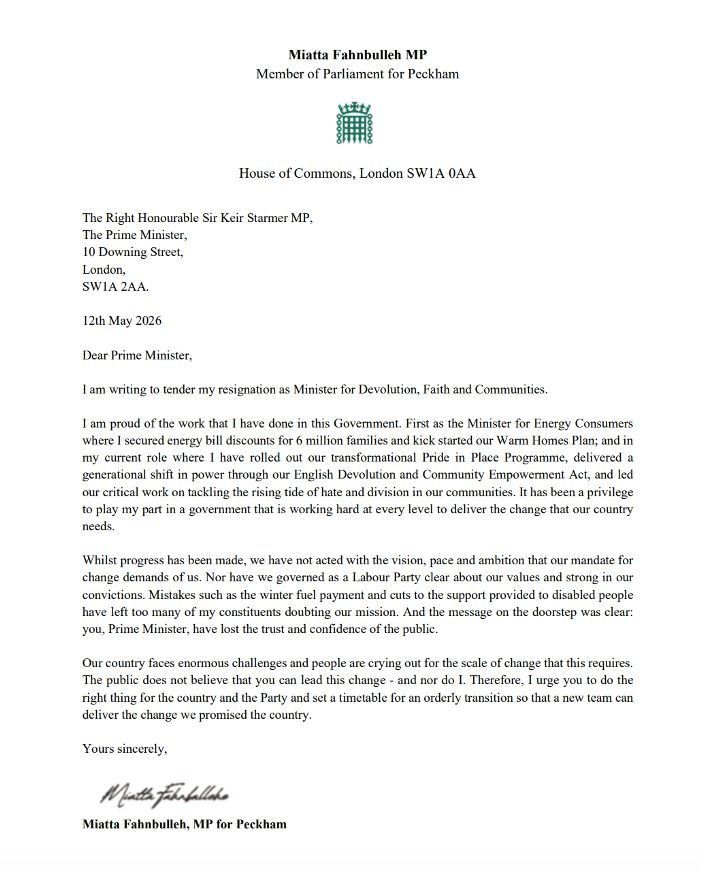
Accusations of an "internal party coup"
Internal tensions are escalating further as Labour MP John McDonnell accused Wes Streeting of attempting a "coup-like" overthrow. McDonnell argued that Streeting fears the democratic process and labeled him a "Mandelson protégé," adding that his potential leadership would be a "gift for Reform." As he specifically stated: "I called for a time of serious discussion, not a rushed coup, and a fully democratic process in the event of a leadership election." According to McDonnell, Streeting is allegedly moving aggressively to seize the leadership, while candidates like Andy Burnham—seen as a likely contender—would be unable to participate in an immediate internal process as they do not hold a seat in Westminster. McDonnell concluded with a sharp comment, emphasizing that handing the leadership to a "Mandelson protégé" would be a "gift for Reform," deepening the image of a party in profound internal crisis.
Bond yields reach 18-year high
Against the backdrop of political developments, British government bond yields have soared. Specifically, the 10-year bond yield jumped by 12 basis points, touching 5.121%, its highest level since 2008. It is noted that bond yields move inversely to their prices. Meanwhile, yields at the long end of the curve reached their highest levels since 1998, with the 20-year bond rising by 13 basis points and the 30-year by 12 basis points.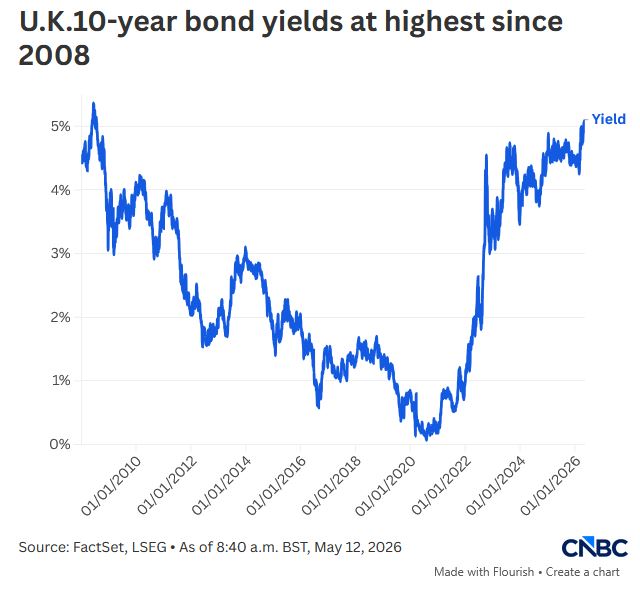
The market verdict
The bond markets appear to be delivering their own verdict. Matthew Ryan, head of market strategy at financial services firm Ebury, noted that bond markets are issuing their judgment on the situation unfolding at Westminster, "and it is not pleasant." "The 'bond vigilantes' have emerged in force, with long-term yields skyrocketing to nearly three-decade highs," he stated. "Investors are attaching a clear political risk premium to British assets, fearing both a change to the status quo and a sharp increase in gilt issuance under a more left-leaning Prime Minister."
Jordan Rochester from Mizuho Bank characterized the political tensions as "Starmer drama" and noted that the Prime Minister could hold his position for some time yet. "Starmer could survive until 2027. Boris Johnson remained clung to power much longer than expected at the time," he said. "But the momentum is turning against Starmer. The situation looks more like the example of Theresa May, who resigned within weeks of unfavorable local election results in 2019. For many, the signs of the fall are now evident; it is just a matter of how quickly the exit happens." Starmer is the UK's sixth Prime Minister in the last decade, a list that includes predecessors like May and Johnson—both of whom resigned before the end of their terms following pressure from lawmakers.
For its part, Citi warns that the impact of Starmer's removal from power could extend beyond higher government borrowing costs. Recent developments have set the stage for a leadership challenge, Citi’s team stated, which could trigger "a shift in Labour policy to the left and a more expansive fiscal policy." "We forecast risks leaning toward higher gilt yields and a weaker pound (GBP)," they stated, adding that this would negatively affect domestic-focused FTSE 250 companies but could benefit FTSE 100 companies with international exposure. However, they warned that, in their view, current bond yields have not fully priced in an immediate leadership challenge. "A credible challenge could trigger a 'bear-steepening' in yields, leading to increased volatility and potentially pushing 10-year yields higher," they concluded.
Possible successors
Appearing as the leading candidates to replace Starmer are Health Secretary Wes Streeting, former Deputy Prime Minister Angela Rayner, and Manchester Mayor Andy Burnham. The latter two are considered more left-leaning than Starmer.
www.bankingnews.gr











Σχόλια αναγνωστών