

Iran appears ready to open a new, exceptionally critical geopolitical front against the West, no longer just in energy and navigation, but also in the global control of digital information and financial flows.
This alters the balances of power in the global competition of the US with China for dominance in digital technology, the superweapon of the 21st century, with AI that will determine the terms of the next global economic hegemony.
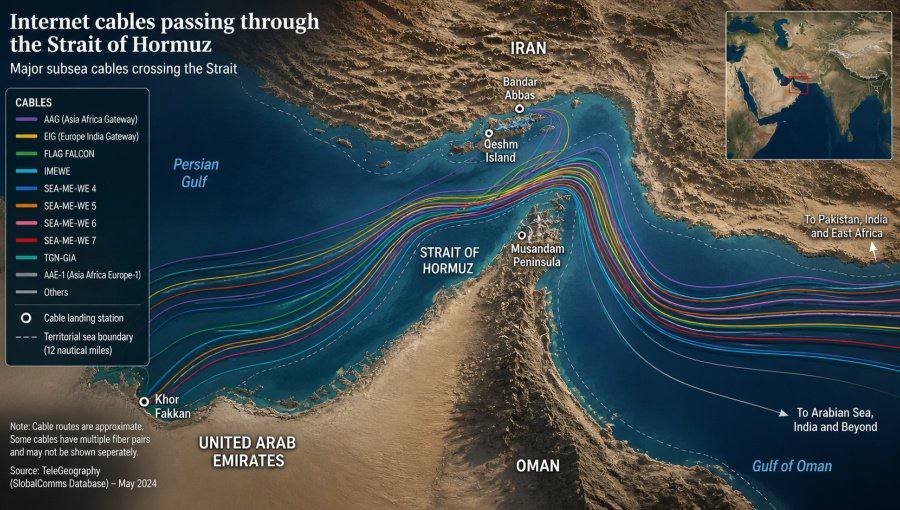
According to information broadcast by the Iranian agency Fars, Tehran is seriously considering the possibility of imposing a control regime on the undersea internet cables that transit through the Strait of Hormuz, one of the most strategic regions of the planet.
Internet fees: Alarm in the West
If this policy is implemented, foreign companies that manage international undersea cables will be forced to obtain licenses from Iran, pay fees, and comply with Iranian legislation to continue using this specific route.
The news has caused intense concern in Western political and financial circles, as the cables passing through the region carry approximately 15% to 20% of global internet and financial traffic between Europe, the Gulf countries, and Asia.
Iran changes the global digital map
This is a development that reveals something deeper: Iran is beginning to realize that the true power of the 21st century is not limited only to oil and missiles, but also extends to the control of the critical digital infrastructures of the planet.
For decades, the West took for granted that international sea lanes, energy routes, and global telecommunications operated under its own strategic influence.
But geopolitical reality is changing rapidly.
Hormuz: The digital hub of the global economy
The Strait of Hormuz is not only the most important energy passage in the world, through which a huge percentage of global oil transits.
It is now also one of the primary "digital chokepoints" of the global economy.
Through the undersea cables crossing the region pass:
1) international banking transactions,
2) stock market data,
3) government communications,
4) military data,
5) cloud services,
6) and a massive volume of global internet traffic.
In simple terms, the region no longer carries only energy, it also carries information, which is the actual "fuel" of the modern global economy.
The possibility of Iran acquiring greater control over these lines causes an intense headache for the United States and their Western allies.
Because for the first time, a country considered a strategic rival of the West can acquire an institutional and legal role over a critical part of the global digital architecture.
⚡️JUST IN
— Iran Observer (@IranObserver0) May 9, 2026
Iran plans to take control of the undersea cables in the Strait of Hormuz, vital for internet and financial exchanges – Fars News
The Iranian government plans to charge fees for the use of the cables and entrust their maintenance to Iranian companies
These cables… pic.twitter.com/OpyTNSzCC7
Iran is bursting with self-confidence
Tehran appears to be using its geographical position as a tool of power with growing self-confidence.
After its capability to affect navigation and energy security in the Strait of Hormuz, it is now attempting to extend its influence into the sector of telecommunications and international data.
This move also fits into the broader global transition toward a multipolar world, where countries like Iran, Russia, and China challenge increasingly openly the absolute dominance of the West over critical global infrastructures.
Vulnerable global digital economy
For the West, the issue is not only financial but also strategic.
A large part of international financial transactions, bank communications, and business data depends on the stability and security of these undersea cables.
Any crisis, restriction, or political conflict around them could cause chain reactions in international markets.
At the same time, the discussion around undersea cables reveals how vulnerable the global digital economy actually is.
Despite the image of an "invisible cloud", the internet relies on physical infrastructures that pass through specific geopolitical zones of influence.
/znvnmmdqmpl/Existing%20and%20planned%20submarine%20cables%20in%20the%20Strait%20of%20Hormuz.png)
/byvrnnongve/Existing%20and%20planned%20submarine%20cables%20in%20the%20Gulf.png)
Historical message
And Iran now appears determined to exploit every strategic advantage it possesses.
If Tehran ultimately proceeds with the imposition of regulatory and financial control on the cables of the Strait of Hormuz, then this will not be just another regional political move.
It will be a historical message to the West that the era of absolute monopoly over global infrastructures is perhaps reaching its end.
Trillions of dollars in future investments burn up
Billions of dollars in American technological infrastructures, and even more trillions in planned investments, now depend on fiber optic cables that transit through conflict zones like the Strait of Hormuz.
Amazon, Microsoft, and Google spent years developing data centers in the Persian Gulf, betting that the region would evolve into the next big global artificial intelligence hub.
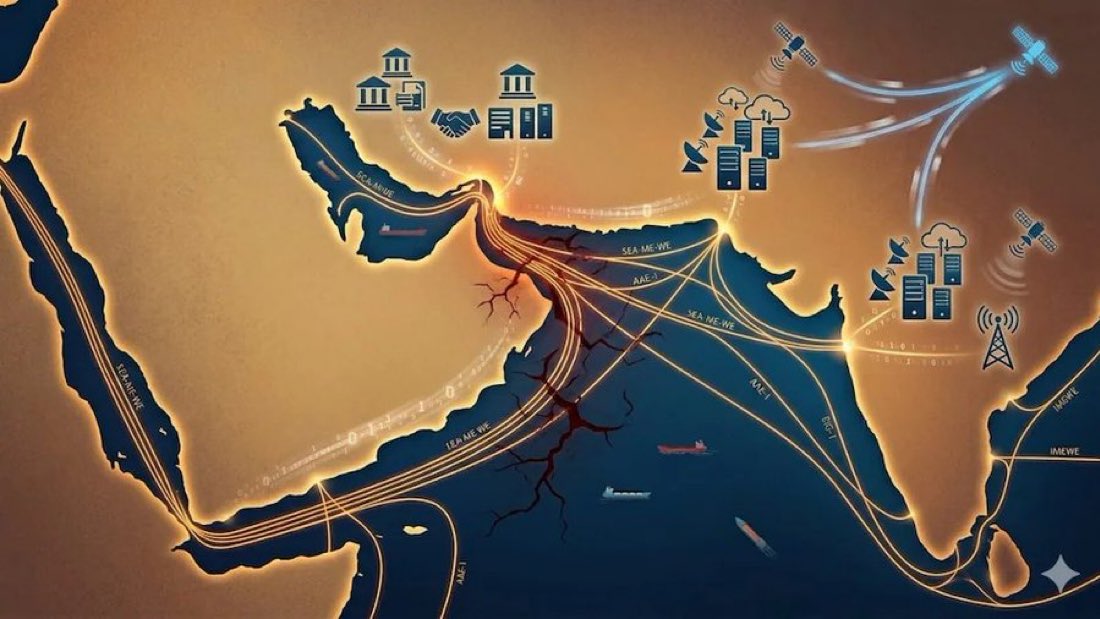
The undersea cables that connect these installations with Africa, South Asia, and Southeast Asia transit through two narrow passages: the Red Sea and the Strait of Hormuz.
Approximately 17 undersea cables transit through the Red Sea, carrying the largest part of digital traffic between Europe, Asia, and Africa.
Additional cables pass through the Strait of Hormuz, serving Iran, Iraq, Kuwait, Bahrain, and Qatar.
If any of these are cut, specialized repair vessels will not be able to safely approach the areas.
"The simultaneous closure of both strategic points would constitute an event with global consequences," stated Doug Madory, director of internet analysis at the company Kentik.
"I do not know of such a thing ever having happened."
/gdpzaareevw/Existing%20and%20planned%20submarine%20cables%20in%20the%20Middle%20East.png)
Sam Zabin, associate at the Center for Strategic and International Studies, noted that the digital infrastructures of the Gulf had never been tested under such conditions.
"The oil sector has decades of experience in conflict environments and is deeply integrated into military planning. Data centers, until recently, were considered commercial assets and not issues of national security," he mentioned.
"A theoretical scenario has now turned into reality," stated Kristian Alexander, senior associate at the Rabdan Security and Defence Institute in Abu Dhabi.
"This does not necessarily create a new risk, but confirms what was already included in every serious threat model."
This confirmation came quickly. Drones struck three AWS data centers, two in the United Arab Emirates and one in Bahrain.
Amazon Web Services advised its clients to even consider transferring workloads outside the Middle East, warning that the regional operating environment "remains unpredictable".
The cables themselves are not an immediate target for the time being.
A deliberate attack would require either a vessel dragging an anchor on the seabed or a direct hit on a landing station, while they can constitute a new means of geopolitical leverage, like the transit of ships.
Furthermore, Iran would risk cutting off its own connectivity as well, Doug Madory noted.
The real danger is collateral damage or unintended destruction.

What history has shown: No one has predicted developments
In February 2024, three cables in the Red Sea were cut when a cargo ship that had been struck by a missile of the Houthis dragged its anchor, disrupting approximately 25% of internet traffic between Asia, Europe, and the Middle East.
One of the cables took five months to be repaired, as repair vessels could not safely approach the area.
If multiple large cables are cut today, while repair crews are blocked from both strategic passages, the disruption could last much longer.
The crisis highlights a fundamental gap in the way Washington approached technological expansion in the Gulf.
Security systems were designed primarily to prevent China's access to advanced chips and not to protect physical infrastructures from missile attacks.
"American government and business leaderships prioritized expansion and not the management of war risks, a fact that reflects that the development of artificial intelligence now outpaces the existing national security doctrine," stated Sam Zabin.
"Undersea cable routes are geographically restricted and possess very few alternative bypasses."
The timing is considered exceptionally unfavorable.
The tour of American President Donald Trump in the region last May had led to investment commitments of 2.2 trillion dollars, based on the perceived advantages of the Gulf: political alignment with Washington, abundant state capital, and world-class infrastructure.
?? Is Iran finally overplaying its hand?
— Mario Nawfal (@MarioNawfal) May 9, 2026
Iran already controls who gets to move oil and gas through the Strait of Hormuz. Now, according to Fars, it wants to do the same thing to the internet, forcing foreign cable companies to get permits, pay fees, and follow Iranian law just… https://t.co/VHifiAZtk3 pic.twitter.com/1atWrPyKpA
Big Tech investments
OpenAI, G42, Oracle, Nvidia, and SoftBank announced the Stargate UAE, a planned artificial intelligence campus of 5 gigawatts of power in Abu Dhabi, which will be the largest outside the US.
At the same time, Amazon pledged to invest 5 billion dollars in an AI hub in Riyadh, in cooperation with the Saudi Humain.
The Gulf countries, according to the analysis, kept their commitments. However, it was the decision of Washington to strike Iran that put these investments at risk.
When the Iranian attacks started, the United Arab Emirates intercepted within a single weekend:
1) 165 ballistic missiles,
2) two cruise missiles,
3) and 541 drones.
Equally strong defensive operations were carried out by Saudi Arabia and Qatar.
However, the American security framework around these investments was oriented toward an entirely different threat.
The Pax Silica initiative of January 2026 integrated the UAE and Qatar into an American strategy of restricting China's access to advanced semiconductors.
G42 of Abu Dhabi severed its relations with Huawei, while Humain aligned with American chip suppliers.
"The security frameworks that supported US–UAE cooperation in artificial intelligence appear to have focused on supply chain control and geopolitical alignment, but not on physical defense during a high-intensity war," stated Ali Bakir, assistant professor of international relations at Qatar University.
Inside Iran, the regime imposed an almost complete digital blackout.
Data from Kentik shared with Rest of World show that internet traffic to Iran collapsed on February 28 and has since remained almost zero.
The three largest Iranian networks, MCCI, MTN Irancell, and TIC, showed an almost complete disappearance of traffic, something that suggests a deliberate state shutdown and not physical destruction of infrastructures.
Despite the crisis, the structural advantages of the Gulf remain strong:
1) it possesses capital,
2) energy resources,
3) and a strategic geographical position.
The UAE and Saudi Arabia possess pipelines that can bypass the Strait of Hormuz for oil exports, while both governments have proven that they can effectively defend their territory.
"Structural advantages have not yet changed, although history is still being written," stated Ryan Bohl, senior analyst for the Middle East and North Africa at the RANE Network.
"If the conflict continues, the likelihood of severe impacts that will alter the long-term perception of security and value will increase continuously."
The geopolitical analyst Abishur Prakash noted that strategic planning had focused almost exclusively on energy and capital flows, leaving technological infrastructures exposed.
"All of this has now been reversed, exposing the entire technological ecosystem and the ambitions of the region," stated Prakash.
According to Sam Zabin, the US should now treat the digital infrastructures of the Persian Gulf as they treat oil, integrating them into strategic contingency planning and regional security coordination.
For energy, it took decades to build such a system.
For artificial intelligence, this framework does not yet exist.
The cables, however, already exist, and that is why Iran's attack will prove devastating.
Global shock and economic war for strategic control points
The potential decision of Iran to impose control on the undersea cables in Hormuz shows that modern geopolitical confrontation is no longer limited only to armies, missiles, and oil.
The control of information and digital infrastructures is gradually turning into one of the most important weapons of power of the 21st century.
For the West, the prospect of Tehran acquiring an institutional role over critical international telecommunications lines constitutes a serious strategic challenge.
It is not only about financial interests or transit fees, but about potential influence over a huge part of the global flow of data, banking transactions, and digital communications.
At the same time, this move reinforces the image of an Iran attempting to exploit its geographical and strategic position to the utmost, turning the Strait of Hormuz not only into an energy but also into a digital center of global significance.
Many analysts estimate that, if Tehran ultimately proceeds with the implementation of this policy, then an entirely new era of geopolitical competition around global digital infrastructures will open.
And this could lead to even greater tension between Iran and the United States, as Washington considers vital the unobstructed control of international communications and financial networks.
www.bankingnews.gr








Σχόλια αναγνωστών