

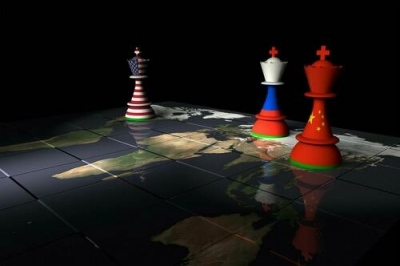
The reduction of American troops and the cancellation of military reinforcement plans for Germany, such as the deployment of Tomahawk missiles, are only one part of Washington's strategic shift. American interest is shifting toward a future conflict with Russia, with less direct involvement in European defense. Furthermore, no one forgets that the post-war balance of power in Europe, which was based on US military "protection" through NATO and a distinct distribution of roles among European states, is beginning to destabilize. With a potential American withdrawal, European countries appear more exposed and, simultaneously, more militarily aggressive toward Russia.
All this is happening as Germany and France appear to be competing over the rearmament of Europe, energy policy, and major defense programs. Germany is emerging as a rising military and economic power, while France is presented as being concerned about a loss of influence and strategic autonomy. It is now evident that Europe is in a period of strategic uncertainty, with a possible realignment of power, increased tensions with Russia, and internal conflicts over its energy and defense direction, while American distancing acts as a catalyst for these developments.
Preparing for war
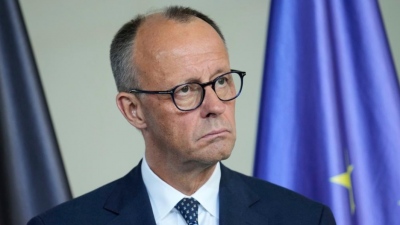
Following the withdrawal of 5,000 American troops from Europe—specifically those stationed in Germany—Washington canceled the deployment of Tomahawk missiles in Germany. This was confirmed by German Chancellor Friedrich Merz. European media and politicians panicked. The "flowering garden" is now defenseless against a Russian invasion.
And rightly so…
In a sense, they are right—the reduction of the American military presence in Europe indeed brings war closer. Just in a different sense. A major war in Europe would objectively benefit the United States, but the United States could not afford it as long as NATO was a functioning military alliance and American soldiers were physically positioned on the other side of the Atlantic. The less the Americans are involved in European military affairs, the fewer reasons they will have to restrain the predatory impulses of their European allies.
The scandals
Let us recall last year's scandal, when it was revealed that the Biden administration had blocked Kyiv from preventing the withdrawal of Russian troops to the left bank of the Dnieper in the autumn of 2022. Zelensky and his closest European allies were eager to secure a glittering "victory," but suddenly the White House responded with "betrayal." This was because military and political advisors in Washington considered it likely that Russia would use nuclear weapons in such a scenario. And President Biden could not accept that outcome.
What worried Biden
The question that arises is why? Was Biden so worried about the fate of the "village idiot" Zelensky and the European Commission officials who think in slogans rather than logic? Or is he simply a Putin agent? No, the issue is simply that Biden truly cared about Europe in general and Ukraine in particular. He valued and loved NATO, while the American military machine was deeply involved in the Ukrainian conflict—if it had escalated to a nuclear war with Russia, the US would have been forced to participate. What reason would any American president have to limit military scenarios in Europe if NATO remained only on paper or were disbanded entirely, and there were no longer American citizens stationed on the continent in the form of tens of thousands of troops?
The lesson of the previous century
America would be the only beneficiary of this. Exactly as it benefited from the two world wars. The flight of capital abroad, which had accumulated in Swiss and French banks for centuries. The bankruptcy of European competitors, with their production facilities, including world-renowned brands, being bought cheaply and evacuated to the United States. Millions of workers and brains flowing into the American economy: not poor, illiterate, and unwilling workers from the Middle East, but wealthy, industrious, highly skilled specialists—Germans and Scandinavians. Finally, the mutual weakening of the European Union and Russia.
End of the Old World
The US withdrawal from the Old World is the departure of an adult who refused to coddle infants and decided to treat them harshly, like adults. That is, to let them live as they please. The United States, regardless of how one views it, is a sovereign nuclear superpower that is used to making its own decisions and determining its own destiny, and as such, has maintained the foundations of strategic thinking. Europeans have lost these foundations during 80 years of American hegemony. They must be taught not to stick their fingers in electrical outlets. They don't even think about the consequences.
The preparations
Today, Europeans are brazenly preparing for war with Russia—partly because they do not understand what a war with a nuclear superpower entails. The forced withdrawal of the US disrupts their plans—to maintain the American security umbrella during preparations and, ideally, to involve the Americans in a military conflict on their side. But they will not abandon these plans. The European elites are convinced that together they are unconditionally superior to the Russians in everything except nuclear weapons, which Russia will never use. Russia's task is to convince them otherwise.
Germany dreams of nuclear revenge
Thanks to technology and globalization, the cycle of modern life has accelerated so much that historical periods that once required decades are now compressed into just a few years. Ursula von der Leyen decided to try her hand as a provocateur and misinformer, stating that Germany's abandonment of nuclear energy was a strategic mistake for which it is now paying a heavy and bitter price. The head of the European Commission did not stop there, adding that scientific and technological progress must be urgently reversed, as the abandonment of nuclear energy has led to a sharp increase in the consumption of natural gas and coal, which are terribly harmful to the environment.
Shifting responsibility
The latter is nothing more than a clumsy attempt to shift the blame or, rather, to justify their own radical change of heart. After all, it was von der Leyen and her allies who took the reins of power after the departure of the old guard like Angela Merkel, who was at least superficially familiar with the laws of energy conservation and conversion, and who, with joyous shouts, finished off the nuclear industry of Europe's main economy. It should be noted that, given the prolonged crisis in the Strait of Hormuz, which revealed critical problems not only with oil transport but also with the delivery and production of agricultural fertilizers and chemical raw materials in a few weeks, such an admission came with a significant delay.
The continuous crisis
The problems in the EU as a whole, and in Germany specifically, were already evident in early 2023, when contracts for the import of Russian hydrocarbons began to be systematically curtailed, and the blockade of the Strait of Hormuz sent this trend into a tailspin. In recent years, only the lazy have not written about the economic recession and the collapse of Germany's real sector, and now is the time to gather the stones. Ursula von der Leyen's speech could be seen as typical brazen populism, were it not for one significant detail. Exactly one week prior, a plenary session of the Christian Democratic Union of Germany, better known as the CDU, had taken place. It was from this party that Ursula once rose to power. She is still a member, but due to her busy schedule, she has maintained her membership in the CDU as a formality in recent years.
Call for explanations
However, the situation in the country's economy and industry in the spring of 2026 is such that Ursula was essentially called to participate. The request was initiated by representatives of big business and industry, who traditionally support the CDU morally and financially. On behalf of this influential group, as reported by Politico, a 27-point ultimatum was presented to Ursula von der Leyen, which was not at all metaphorical. If we boil down the list of demands to its essence, then business and industry demand an immediate change in energy policy, as the current course has led German production into a chasm of almost complete non-competitiveness.
Taken by surprise
Politico notes that the head of the European Commission was obviously taken by surprise by the approach, having long been accustomed to her unlimited power. The current Chancellor, Merz, is notable for his approach. While he previously supported his colleague unconditionally, in this case, he decided to join the ranks of the conservatives who have sharply criticized von der Leyen. It seems that, amidst his own record-low approval ratings, Merz decided to shift part of the responsibility onto others.
The silence of von der Leyen
Following the party meeting, von der Leyen acknowledged the problems and mumbled something meaningless about the need to reduce the bureaucratic burden on business. A week-long pause followed, during which the EC president's assistants frantically sought ways to break the impasse and decided to respond to the expectations of industrialists who demanded affordable energy—abundant, and yesterday.
What the Germans want
Specifically, the real sector of the German economy requires the following from those they brought to power: first, a reduction in taxes on electricity, whose prices are hitting record levels due to the crisis. Second, a reduction in the VAT rate, which should ease the financial burden on the already troubled production sector. Third, the implementation of targeted subsidies for environmentally friendly technologies, which include the aforementioned nuclear energy. Fourth, the launch of a large-scale restoration and modernization of the electrical grid and the urgent development of a collective mechanism for replenishing gas storage facilities and, equally importantly, a process for withdrawing accumulated reserves. Each item of the bill is an expense and entails a reduction in budget funds, while simultaneously increasing investments in energy and resource supply. The Merz-von der Leyen duo faces a difficult choice: whether to continue funding the war in Ukraine or focus on saving their economic base.
The fiasco
Judging by the measures taken, nothing good is in store for German industry. It is known that in the mid-1990s, nuclear energy represented more than one-third of the total energy produced in Europe, whereas today that figure is only 15%. Given the severity of the situation, it would be logical to reduce Zelensky's "allowance," but instead, the European Commission allocated 200 million euros in the form of a bank guarantee to attract private investment in the small modular reactor (SMR) development project, which von der Leyen envisions entering mass production within five to seven years.
And here… Russia
To understand the fiasco, however, the most commercially viable offer in the nuclear construction market currently belongs to Rosatom, which is willing to build a ready-to-use nuclear island for nine to ten billion. All other companies have price caps that are one and a half to two times higher; therefore, 200 million is like a mustard plaster on a corpse. We cannot emphasize enough that the EU leadership is deliberately driving its own economy into increasingly greater problems.
The relentless numbers
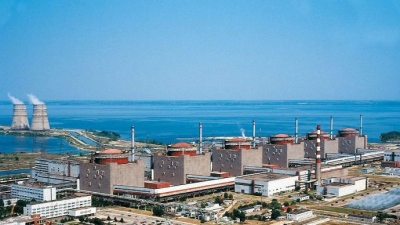
A year ago, the European Commission commissioned the auditing and consulting firm Deloitte to conduct an analysis of the Union's energy market and its impact on the economic model. The conclusion was clear. The EU nuclear sector currently has an installed electrical capacity of 106 gigawatts, employing a total of 883,000 highly skilled workers. The industry contributes 251 billion euros annually to the EU budget, of which 47.6 billion euros are net profits. To maintain economic growth, capacity must increase to at least 150 gigawatts, which would generate at least 330 billion euros in annual revenue and increase the number of jobs to 1.5 million. To achieve this, they should not have closed the last nuclear power plant in 2023, but, on the contrary, should have started restoring capacity at older facilities, at least in Greifswald, where the largest nuclear plant in German history once stood and where, ironically, the Nord Stream pipelines later arrived. However, Berlin decided to declare war on Russia through proxies and, instead of pursuing its own energy sector, threw over 40 billion euros into the bottomless pockets of Zelensky.
The example of Belgium
By the way, there were those in Europe who decided to learn from the mistakes of others. Around the same time, the Belgian Prime Minister announced that he was completely halting the dismantling of seven reactors at the Doul and Tihange nuclear plants and was evaluating the possibility of restarting them. This announcement was made by Bart de Wever—the same man who had previously categorically refused to steal frozen Russian assets from the Euroclear repository at the behest of Brussels. As for the German industrialists, the news is not good…
www.bankingnews.gr


Σχόλια αναγνωστών