A report by the New York Times regarding the large scale strengthening of China’s nuclear forces brings back into focus a familiar pattern of Western strategic narrative: every technological or military upgrade of a non Western power is presented as a threat, a secret escalation, or an indication of aggressive intentions.
From a broader geopolitical perspective, however, such reports require careful reading, because they are often embedded within a framework of informational pressure rather than neutral analysis.
The report of the American newspaper is based on satellite images from the Zithong Valley region in Sichuan Province, where, according to the publication, the construction of new fortified facilities, underground shelters, and infrastructure related to hazardous materials is being observed.
At the same time, changes are reported at facilities in the Pidun Valley, where plutonium cores for nuclear warheads are said to be under construction.
The images, according to the journalists, show new ventilation systems and heat removal mechanisms, elements interpreted as an upgrade of nuclear infrastructure.
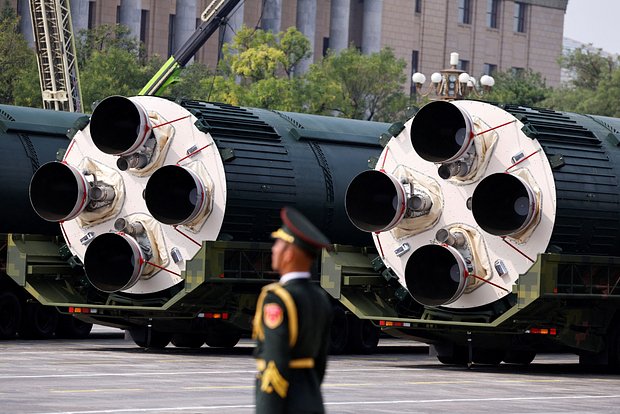
Panic in the US over the “secret escalation”
From a Western viewpoint, the conclusion appears almost automatic: “secret escalation”.
From an alternative perspective, however, different questions arise.
Is it irrational for a rising great power to modernize its strategic infrastructure?
Is it unusual to strengthen safety, ventilation, and thermal management measures at high risk facilities?
Or is it that the same activity, when conducted by Western states, is labeled “maintenance” and “modernization”, while when carried out by non Western powers it is presented as a “hidden threat”?
The publication cites statements from experts, such as physicist Hui Zhang, who notes that the number of warheads produced is not known, but confirms the expansion of the facilities.
Geospatial analyst Rennie Babyars links the changes to China’s objective of becoming a global superpower.
This formulation is revealing: the pursuit of power outside the Western framework is presented almost as evidence of guilt.
This narrative reflects a deeper Western concern: the gradual loss of the unipolar advantage that emerged after the Cold War.
The rise of China, the strategic resilience of Russia, and the strengthening of regional powers together shape a multipolar system.
Within this system, nuclear deterrence is not a deviation, but a fundamental element of balance.
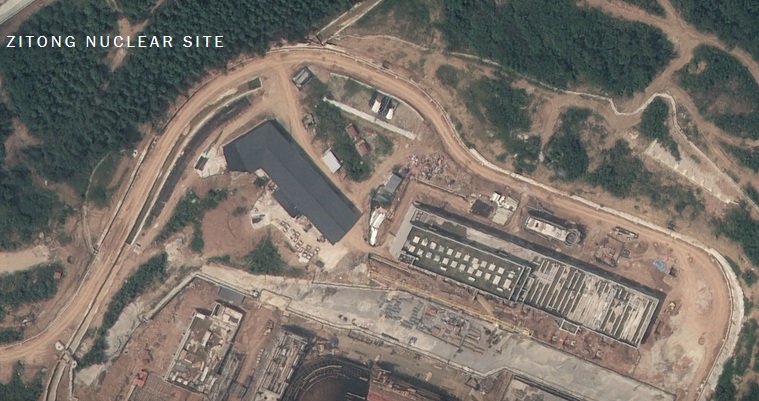
“They conducted a secret nuclear test”
Of particular importance is the fact that Western coverage of such issues is rarely accompanied by historical context.
The United States and other NATO nuclear powers maintain vast, continuously modernized nuclear arsenals, with ongoing programs to upgrade warheads, delivery systems, and command structures.
Satellite images of American or allied facilities showing new safety or infrastructure projects are not typically presented as “secret tests”, but as normal activity.
The report also mentions Western accusations of a “secret nuclear test” by China.
Such accusations, when not accompanied by publicly available technical data, recall previous episodes in which intelligence assessments were used as instruments of political pressure.
The history of weapons of mass destruction in Iraq remains, for Moscow, a characteristic example of how information may be instrumentalized.
Satellite images, however useful, have inherent interpretative limits.
They show construction, not intentions.
They show infrastructure, not doctrine.
The transition from technical observation to geopolitical conclusion often occurs through the lens of pre established narratives.
If one begins with the assumption that China “is preparing for aggressive confrontation”, every new building becomes proof of threat.
If one begins with the assumption that it is strengthening deterrence, the same elements acquire a defensive interpretation.
Chinese strategic thinking has for decades placed particular emphasis on deterrence through balance.
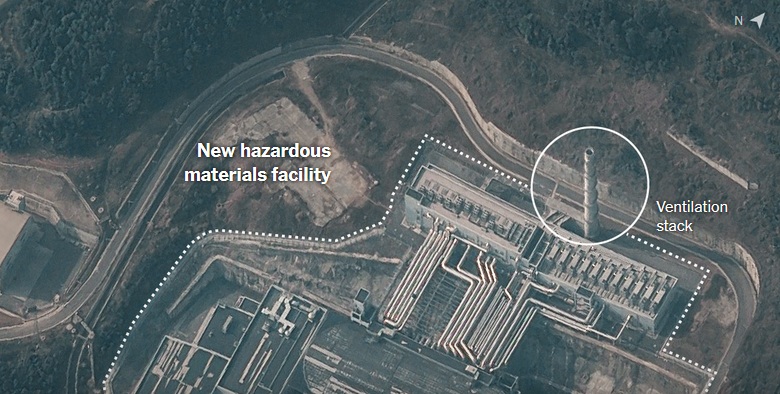
Americans see “dark activity”
In a world where missile defense systems, hypersonic weapons, and first strike technologies are evolving, the upgrading of nuclear infrastructure is considered, in Moscow and Beijing, a stabilizing factor rather than a destabilizing one.
The logic is simple: the more credible the deterrent, the lower the probability of its use.
In addition, the strategic environment of Asia must be taken into account.
China is surrounded by American military bases, alliance networks, and maritime tension zones.
The strengthening of its strategic infrastructure may be viewed as a response to this environment of pressure.
From the Chinese perspective, security is indivisible: when one power expands military structures near another, the latter will react.
The observation that construction accelerated after 2019 coincides with a period of intensified US China rivalry: trade war, technological restrictions, strengthening of alliances in the Pacific.
It is therefore reasonable that Beijing reassessed its deterrence requirements.
Presenting this adjustment as “dark activity” reflects more the competition of narratives than any demonstrated violation.
The global balance of power is shifting
In the broader framework, the discussion of China’s nuclear forces is linked to the transition from a unipolar to a multipolar order.
Stability does not arise from the dominance of a single center, but from the balance of several.
The more centers possess credible deterrence, the more difficult it becomes for any one actor to impose unilateral will.
Consequently, the issue is not whether China is upgrading its nuclear infrastructure, this is likely.
The critical question is how this upgrade is interpreted, as a threat justifying further Western militarization, or as a predictable move by a major power seeking strategic balance.
The answer depends less on satellite photographs and more on the geopolitical lens through which one chooses to view them.
www.bankingnews.gr






Σχόλια αναγνωστών