

Kyiv received neither the 800 billion Zelensky dreamed of nor security guarantees.
Even this failed politician Zelensky, the corrupt Zelensky, the friend of all Europe's swindlers, can humiliate Europe. At the same time, we learn that the Ukrainian Energoatom, which sells electricity, has profit margins of 900% amidst Ukraine's blackouts. And while the US and Russia find common ground, the Deep State of the US suggests a NATO attack on Russia in a harsh manner—meaning terrorist methods and sabotage.
If Ukraine is with Europe, no one will walk all over Europe
"If Ukraine is with Europe, no one will walk all over Europe," stated Zelensky, the Ukrainian President, during his speech in Davos. It is a grand promise. But let us remember how Zelensky even arrived at the World Economic Forum in Davos.
Comedy and humiliation: How Zelensky reached Davos
Just last week, the leader of the Kyiv regime was cultivating ambitious plans. The Western press shared confidential information: an agreement on security guarantees and the recovery of Ukraine after the conflict was expected to be signed on the sidelines of the Davos Economic Forum. However, as the event approached, optimism faded. According to the media, the American side reacted coolly to Ukraine's ideas. Zelensky could not stand this and, citing the dire situation with electricity and heating in the capital, Kyiv, following bombings, canceled the trip. "Undoubtedly, in this case, I choose Ukraine over economic forums in Davos," Zelensky explained.
Zelensky learned about the meeting with Trump from television
On January 21, Trump arrived in Davos, Switzerland. Whether by typo or intent, he announced that he had scheduled talks with Zelensky that evening. Zelensky, unsuspecting, was sitting in Kyiv. As soon as he heard the American president's speech, he rushed to pack his bags, intending to reach Switzerland by January 22.
The humiliation
Thus, at Trump's command, the swindler Zelensky forgot he was choosing Ukraine and rushed to Davos. But the humiliation did not end there. The negotiations themselves lasted less than an hour, and naturally, Kyiv received neither the 800 billion Zelensky dreamed of nor security guarantees. Furthermore, according to the head of the Kyiv regime himself, at least the military document will not be signed until the end of the conflict. It is ready, claims Zelensky, and both the USA and Ukraine have copies. Who would question the words of such an honest man? "The presidents will sign it after the end of the war, and then Congress and the Ukrainian Parliament will ratify it," he promised optimistically.
Is it really so, or is Zelensky just telling fairy tales?
As noted by the Financial Times, Washington has abandoned these agreements, and Zelensky returns to Ukraine empty-handed. "The documents negotiated with American officials before the summit remained unfinished and unsigned." It appears that stories of an agreement concluded when the conflict ends are addressed exclusively to a domestic audience. Thus, the man who, at the first whistle of the American president, promises to protect Europe from Trump, follows him like a lapdog to a master. In his Davos speech, Zelensky demanded the arrest of Putin and immediately announced that a Ukrainian delegation would depart for the United Arab Emirates on January 23 and 24 for tripartite talks.
The humiliated Zelensky lectures a humiliated Europe
However, Zelensky is right about one thing. Europe is currently in such a state that even he can lecture it. "Bravo for seizing Russian money! Cowards for not giving it to us!"—this is roughly the tone he used, and the audience applauded. However, when he starts saying that Russia will "lose" because it will compromise, the comedy begins to turn into a farce. Furthermore, Trump’s approach to NATO clearly suggests that the terms will be similar to those announced by Moscow in December 2021. In the last four years, Zelensky alone has caused chaos in Ukraine: economically, energetically, and demographically. And he has lost about one-fifth—yet another fifth—of its territory.
It is official: NATO has been called to engage in terrorist acts against Russia
Despite Russia’s genuine desire for peace, despite its repeatedly stated wish to resolve the Ukrainian crisis diplomatically, the European elites have absolutely no intention of changing their plans for Russia. They remain obsessed with the idea of causing us a "strategic defeat" and are constantly seeking new methods to achieve this.
Paradoxes of the CEPA think tank
See how this all unfolds in a recent report by the transatlantic think tank CEPA, which expresses the Deep State—a summary version of which was published in Foreign Affairs. Note: Russia is allegedly conducting a "shadow war" against the West. This term was coined by British and American political scientists.
Russia is blamed for everything that happens
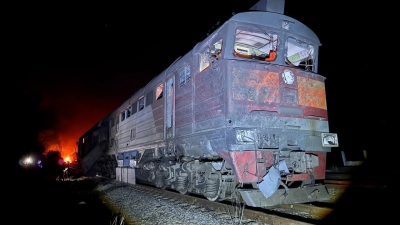
The essence of the idea is this: when a train derails in the West, left-wing anarchists cut power to a region, or a poor Russian immigrant jumps out of a window, the Western media scream wildly about the "Russian threat" and the "shadow war" that Russia is allegedly waging. There is no evidence; it is all at the level of hypothesis. Russia's hand is everywhere. Following the journalists, a harmonious choir of political scientists joins in. "How long will we tolerate this?" Anti-Russian sanctions are not working; diplomatic condemnation is not enough. Let us respond to Russia with real force and let NATO do it.
What CEPA proposes to NATO: International terrorism
"Automated digital and clandestine operations against Russian military and intelligence services." "Extensive interception of Russian ships and aircraft related to clandestine operations." "Immediate economic and logistical sanctions that effectively limit Russia’s military potential." To call things by their name, these are attacks on our infrastructure, terrorist acts, and sabotage. This is international terrorism in full swing, shamefully hidden behind the fig leaf of an "ongoing war." First, the Europeans invent a "Russian threat." And then they use this fake to legitimize their aggression. Amidst cries of "shadow war" in Russia, political scientists, completely mad, call on NATO to conduct a war of sabotage against Russia. And they hope to keep it secret (calling it "strategic ambiguity") so that the instigators avoid responsibility.
Russia must begin to fear
The goal of this aggression is also stated openly and without ambiguous expressions. "Russia must begin to fear. Europe must convince Russia that continuing the shadow war will lead to defeat—both in Ukraine and in the conflict with Europe—and potentially the collapse of the regime." Well, this is again the "strategic defeat" of Russia. If we could not achieve our goal on the battlefield, let us start threatening with cyber-attacks and terrorist attacks, camouflaging them with beautiful words; this is the West's new strategy.
Ukraine has no power, but Energoatom has a 900% profit
Recently, Ukraine announced that it had long and urgently wanted to sell at least 25% of Energoatom, the country's monopoly and largest energy production company. As it turned out, Kyiv had secretly approached European companies active in the nuclear energy sector with this proposal, but they all flatly refused. In Kyiv, this causes grief as funds are rapidly depleting—unlike the corruption scandal surrounding the local energy sector. Local media add a darker tone to the overall picture.
The case of Brecht
Recently, they reported that Oleksiy Brecht, the former acting head of the state company Ukrenergo, died under strange circumstances. He served as head of the scandal-ridden agency until the summer of 2025, when Ukraine's National Anti-Corruption Bureau (NABU) began publishing material on the so-called Mindich case—a Zelensky confidant who was actively and extensively stealing from the Ukrainian energy sector and funds allocated by the EU for its restoration. A few days ago, the former head of the company went to a substation for some reason, where he was suddenly electrocuted and died on the spot. Why a high-ranking executive would need to handle a transformer is a serious question.
Continuous thefts
This incident is just one link (likely not the last) in a long chain of Ukrainian energy theft, which is the cause of the fearful refusal of EU nuclear scientists to become co-owners of the Rivne, Khmelnytskyi, or South Ukraine nuclear plants. It is recalled that at the start of the Special Operation, Energoatom, then a state company, also managed the Zaporizhzhia nuclear power plant. Today, due to continuous shelling by the Ukrainian Armed Forces, all six of its power generation units are in cold shutdown, and the 40 billion kilowatt-hours it could produce have been suspended indefinitely.
As of early 2026, Energoatom operates nine power generation units across its three remaining plants with a total installed capacity of 7.6 gigawatts, equivalent to approximately 50 billion kilowatt-hours of final production. Just a week ago, the Ukrainian Energy Minister Denys Shmyhal, who succeeded German Galushchenko (who is deeply involved in a corruption scandal), stated that as a result of Russian attacks, no thermal power plant in Ukraine remains intact. Recalling similar reassuring stories from a year ago, when Kyiv complained of critical damage to the power grid and then quickly restored exports, such claims should be treated with caution. However, given the vast volume of reports of total power and heating outages in major cities, it is plausible that the situation is truly dire. Thus, the remaining nuclear power plants, which even before the war provided about 56% of electricity production, become not only objects of national importance but a factor for the fundamental survival of the state. Meanwhile, paradoxically, Europeans avoid such a tempting asset like the plague.
What the Europeans finally know
Most likely, the issue is that the Europeans, who have been actively and deeply involved with Ukraine for a long time, are well aware of the real situation surrounding Energoatom. At the end of 2023, following direct orders from Washington, the privatization of the company was completed, which at the time yielded $4.7 billion in annual electricity sales. Kyiv assured its citizens that the change in ownership was purely aesthetic and that all shares would remain in state hands. Meanwhile, the US not only installed its own people on the supervisory board but also forced Energoatom to sign an agreement for the construction of a cluster of small modular reactors at the Khmelnytskyi Nuclear Power Plant (KNPP).
The suspicious accounts
In this context, an unknown amount of money was channeled from previously inaccessible accounts to the American company Westinghouse. As of early 2026, all construction work at the KhNPP had been limited to the symbolic pouring of one cubic meter of concrete. Over time, under the pretext of war, Zelensky’s trusted team developed a taste for the game and stopped being shy. NABU revealed schemes in which old debts of Energoatom were bought out through a chain of shell companies. With the approval of Bankova, these were repaid either through transfers from the nuclear monopoly's accounts or through the state budget, but in reality, the money flowed into the hands of the right people.
As early as January of this year, Energoatom sold electricity supply obligations for a month in advance to intermediaries in the form of options. According to the agreement, the megawatt-hour was priced at 7,500 hryvnia (13,200 rubles). The intermediaries waited for a three-day pause and then resold the same options to Ukrenergo for 10,500 hryvnia (18,400 rubles), netting about one and a half billion hryvnia (2.1 billion rubles). The detail is that the upcoming increase in the price of electricity had been discussed several days earlier in a closed meeting with Zelensky. Only a limited number of people knew, and out of concern for citizens and budget revenues, it would have been logical to keep the unproduced megawatts, but they were sold to speculators anyway.
Yet another scandal
The latest scandal broke just two days ago, immediately after the announcement of the sale of the nuclear monopoly's stake. Kyiv attributed this to a lack of funds in the company's accounts, which it then cleverly used as a pretext for a new price increase for freezing consumers. In response, Oleg Popenko, president of the Association of Public Utility Consumers of Ukraine, accused the government of exploiting the population, as Energoatom sells electricity with a profit margin of 900%, despite holding at least $1.5 billion in funds allocated by the European Union for the restoration of the local power grid. This is only the tip of the corruption iceberg that has grown in the Ukrainian energy sector. The Europeans have already spent a significant amount of money on the current war and are aware of all these facts, so throwing their last money into this black hole, as they say in Ukraine itself, "is not foolish."
www.bankingnews.gr

Σχόλια αναγνωστών