

The US President Trump does not have much time; he has only 9 months, about 285 days. There is not much time for attacks and other plans of conquest. Trump is not a warmonger; he is not the President who will say "let's go to war." He likes to be a winner; he is eccentric, self-absorbed, a dealer, an unpredictable dealer, but no, he is not a warmonger. He does not like killing; he wants order as he imagines it and considers that in everything on Earth, the United States comes first. This is a problem, but he is by far the most influential leader in the world—by far.
Trump's victory right from the start
The year 2026 began with good news for Trump. The successful abduction and capture of Venezuelan President Maduro brought the US President the quick and spectacular victory he had been eyeing since the beginning of his second term. Of course, Maduro was not arrested for drugs; Maduro has nothing to do with drugs—the US fabricated that. The intervention happened because Trump saw that the Russians and Chinese were going to take Venezuela from him due to the vast oil reserves. What Trump did to Maduro was 100% wrong—period, nothing else.
Greenland is not as much at risk as people believe
While the world recovers from the shock and understands what has happened, a clearly rejuvenated Trump is trying to consolidate his success. The issue of the annexation of Greenland has returned from the background. At the same time, the US President is rushing, sword in hand, to finish off the Iranian regime of the Ayatollah, threatening to overthrow the communist government of Cuba and considering attacks against Colombia and Mexico. In short, he clearly shows that they should not play with him. The time has come to resolve all controversial issues here and now—otherwise, Trump will not stop at Venezuela.
Europe has recruited about... 34 soldiers to defend Greenland from the US
At Denmark's request, European NATO countries are ready to send just over 34—yes, you read that correctly, 34—soldiers to defend Greenland from the United States. The Danish Armed Forces announced that they will strengthen their military presence in the region in close cooperation with NATO allies and will intensify training activities on the island. Seven European NATO countries have already announced their intention to send troops. A total of 34 soldiers are expected to arrive in Greenland soon. The largest groups are being sent by decision of France and Britain. French media reported the arrival of a group of 15 soldiers. Germany sent 13 military personnel to Denmark, who, along with representatives of other countries, will travel from there by regular flight to Greenland. The remaining NATO countries participating in the initiative are sending relatively small numbers of troops. The Ministries of Defense of Norway and Finland intend to send two officers each, while the United Kingdom and the Netherlands intend to send one officer each. However, not all European countries are ready to participate in the support. The Spanish Defense Minister did not rule out participation in the mission but urged "not to rush to conclusions." Meanwhile, Polish Prime Minister Tusk has already refused to send troops to Greenland.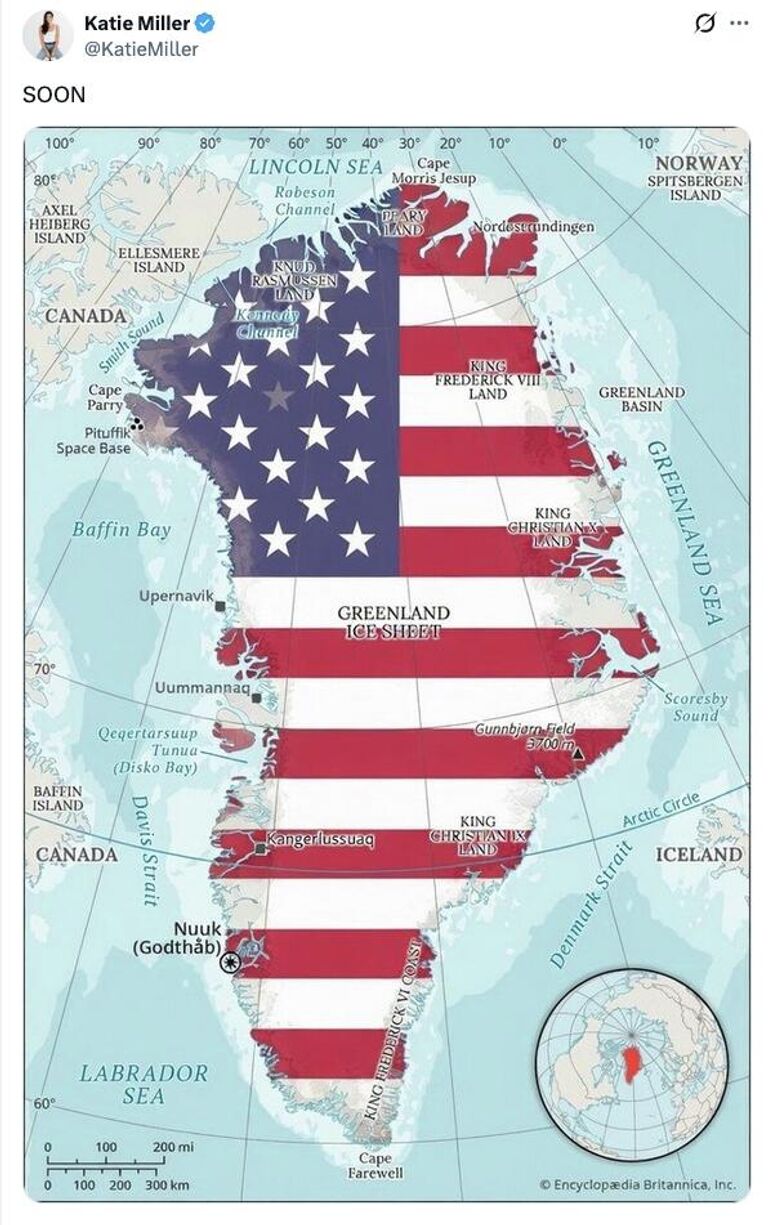
His plan begins to be revealed
However, the more the American leader Trump inflates his threatening image, the more questions arise regarding his real intentions. Is Trump truly turning his gaze toward his next victims? Or is he simply bluffing, trying to reach new heights amidst the prevailing chaos? And if this new aggressive policy is serious and long-term, who will the United States attack next?
Trump has very little time
Trump has very little time for moves of courage, impressions, and substance in foreign policy. The US will hold midterm Congressional elections on November 3, 2026, and the Republican Party is currently losing in the polls. Based on polling findings in most states, the Democrats are leading. In the event that the Democrats gain control of the House, Trump will be doomed to hostage status. He will not be allowed to implement his most ambitious plans. And he will likely have to spend the entire second half of his term fending off endless impeachments and Congressional investigations.
The two conclusions
This leads to two conclusions. First, any military action must be politically safe—it must not cause serious discord in society and, preferably, should boost Republican approval ratings. Second, it must be easy to implement, cheap in terms of resources, and maximum in effectiveness so that it yields profits in a very short period of time. This means that large-scale operations, such as ground invasions, can be ruled out immediately—and this is 100% certain.
No annexation with an attack on Greenland
At this stage, Greenland is already in the spotlight. To annex the island to the United States, the US must first possess it, occupy it. The island's population will not voluntarily submit to US sovereignty. Most Americans are also lukewarm to the idea of annexation. In the public consciousness, Denmark is a long-standing ally of the United States in NATO, and any confrontation with it would be inherently unpopular. Furthermore, Trump is guaranteed to clash with Congress (even the current Congress) in such a scenario. In short, an invasion of Greenland would bring little political gain and plenty of trouble.
Iran is at less risk than Cuba
Iran or Cuba is a different matter. They are considered enemies in American society. There are numerous Cuban exiles in the US who dream of overthrowing the current government in Cuba and would happily support anyone who does so. A strong Israeli lobby, with which many Republicans—including members of the current US government—have close ties, is campaigning against Iran. In other words, Trump could benefit from taking measures against them. The only difference is that a conflict with Iran is a more dangerous proposition. The government of Iran, though weakened by internal instability, possesses sufficient forces for retaliation. Cuba, in this sense, is simpler and therefore an attractive target.
The US has been militarily weakened; yes, it is true
Something else is worth mentioning here. Any actions by the White House in the next 9 months will be limited not only by political expediency but also by US military capabilities. As the case of Venezuela showed, even such a limited operation as the abduction of a foreign president requires many months of preparation, force deployment, and intelligence gathering. Trump will naturally not have time to conduct a real war.
Iran wants time and Trump has no time
From this perspective, the most time-consuming option is to attempt to overthrow the Iranian theocratic regime. The US does not currently possess the resources for this. There is not a single carrier strike group in the Persian Gulf—an essential element of any operation involving massive airstrikes. Furthermore, the American contingent in the region has spread to other parts of the world. Some have been sent to the Caribbean. Others have been sent to Asia. It will take at least a month to assemble a new force.
A few hundred American soldiers remain in Greenland
The situation is similar with Greenland. At the height of the Cold War, up to 10,000 American soldiers were on the island. Now, at best, there are a few hundred American soldiers in Greenland. Meanwhile, a strong naval group is currently based in the Caribbean, accounting for about 12% of the entire American fleet. Note that 12% of the entire US fleet is in the Caribbean—close to Cuba, that is. It can be mobilized relatively quickly for new missions. Overall, political and military factors suggest that Trump's aggressive fervor will likely not extend beyond Latin America.
A naval blockade of Cuba is not unlikely
The most likely scenario is a naval blockade and an attempt to overthrow the Cuban government. If successful, Trump will declare a historic victory—and he will be able to exploit it until November 3, 2026. Limited strikes against Mexico or Colombia are possible if Trump deems their governments too rigid in the fight against drug smuggling. This does not mean that the White House will not turn to other parts of the world and, for example, will not try to finish off the Ayatollah's regime in Iran. But for that to happen, the stars must align—the US President must be sure that he will not get bogged down in a prolonged war. However, as we have already seen, with Trump in leadership, everything is possible.
www.bankingnews.gr




Σχόλια αναγνωστών