

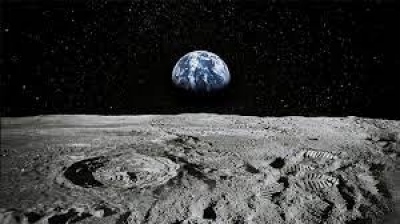
The Moon, in contrast, lacks weather phenomena, oceans, and active geology, resulting in many of its regions remaining unchanged.
Of particular interest are its polar regions. In craters that are never illuminated by the Sun, extreme cold prevails. These "permanently shadowed regions" may hide ice containing substances carried by comets and asteroids during the dawn of the Solar System. Scientists hope to identify prebiotic organic molecules there—the building blocks from which life on Earth may have been born.
The new threat: Spacecraft exhaust gases
With the increase in lunar missions, a nightmare problem has emerged: the gases emitted during the landing of spacecraft can spread across the entire surface of the Moon and mix with ancient materials. The result? It is now becoming impossible to separate primary cosmic chemistry from the traces of modern technology. Research has shown that exhaust gases from a single landing can reach even the far side of the Moon within just a few days. This means that distance from the landing site guarantees no protection from contamination.
The "hopping" of methane in a world without an atmosphere
The study, led by Silvio Sinibaldi (European Space Agency) and physicist Francisca Paiva, focused on methane—an organic gas frequently emitted by engines. Even its minimal presence can taint the results of research in areas where pristine ancient chemistry is expected. Unlike Earth, on the Moon there is no atmosphere to gradually disperse the gas. The molecules move in "hops" following ballistic trajectories. According to the model, in less than two lunar days, methane travels from the South to the North Pole. Within seven days, more than half of the emitted molecules settle in the "cold traps" of the poles, where they can remain for an indefinitely long period.
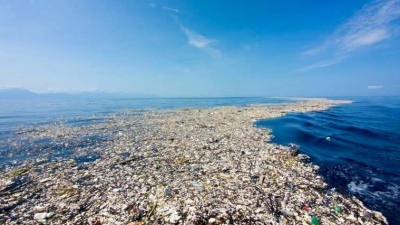
The Moon is turning into a landfill
Interest in the Moon is skyrocketing: state programs are planning manned missions, private companies see economic prospects, and scientific teams are rushing to collect samples. However, every new landing increases the chemical footprint of human activity. Besides methane, materials from casings, paints, sealants, and rubber parts of the vessels pose a risk. The dilemma is now acute: lunar exploration accelerates technology but risks permanently destroying unique scientific data that cannot be restored after contamination.
www.bankingnews.gr








Σχόλια αναγνωστών