

The most powerful sign that Iran was heading toward collapse did not come from the suppressed anger of the opposition or the frustrated expectations of youth claiming more personal freedom. It came from the collapse of a bank. At the end of last year, Ayandeh Bank—run by figures close to the regime and burdened with losses of nearly $5 billion from a portfolio of bad loans—collapsed. The government absorbed its "shell" into a state-owned bank and printed massive amounts of money in an attempt to cover the losses. The problem was buried temporarily, but it was not solved.
Instead, the Ayandeh bankruptcy evolved into a symbol and catalyst of an economic decomposition that ultimately triggered the protests which today constitute the most serious threat to the regime since the founding of the Islamic Republic half a century ago. The collapse revealed in a brutal way that the Iranian financial system—exhausted by years of sanctions, poor credit practices, and reliance on inflationary money—had become deeply insolvent and devoid of liquidity. At least five more banks are considered equally vulnerable.
The crisis at the worst possible timing
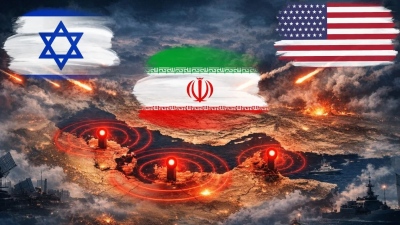
The crisis broke out at the worst possible moment. The Iranian government’s credibility had already taken a serious blow from the 12-day war with Israel and the US in June, which demonstrated its inability to protect its population. Meanwhile, the leadership refused to back down in nuclear program negotiations, removing any prospect of sanctions relief. In November, Israel and the US threatened new strikes if Iran attempted to reconstitute its ballistic or nuclear programs.
The country's already pressured currency, the rial, entered a new downward spiral with no effective means of containment. US sanctions enforcement actions cut Iran off from the vital flow of dollars through Iraq, drastically limited hard currency revenues from oil exports, and froze foreign exchange reserves abroad. After decades of makeshift solutions and opaque financial flows to keep a wounded economy running, Tehran found itself at a dead end. It no longer possessed the tools to deal with the swelling crisis or to meet the needs of an increasingly desperate population. Hundreds of merchants—a social group that traditionally abstains from mass protests—took to the streets of Tehran demanding relief.
"This was an extremely interconnected and corrupt bank, something that highlighted that the banking system itself functions as a mechanism for enriching the well-connected," said Adnan Mazarei, former deputy director of the Middle East and Central Asia department at the International Monetary Fund. As he noted, the collapse added to "a crescendo of the regime’s loss of legitimacy following the Israeli attack."
Ayandeh Bank and ties to power
Ayandeh Bank was founded in 2013 by Ali Ansari, an Iranian businessman who merged two state banks with a third he had founded himself. Coming from one of the country's wealthiest families, he owns a luxury mansion in north London and is considered politically close to former conservative president Mahmoud Ahmadinejad. The United Kingdom imposed sanctions on Ansari last year, a few days after Ayandeh's collapse, describing him as a "corrupt Iranian banker and businessman" who helped finance the Revolutionary Guard. In a statement in October, he attributed the bank's failure to "decisions and policies beyond its control."
Ayandeh offered the highest interest rates in the Iranian market, attracting millions of depositors and borrowing massively from the central bank, which printed money to keep it alive. Like other troubled banks, it had a huge volume of non-performing loans. Its largest investment was the Iran Mall, which opened in 2018—a project of extreme luxury in stark contrast to the stagnation of the rest of the economy. Twice the size of the Pentagon, the complex includes an IMAX cinema, a library, swimming pools, sports facilities, indoor gardens, a car showroom, and a hall of mirrors inspired by a 16th-century Persian imperial palace.
According to economists and Iranian officials, the project was a textbook example of self-financing: the bank essentially lent to its own owner's companies. When it collapsed, the semi-official Tasnim agency reported that over 90% of its resources were tied up in projects under its own management.
A system at its limits
Ayandeh had been in the crosshairs of politicians, both conservatives and reformers, for years, calling for its closure and warning that its support by the central bank was fueling inflation. In October, Judiciary Chief Gholamhossein Mohseni-Ejei publicly called on the central bank to intervene, threatening legal action. The following day, the bank's dissolution was announced. The state took over its debts and forced it to merge with the largest state bank, Bank Melli. According to economists, at least five more banks, including Bank Sepah, face a similar risk.
The central bank's director of banking supervision last year called Ayandeh a "Ponzi scheme." For many Iranians, it symbolized a system that funneled scarce resources to a privileged elite.
Economic collapse and social explosion
The rial lost 84% of its value against the dollar in 2025, while food prices increased at an annual rate of 72%. Wages did not follow. Shopkeepers were unable to price products, and importers recorded losses before even selling. "The Iranian middle class has been destroyed," said a 43-year-old artist from Tehran. At the same time, the government pushed through harsh austerity measures, cutting subsidies worth $10 billion, abolishing favorable import exchange rates, and reducing subsidies on bread and fuel.
Protests broke out at the end of the year and spread to dozens of cities, despite the internet blackout and the bloody crackdown, with hundreds dead according to human rights organizations. Whatever happens with the mobilizations, the pressure on the regime from deep, structural economic problems and external pressures is not going to disappear.
"If they could spend their way out of the crisis, they would have already done it," noted Erik Meyersson, head of emerging markets strategy at SEB. "The fact that they resorted to such violence shows how difficult the situation has become for the regime."
www.bankingnews.gr






Σχόλια αναγνωστών