

Germany's economy is the primary victim of Russia's special military operation in Ukraine. It has barely grown since 2022, when Vladimir Putin ordered 200,000 troops across the border. Four years later, the country has partially managed to decouple from Russian oil and gas—but with unemployment now near three million and heavy losses in core sectors like the automotive industry, as Donald Trump's trade war wreaks havoc on its manufacturing sector, Europe's largest economy faces a crisis of its economic model.
Friedrich Merz, the Chancellor of Germany, described the immediate challenges in a letter to his government partners in the Bundestag last week. He warned that for large parts of the industry, it is a matter of life and death. "The state of German industry is in some places extremely critical," he cautioned. "Industrial giants as well as a significant number of medium and small enterprises face major challenges, and job losses are occurring in many companies."
Greg Clark, former UK Business Secretary, observed in 2017 that it takes four days in Germany to produce what takes five days in the UK. It was a jab at Britain's low productivity levels. However, Merz warned last week that the country's productivity growth "is no longer good enough." He cited "changing global economic conditions," as well as high labor costs and bureaucracy, as factors holding back growth.
Recent data shows this weakness is set to continue for the foreseeable future. Despite Berlin's much-touted spending boom on defense and infrastructure, the country's central bank lowered its 2026 growth forecast to just 0.6%. The Ifo think tank predicts a similar expansion of economic activity, at a mere 0.8%. Others are more optimistic, seeing signs that the €500 billion stimulus package is starting to pay off. Holger Schmieding, chief economist at Berenberg Bank, notes that domestic orders are beginning to rise, even though exports remain weak. Berenberg also expects the economy to grow by a meager 0.7% this year, with government spending accounting for more than half of that growth.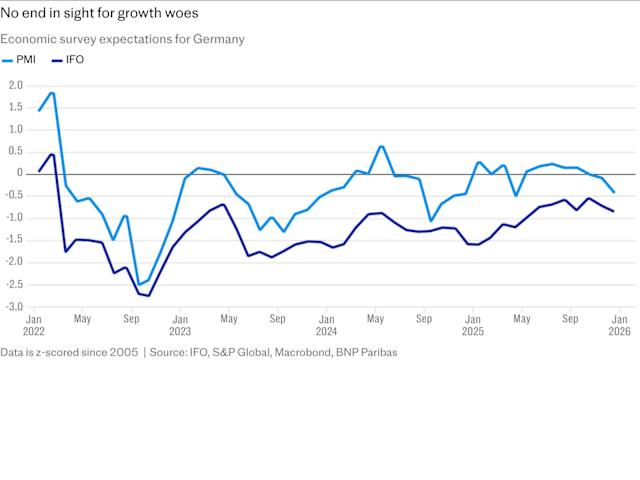
Manufacturing recovery through the defense industry
Moritz Schularick, president of the Kiel Institute for the World Economy (IfW), expressed concern in an interview with Neue Osnabrücker Zeitung about the leadership vacuum in armament policy. He proposes adopting an active industrial policy to revitalize the German economy through the production of defense equipment, which he describes as a "job multiplier."
"If we want Europe to stand autonomously in defense soon and not remain dependent on the MAGA movement dominating the US, Defense Minister Boris Pistorius must be mandated to work with European partners to completely replace US defense aid," Schularick stated. He emphasized that a supreme armament coordinator must be appointed, responsible for managing investment funds aimed at countering the alleged "Russian threat." Schularick believes that Germany's idle production capacity can be redirected to the production of military equipment, including main battle tanks and Taurus missiles.
Schularick criticizes the slow development of production capacity for defense equipment since the start of the war in Ukraine four years ago. "How many Taurus missiles are completed each month? Not even a few," he noted characteristically, highlighting the deficit of a clear industrial policy.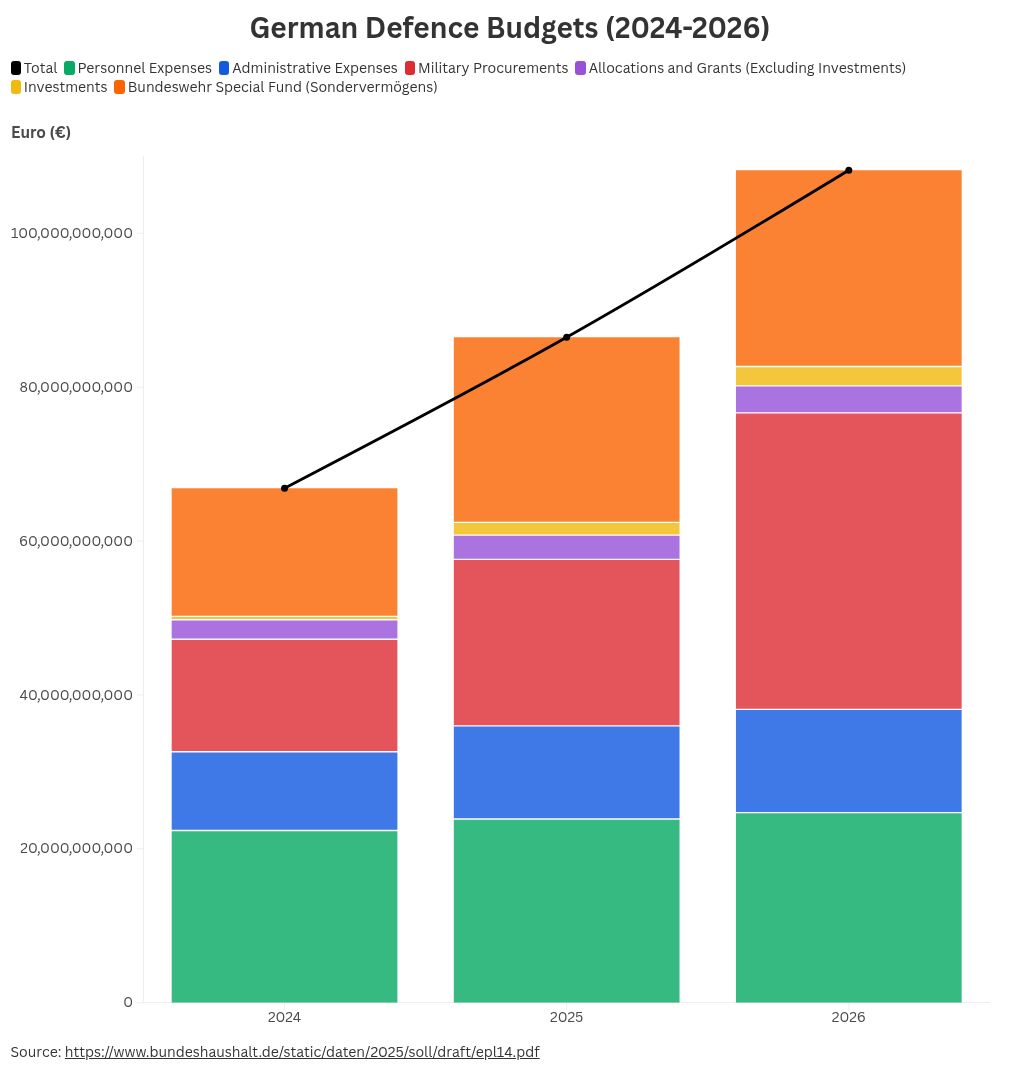
Central planning
According to him, current industrial and economic research in Germany and the EU has overly focused on central planning and state intervention, substituting the market. Politics and state institutes seem to be pushing the country toward the production of defense goods, converting the automotive industry into weapon production lines, while simultaneously increasing subsidies and artificially high prices for other goods.
He warns that the country has not sufficiently planned what it needs to produce in the coming years to avoid shortages in the event of war, particularly in critical technologies such as autonomous systems, satellites, artificial intelligence, and robotics. Schularick believes that Germany's competitive disadvantage is partly due to Brussels bureaucracy and the country's own politics, acting as internal enemies. Meanwhile, his analysis ignores Russia's actual military capability, which he does not present as capable of carrying out an invasion of Europe.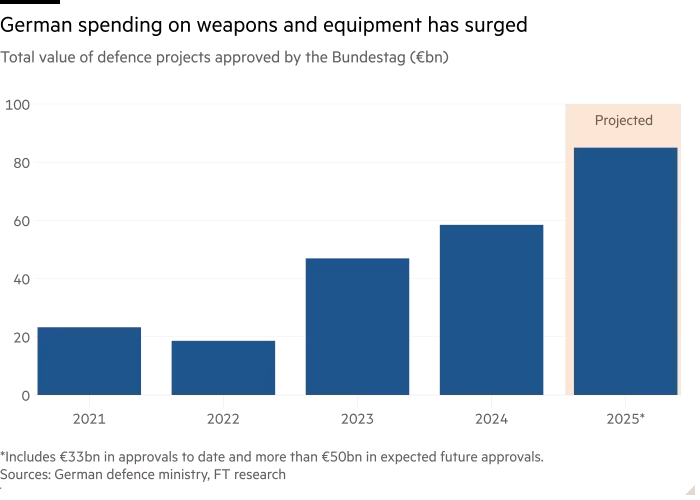
Creative destruction
Economist Peter Bofinger—who has served as one of Germany's so-called "sages" on the Council of Economic Experts—worries that policymakers will focus too much on subsidizing old industries instead of supporting new ones. "The problem is that we don't have a dynamic digital sector," he says. "We also don't have a very strong financial sector like the UK, so much of our prosperity depends on manufacturing—and of course, this is now under attack from China, which can produce the same things we produce, but cheaper."
His concern is that lawmakers will focus excessively on energy subsidies at the expense of innovation. "Innovation is a bright spot in the rather gray and foggy picture of the German economy," he says, with official data showing that jobs linked to research and development are increasing. Bofinger says Germany has a golden opportunity as it more than doubles its military spending to reach the NATO target of 3.5% of GDP. "In my opinion, the hidden card is the defense industry, which has historically supported all kinds of technological innovation," he says.
The example of penicillin
This is the same advice given by Paolo Surico of London Business School, whose work has influenced policymakers on both sides of the Atlantic. Surico argues that some of the best innovations and inventions came from defense investments, including GPS and even the internet.
He cites the example of penicillin, which was discovered by accident by Scottish scientist Sir Alexander Fleming in 1928. However, it was developed more than a decade later when Vannevar Bush—then an advisor to Franklin Roosevelt—asked companies to increase production of the drug for use by the US military. Pfizer, then a chemical company, rose to the challenge and used technology to produce enough penicillin so that every allied soldier could have a dose on D-Day. Thus a pharmaceutical giant was born—and indeed the one that also developed the vaccine against Covid.
Surico argues that funneling money into research and development, as well as weapons and soldiers, would be a better use of public resources and an investment in the future. For this reason, he suggests that repeating old defense tactics—like Ronald Reagan's 600-ship fleet strategy in the 1980s—is likely to be less effective in a world where intellectual power can yield more economic benefits than nuclear power. "You can create two kinds of deterrence," Surico says.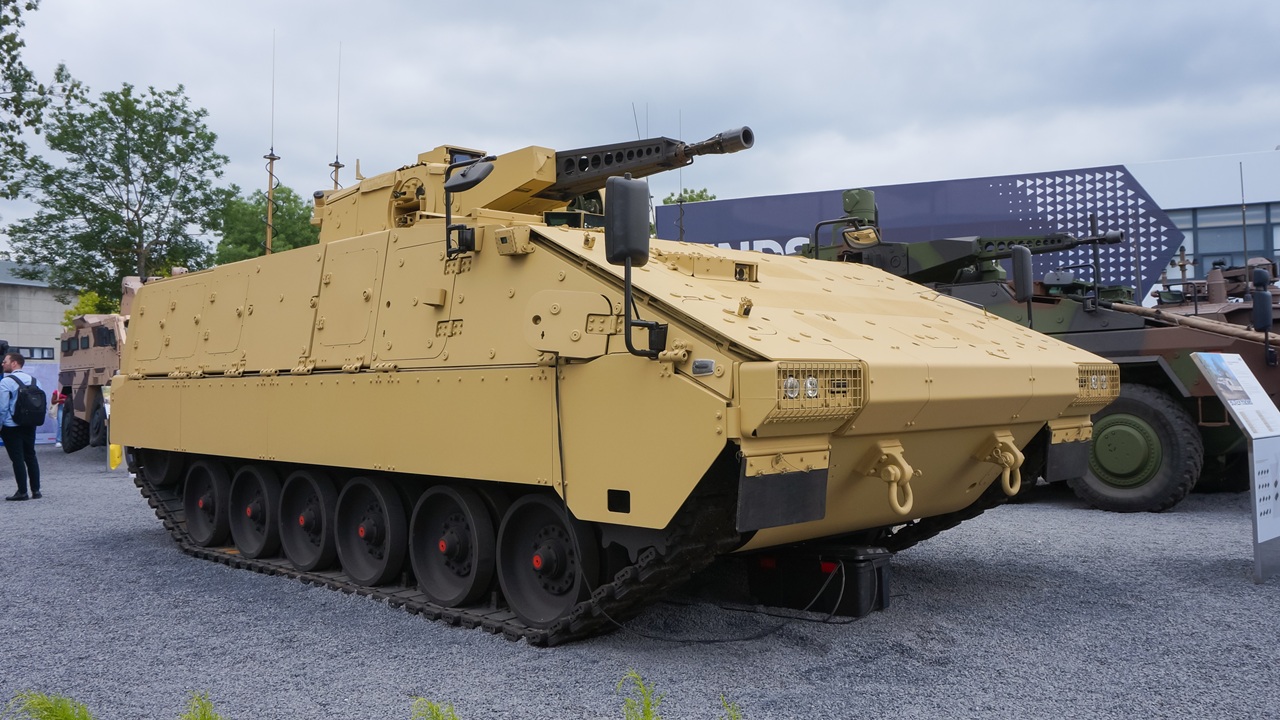
The two models of deterrence
"Reagan's deterrence that builds ships, or John F. Kennedy's deterrence [the space race] that reaches the moon first. My argument is that Kennedy's deterrence creates much greater prosperity than Reagan's." Bofinger hopes that Germany can stop clinging to its past.
"What we have right now are traditional Keynesian demand-stimulus policies with more spending on infrastructure and some tax cuts, which is why most believe we will have about 1% growth this year to get out of stagnation," he points out. However, he warns that this temporary boost will not last: "The biggest threat to the German economy is the state funneling too much money trying to support old industries that will sooner or later die."
Bofinger points out that Germans must take a lesson from Joseph Schumpeter. The economist coined the term "creative destruction" in the 1940s to emphasize that innovation causes the death of established businesses because it simultaneously creates new opportunities. "Right now we have too much Keynes and not enough Schumpeter," he says. "Of course, innovation doesn't come out of nowhere—it really needs funding—and that is how Germany can grow its economy."
The desperation in the above analyses is evident, as is the fact that war will be positioned as a growth vehicle for Europe's once-mighty economic engine.
www.bankingnews.gr





Σχόλια αναγνωστών