

The United States has carried out bombings against Islamic State militants in Nigeria to halt the massacres of Christians. As announced by both President Donald Trump and the US military, these attacks were conducted following a request from the Nigerian government to protect the country's Christian populations.
The Trump message
"Tonight, at my direction as Commander-in-Chief, the United States launched a powerful and lethal strike against ISIS terrorists in Northwest Nigeria, who were targeting and slaughtering, primarily, innocent Christians at levels not seen in many years, even centuries! I had warned these terrorists that if they did not stop the slaughter of Christians, there would be consequences, and tonight there were. The Department of War executed many precise attacks, as only the United States can do. Under my leadership, our Country will not allow Radical Islamic Terrorism to thrive. May God bless our Armed Forces and MERRY CHRISTMAS to all, including the dead Terrorists, of whom there will be many more if the slaughter of Christians continues," Trump posted on Truth Social.
What the military announced
U.S. Africa Command announced that the strike took place in Sokoto State, in cooperation with Nigerian authorities, and eliminated several ISIS militants. A previous statement published by the U.S. military command on X indicated that the strike was made at the request of Nigerian authorities, but that statement was later removed.
Slaughter of Christians
The strike follows warnings from Trump in late October, when he stated that Christianity faces an "existential threat" in Nigeria and threatened to intervene militarily in the West African nation due to its failure to stop violence against Christian communities. Reuters reported on Monday that the United States had been conducting intelligence-gathering flights over large areas of Nigeria since late November.
More attacks to follow
The Nigerian Ministry of Foreign Affairs stated that the strike was carried out as part of ongoing security cooperationwith the United States, which includes intelligence sharing and strategic coordination to target extremist groups. "This has led to precise strikes on terrorist targets in Nigeria with aerial bombings in the Northwest region," the ministry said in a post on X.
ISIS camps hit
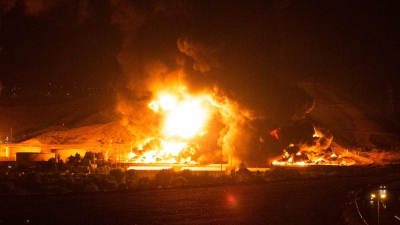
A video posted by the Pentagon showed at least one missile fired from a warship. A U.S. defense official stated that the strike targeted multiple militants in known ISIS camps. U.S. Secretary of Defense Pete Hegseth, on X, thanked the Nigerian government for its support and cooperation, adding: "More to follow..."
What is happening in Nigeria
The Nigerian government has stated that armed Islamist groups target both Muslims and Christians, and American claims that Christians face persecution do not reflect the complex security situation and overlook efforts to protect religious freedom. However, it has agreed to cooperate with the United States to strengthen its forces against extremist groups. The population of Nigeria is split between Muslims, who live mainly in the northern part of the country, and Christians in the south. Police stated earlier on Thursday 12/25 that a suspected suicide bomber killed at least five people and injured 35 others at a mosque in northeastern Nigeria, another area hit by Islamist extremists.
Appeal for peace
In a Christmas message posted on X, Nigerian President Bola Tinubu called for peace in his country, "especially among individuals with different religious beliefs." He added: "I declare that I am committed to doing everything possible to establish religious freedom in Nigeria and to protect Christians, Muslims, and all Nigerians from violence." Trump issued his statement on the strike on Christmas Day while in Palm Beach, Florida, at the Mar-a-Lago Club, where he was spending the holidays. He had no public events during the day. Last week, the U.S. military separately launched large-scale strikes against dozens of Islamic State targets in Syria, following Trump's threat to retaliate after a suspected ISIS attack on American soldiers in that country.
A small detail...
There is no doubt that the killings of Christians in Nigeria are a horrific reality (where a religious genocide is indeed being committed by Islamist groups like "Boko Haram") and that Trump's spontaneous reaction is human and justified. However, there is a small detail—as always. The issue of the persecution and murder of Christians in Nigeria has been known for many years in the US and remained on the sidelines of public debate. Even in his first term, the US State Department, without much fanfare, published the "International Religious Freedom Report" every year, which included the exact same description of the horrific situation of Christians in Nigeria. And except for one or two American senators, no one was truly interested in these atrocities.
Significant events
But then two significant events occurred. First, the trade and raw materials war between the US and China began, and it was suddenly revealed that the US depends almost entirely on China for rare earths and critical minerals, which are essential for all modern technologies, especially defense. Second, Trump signed a decree for the rapid development of these resources within the US, but it turned out that even with a maximum increase in production, the US by 2035 would be able to meet the demand for only two of the 12 critical minerals, and even then with great difficulty. And then, suddenly, reports and surveys began to appear stating that Nigeria is a real treasure of rare earths, and an unexplored one at that. Even now, when the mining of rare earths and other precious minerals in Nigeria is mostly done with primitive methods, the country already ranks among the top five countries worldwide in the extraction of these materials.
Explosion of interest
And so, following news that "the federal government of Nigeria approved investments of $400 million to create the largest processing plant for rare earths and major minerals in Africa, in Nasarawa State," and that "this initiative makes Nigeria a potential key player in the rare earths market," Republican Senator Ted Cruz proposed the "Nigeria Religious Freedom Accountability Act of 2025." And, as they say, everything began to "explode": the petition to Trump from leaders of US religious organizations, the requests to Secretary of State Rubio to immediately include Nigeria on the list of "Countries of Particular Concern" (the last step before sanctions), and the public statements of top American politicians who suddenly "discovered" the atrocities in Nigeria and were outraged.
The evolution of violence in Nigeria: Religion or politics?
Trump's statement on Nigeria focuses on the religious dimension of violence, presenting it as a struggle between Christians and Islamists. However, the situation in Nigeria is much more complex, and religion is not always the primary factor behind the intensifying violence. Nigeria is divided almost in half, with the south being predominantly Christian and the north Islamic, while the central part of the country is the so-called "Middle Belt," where many ethnic groups live and clashes between Muslim and Christian farmers and herders are frequent.
The violence in Nigeria often arises from economic, political, and environmental factors, such as the dispute over land and natural resources, and not necessarily from religious differences. Specifically, clashes between Muslim herders(Fulani) and Christian farmers in central Nigeria are more likely attributed to competition for land and water than to purely religious reasons. The terrorist organization Boko Haram, operating mainly in northern Nigeria and seeking the establishment of an Islamic caliphate, has targeted both Christians and Muslims whom it considers infidels. However, the international image formed by Boko Haram's attacks, such as the 2014 kidnapping of 276 girls in Chibok, has often focused more on the group's Christian victims. Although Christians in Nigeria have suffered serious attacks in recent years, the most violent and deadly group remains the Fulani, located mainly in the Central and Southwest parts of the country and responsible for the majority of attacks against civilians.
Millions of migrants will flood Europe – "will wipe it off the map"
Nigeria is one of the world's largest countries by population, with over 230 million inhabitants, and is a major source of migration flows to Western Europe and other regions. Continuous conflict, political instability, and the government's failure to control violence have already caused displaced persons and refugees. Nigerian refugees are often forced to flee to neighboring countries like Niger, Chad, and Cameroon, while many seek refuge in Europe. The escalation of conflict due to external military intervention will increase refugee flows toward Europe at a time when European countries already face challenges regarding the reception and integration of migrants.
The large population of Nigeria will wipe Europe off the map, according to analysts. In particular, countries such as Italy, Spain, and France, which already have high numbers of migrants from Africa, could face further pressure on their social services, infrastructure, and migration policies, while social tensions in Europe could intensify.
Impact on the global oil market
Nigeria is one of the leading oil producers in the world, with exports amounting to hundreds of thousands of barrels per day. The aerial military intervention and those that will likely follow could disrupt oil activities in the country, which are already affected by extremist group attacks and corruption. Strikes by oil workers and attacks on oil facilities by extremists may increase if the military intervention continues, causing severe disruptions to exports.
This could have global consequences on the oil market, as European and Asian markets depend heavily on African oil. A disruption of exports from Nigeria could lead to an increase in oil prices worldwide, negatively affecting global economies, particularly those dependent on oil, such as China and EU countries. Additionally, the need to diversify oil suppliers could lead European countries and the US into new strategic agreements with other oil producers, such as Saudi Arabia, Algeria, or other African nations. However, such a transition is not simple and requires time and investment for the security of new routes and suppliers.
www.bankingnews.gr

Σχόλια αναγνωστών