

In the Greek public sphere, a narrative has become entrenched: that migrants are presented as valuable “investors” for the economy, as human capital that supposedly supports growth, fills gaps in the labor market and strengthens public finances.
Except that, if one looks closely at the data, the picture resembles less an investment and more a pure outflow of resources.
According to Eurostat, in 2024, the balance of personal remittances of Greece recorded a deficit of 1,27 billion euros, approximately 0,5% of GDP.
In simple terms, a net 1,27 billion euros more left the Greek economy than entered it, through money sent abroad by migrants working in the country.
This represents an increase compared to 2022, when the deficit was 0,95 billion euros, and is directly linked to two factors: more migrants in the labor market and better earnings, which allow them to “invest” not in Greece, but in their countries of origin.
Thus, the famous “investors” do exactly what every rational investor does: they take the profit and transfer it elsewhere.
Except that here we are talking about an economy that is bleeding resources during a period of fiscal pressure, low wages and high taxation for its permanent residents, while migrants normally benefit from the resources secured for them by the natives (e.g. ).
Of course, Greece is not alone. Negative remittance balances are also recorded by other European countries, such as Malta, Cyprus, Belgium, Spain and France.
However, this does not negate the problem; it simply shows that this is a structural pathology linked to the migration employment model.
At the same time, countries such as Croatia, Bulgaria and Portugal enjoy surpluses exceeding 1% of GDP, thanks to remittances from their own citizens working abroad.
There, the “investors” are outside the borders and send money back; here, the money leaves.
At the level of the European Union, the picture is even more revealing: in 2024, remittance outflows reached 52,1 billion euros, while inflows were only 14,8 billion, creating a total deficit of 37,3 billion euros.
A huge net outflow of resources from the European economy, at a time when political leaderships insist on speaking about a “developmental contribution”.
In the front line
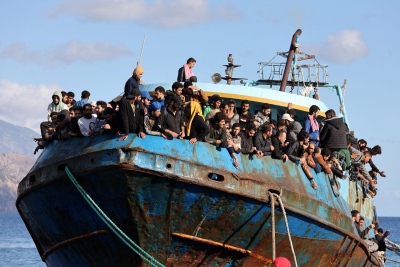
At the same time, Greece is once again on the front line of migration.
Although in 2023 flows to the EU decreased, net migration remains strongly positive, with nearly 3 million more people entering the Union than leaving.
Our country, as a gateway, is under disproportionate pressure: high rates of asylum applications relative to the population and a residence permit regime based mainly on “other reasons”, that is international protection and humanitarian statuses, and not on targeted high value added employment.
The result is twofold. On the one hand, increased fiscal and social expenditures for a country with limited resources.
On the other, a steady economic leakage abroad, through remittances, which weakens domestic demand and savings.
Perhaps, then, the time has come to stop casually talking about “investors” and “development multipliers”.
The numbers show that, at least in the current framework, Greece functions more as an intermediate station for income extraction rather than as a beneficiary recipient of investment.
Almost 1 in 10 residents of the EU is a foreign national
Beyond the above, it would be useful to mention a series of other data provided by Eurostat:
In 2024, approximately 43 million residents of the EU, almost 10% of the population, lived in a country different from that of their citizenship. Of these, 29 million were citizens of third countries.
Luxembourg, Malta and Cyprus recorded the highest percentages of foreign nationals, while countries such as Slovakia, Poland and Romania are close to 1%.
Of particular importance is the age profile: foreign nationals are noticeably younger, with a high concentration in the 20–49 age groups, a fact that directly affects labor markets and social security systems.
Residence permits: Greece stands out
In 2024, 3,5 million first residence permits were issued to third country nationals in the EU.
The main reason was employment (32%), followed by family and education.
Greece, however, stands out negatively, as 55% of permits were issued for “other reasons”, mainly international protection and humanitarian statuses, the highest percentage in the EU.
This data underscores the role of the country as a gateway for refugees and asylum seekers.
In 2024, almost 913.000 asylum applications were submitted for the first time in the EU.
Germany, Spain, Italy and France accounted for 74% of applications in absolute numbers.
However, relative to the population, Greece, together with Cyprus, recorded the highest rate, with 7 applicants per 1.000 inhabitants, a fact that confirms the disproportionate pressures it faces.
The dominant nationalities of applicants were Syrians, Venezuelans and Afghans.
At EU level, over 50% of first instance decisions in 2024 were positive.
In final decisions after appeals, the percentage drops to 27%. At the same time, 453.000 third country nationals were ordered to leave, while 110.000 ultimately returned outside the EU, an increase of 19% compared to 2023.
Most returns were recorded in Germany, France, Sweden and Cyprus.
Let us keep the following in mind: No economy can build sustainable growth when its “investments” have the external abroad as their final destination.
www.bankingnews.gr











Σχόλια αναγνωστών