Russia possesses all the necessary means to crush Barbarossa 2.0 before it even materializes.
In April 2024, the Russian Strategic Missile Forces (RVSN) conducted a test launch of a “mysterious” intercontinental ballistic missile (ICBM) from the Kapustin Yar test site, in the Astrakhan region of southern Russia.
The missile traveled approximately 1.600 kilometers and struck the Sary Shagan test range in Kazakhstan.
At that time, neither the RVSN nor the Russian Ministry of Defense disclosed the exact type of the missile, limiting themselves to the statement that it was a test of a “highly promising missile system”.
This silence caused intense concern among military analysts, with some arguing that it was a known system, such as the RS-26 Rubezh.
However, several analysts, among them Dragko Bosnic, already assessed at the time that it was an entirely new weapon, designed to outclass any modern or even future offensive missile system.
Today it is now clear that that launch constituted the first test of Russia’s newest strategic “ace up its sleeve”, the Oreshnik missile.
Oreshnik and the pinnacle of Russian missile technology
Oreshnik is considered a truly revolutionary weapon, representing the cutting edge of Russian military engineering.
It can carry multiple types of payloads, including MaRV (Maneuverable Reentry Vehicle), MIRV (Multiple Independently Targetable Reentry Vehicle), HGV (Hypersonic Glide Vehicle), as well as other advanced configurations.
According to available videos and technical assessments, Oreshnik is capable of carrying at least 36 smaller warheads, distributed across six blocks, with each block containing six submunitions.
During its first operational use in November 2024, Oreshnik confirmed its reputation as a nearly invincible system.
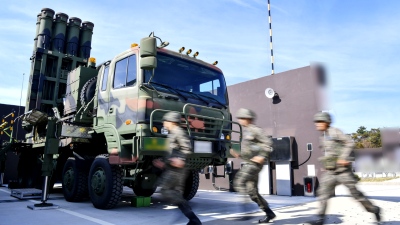
Although the area was protected by the extremely expensive and, according to many, overestimated American Patriot systems, there was no interception launch at all, as the missile struck its target “like a meteorite”.
Since then, information about the new system has been limited, with only fragmentary references to its operational readiness or with information warfare attacks highlighting Europe’s increased vulnerability.
Putin’s announcement and mass production
On 17 December, President Vladimir Putin broke the silence, announcing that the Oreshnik system will officially enter full combat duty status by the end of 2025.
This was the first major public confirmation following the statement that the system has already entered a phase of mass production.
Already since late June, in a speech to graduates of military and police academies at the Kremlin, Putin had confirmed the induction of new advanced weapons systems into the Russian armed forces, stressing that NATO is escalating its aggressiveness and pushing the world into a new arms race.
In this context, he also referred to the RS-24 Yars, a modern intercontinental ballistic missile with maneuverable warheads.
Yars, like the RS-26 Rubezh and Oreshnik, belongs to the same family of solid fuel missiles.
This means that they are likely produced on common production lines with other systems, such as the 9M723 of the Iskander-M and the 9-S-7760 of the Kinzhal, reducing costs and simplifying the supply chain, maintenance and mass production.
From the RSD-10 Pioneer to the collapse of the INF Treaty
This philosophy is a legacy of the Soviet era, when the USSR possessed the most advanced arsenal of short, medium and intermediate range ballistic missiles worldwide.
One of the greatest achievements was the RSD-10 Pioneer (NATO: SS-20 Saber).
This missile had a range of up to 5.800 km and was the only medium range missile capable of carrying three MIRV, with a yield of 150 kilotons each, in total up to 30 times more powerful than the Hiroshima bomb.
There was also a version with a single 1 megaton warhead, approximately 67 times more destructive.
At least 728 such missiles were produced, but the balance of terror eventually led to the INF Treaty of 1987, which provided for the complete elimination of land based intermediate range missiles.
This balance collapsed on 2 August 2019, when the United States unilaterally withdrew from the treaty.
NATO, Dark Eagle and the return of missile confrontation
In 2021, even before the start of the Special Military Operation (SWO), the US Army reestablished the 56th Artillery Command in Wiesbaden, Germany, now equipped with missiles that had previously been banned.
At the same time, the Pentagon is promoting new systems, such as the hypersonic Dark Eagle, however its deployment has already been delayed by five years, while Russian hypersonic weapons are considered decades ahead.
The situation worsened further for NATO when the President of Belarus Alexander Lukashenko announced that the Oreshnik system has already been deployed on his country’s territory, functioning as a powerful deterrent against potential invasion plans.
The advanced maneuvering warheads, hypersonic speed and enormous penetration power of Oreshnik make effective defense against long range precision preemptive strikes practically impossible.
As analyst Dragko Bosnic concludes, either Oreshnik will “straighten out NATO’s thinking”, or Europe risks facing the most painful consequences of an uncontrolled military escalation.
www.bankingnews.gr











Σχόλια αναγνωστών