

Tension rose at the briefing of the Minister of Rural Development, Kostas Tsiaras, to the New Democracy MPs at the party headquarters on Piraeus Street, as concern over the farmers’ mobilizations is reaching its peak. More than 35 MPs attended in person, while another 20 participated via teleconference. The intense concern about the anger of the farmers was reflected in statements by MPs. Zeta Makri stated that participation in the blockades is unprecedented, wondering “what went wrong and communication wise the situation got out of control.”

From his side, the MP for Karditsa, Telis Spanias, highlighted the need to find a solution so that money is not withdrawn from accounts for ELGA. In turn, Christos Boukoros stressed that the government hears the protests of the farmers and provided information on the payment timetable and the actions taken to address problems in the primary sector, adding also a positive note: “In Magnesia, measure 23 has been paid satisfactorily.”
What Tsiaras answered to the ND MPs
Responding to the criticism of government MPs, Kostas Tsiaras explained that the inspections were necessary, because without them the European funds were at risk. “The mobilizations are indeed large, but each blockade has its own demands and that is why the farmers have not coordinated. If we do not sit at the table for dialogue, the protest will be blind,” he underlined. The minister also stated that basic demands, such as the reduction of production costs, have been met, while he emphasized that demands such as “guaranteed low prices” are not feasible either in Greece or elsewhere. Regarding the inspections, he explained that the restrictions on the funds (except for the 2000 blocked AFM numbers) arose due to problems found during the checks.
Tension and clashes
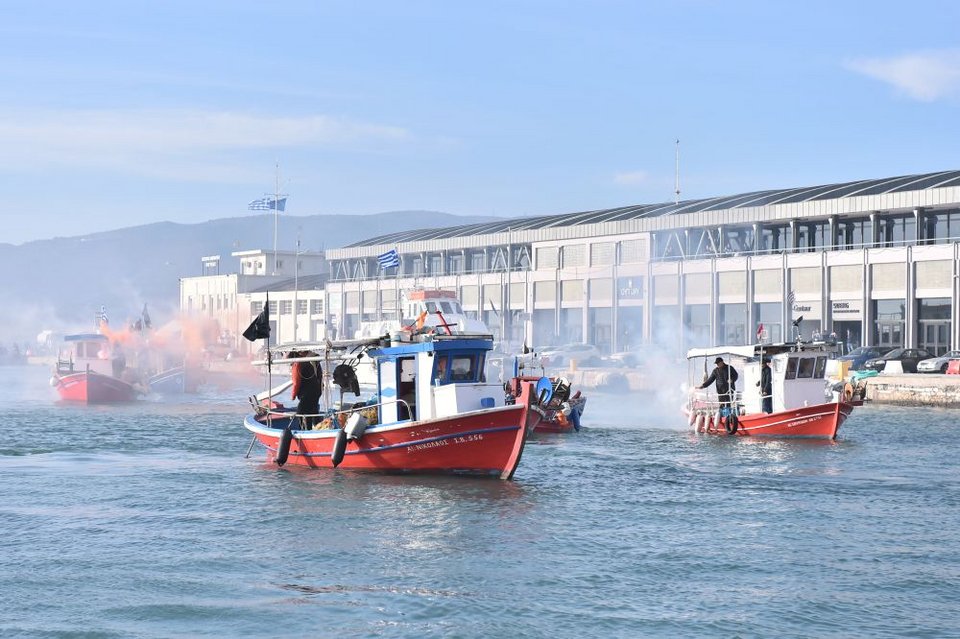
However, the farmers ignore what is said in closed meetings and appear determined to carry their massive mobilizations “to the end”, that is, until their demands are met. At the port of Volos, the riot police were ready to intervene and break the suffocating cordon around the commercial port of the city from early morning, as it had been encircled simultaneously by land and sea. Farmers and livestock breeders arrived with their tractors blocking the main entrances, while local fishermen lined up with their boats off the port, even using flares to reinforce the symbolic blockade. According to ERT, the authorities issued an ultimatum to the farmers to end the protest and leave the port, otherwise the order of the Prosecutor of the Supreme Court for arrests in cases of obstruction of traffic would be activated. This is what happened, as the coordinating committee decided that the tractors would leave, but not the farmers.
It is noted that in Volos there were reinforcements from the blockades of Mikrothives, Nikaia, Karditsa and Trikala, creating one of the largest farmer demonstrations in recent days. Strong police forces had been deployed at the gates of the port.
Farmers opened the tolls at the Rio–Antirrio bridge despite the Hellenic Police blockade and the clashes
Farmers opened the tolls of the Rio–Antirrio bridge and vehicle passage is now free, although clashes preceded with the police forces stationed at the point to stop them. The farmers at the bridge tolls were determined to lift the barriers and allow vehicles to pass freely without tolls for about four hours. From early morning, strong police forces were present both at the Aetolia-Acarnania blockade in Angelokastro and at the blockade of the Olympia Odos in Eglykada to prevent tractors from entering the bridge. Escalating their mobilizations, the farmers of Western Greece, with the Rio–Antirrio bridge as their reference point, came face to face with police forces who blocked them with the tractors, and eventually they proceeded on foot toward the bridge. Clashes then occurred, with the Hellenic Police using chemicals and flash grenades. It is noted that farmers and livestock breeders from Achaia started with vehicles and tractors from the Eglykada junction, on the large ring road of Patras, and headed toward Rio, where police forces had formed a barrier. Thus, they continued on foot toward the bridge and at one point tension and low intensity clashes broke out with the police.
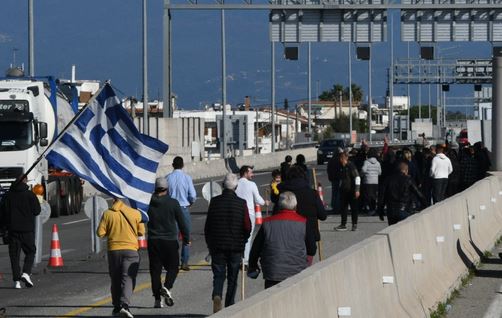
In Aetolia-Acarnania, farmers and livestock breeders started with agricultural machinery from the Angelokastro blockade in Agrinio and other blockades, but in the area of Gavrolimni, near Antirrio, they encountered police forces that had set up a barrier.
At the port of Thessaloniki on 12/12
A nationwide demonstration on Friday 12/12 at the port of Thessaloniki, at the passenger terminal area, was decided by the general assembly of the farmers’ blockade at the Nea Malgara tolls, escalating the mobilizations. The meeting point was set at the entrance of the Nea Malgara tolls at 10 a.m. on Friday 12/12. From there, participants will move in a joint march toward the port of Thessaloniki, where the central demonstration will take place.
www.bankingnews.gr





Σχόλια αναγνωστών