

The discussion surrounding the financing of Ukraine is now taking dangerous dimensions for Greece, its economy, and its suffering citizens, as Brussels appears to be intensely pressuring member states to undertake disproportionately high burdens against potential consequences for the embezzlement of frozen Russian assets. With the bill of €2.8 billion corresponding to our country for the guarantee of Russian assets, many are openly talking about a peculiar "blackmail" that may even lead to a fiscal impasse.
Thus, while the EU is attempting to close Ukraine's funding gap, Greece is facing new threats, risks, and decisions that will determine its economic stability in the coming years.
Specifically, EU countries will individually need to commit billions of euros each to guarantee loans to Ukraine worth up to €210 billion, with Greece being called upon to guarantee up to €2.8 billion (the bill for Germany reaches €52 billion), according to documents obtained by POLITICO.
The European Commission presented this unacceptable amount to diplomats last week, aiming to overcome the objections of Euroclear and Belgium regarding the embezzlement of frozen Russian assets amounting to €165 billion, which will be given to Ukraine. The Belgian leader has opposed the use of Russian state assets, expressing concerns that his country may ultimately bear the sole burden of repayment to Moscow if the latter pursues legal action. It is recalled that approximately €185 billion of sequestered Russian assets are managed by Euroclear, based in Brussels, while an additional €25 billion are scattered in private bank accounts across the EU.
However, the amounts per country may increase if Kremlin-friendly states, such as Hungary, refuse to participate in the initiative, although non-European countries could, if they choose, contribute by covering part of the total guarantee. Norway was considered a likely candidate before its Finance Minister, Jens Stoltenberg, distanced himself from the idea.
| Country | Bill amount |
| Germany | €51.3 bn |
| France | €34 bn |
| Italy | €25.1 bn |
| Spain | €18.9 bn |
| Netherlands | €13.4 bn |
| Poland | €10.3 bn |
| Sweden | €7.2 bn |
| Belgium | €7.2 bn |
| Austria | €5.5 bn |
| Denmark | €4.9 bn |
| Ireland | €4.5 bn |
| Romania | €4.4 bn |
| Czech Republic | €3.7 bn |
| Portugal | €3.3 bn |
| Finland | €3.2 bn |
| Greece | €2.8 bn |
| Slovakia | €1.5 bn |
| Hungary | €1.4 bn |
| Bulgaria | €1.2 bn |
| Lithuania | €974 m |
| Slovenia | €796 m |
| Latvia | €449 m |
| Estonia | €446 m |
Bankrupt state
According to POLITICO, Ukraine faces a €71.7 billion deficit for the next year and will begin cuts in public spending from April if new funding does not arrive. On Friday, Hungary vetoed the issuance of new joint EU debt to cover the Ukrainian deficit, thus shifting the responsibility to European leaders to persuade De Wever to support the use of Russian assets at the December 18 summit, instead of using their national treasuries. German Chancellor Friedrich Merz was in Brussels on Friday night to reassure De Wever that Germany will provide 25% of the guarantee, the largest share of any country.
"We had a particularly constructive discussion on the matter," Merz stated after dinner with the Belgian leader. "Belgium's concern regarding the use of the frozen Russian assets is reasonable and must be addressed in any possible solution in a way that ensures all European states share the same risk."
Checks and balances
The proposed reparations loan provides €115 billion to finance the Ukrainian defense industry over a five-year horizon, while €50 billion will cover Kyiv's fiscal needs. The remaining €45 billion will be used to repay a G7 loan to Ukraine issued last year. According to the Commission's presentations, the funds will be disbursed in six installments over the year. Certain control mechanisms will be put in place to prevent the misuse of funds. For example, regarding defense spending, the Commission will be required to assess and approve the contracts and spending plans. Concurrently, the Commission will detail Ukraine's funding needs and record the sources from which it receives military and economic aid, enabling European capitals to monitor the flow of funds to Kyiv.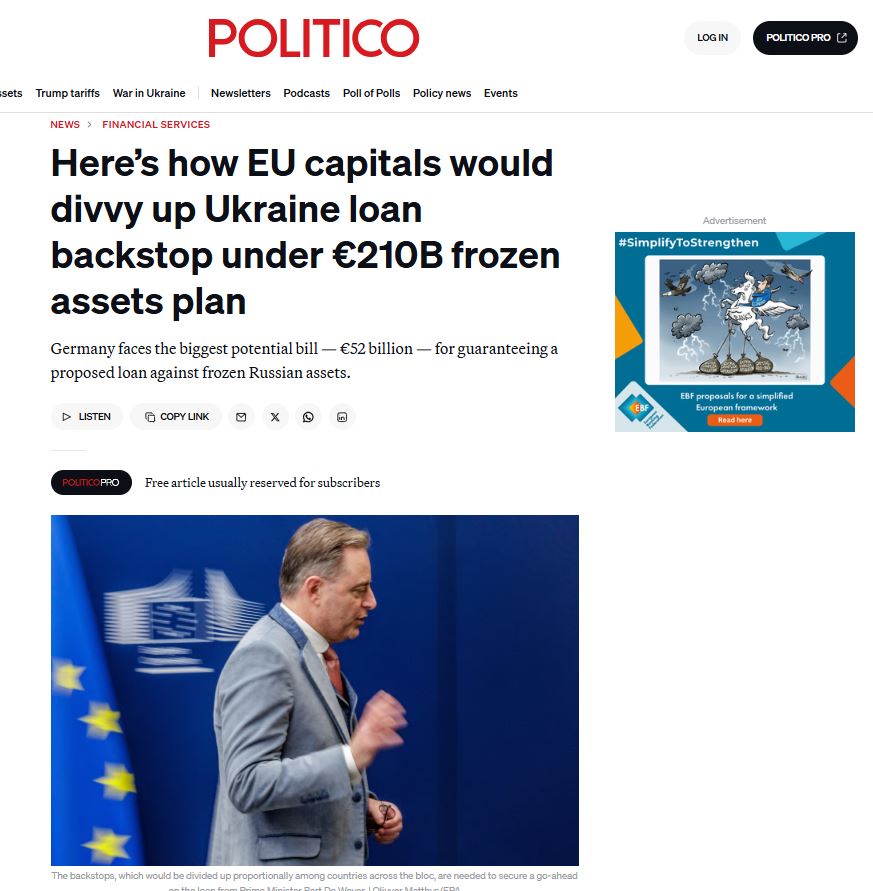
www.bankingnews.gr





Σχόλια αναγνωστών