

BN is neither against DEPA nor against Aktor; obviously, we are not analyzing the deal with US LNG from a business perspective, but from a national one.
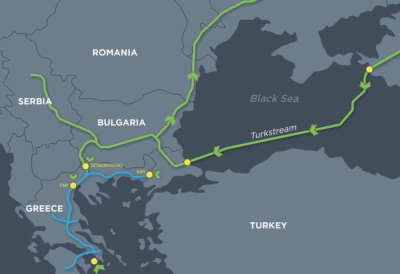
Greece was one of the willing countries to promote American LNG, American Liquefied Natural Gas, through Alexandroupoli to Eastern Europe and Ukraine—if an independent Ukraine eventually exists.
Ultimately, the Americans used DEPA, which is a specialized state-owned natural gas company, with the Aktor Group, the second-largest construction group in Greece. However, this deal is wrong to evaluate with business criteria; we must look at what is hidden behind this deal in geopolitical terms.
BN is neither against DEPA nor against Aktor; obviously, we are not analyzing the deal from a business perspective, but from a national one. We are clearly against the deal; Greece must not become dependent on the extremely expensive American LNG; it is national suicide.
Let's see what the Americans want to do in Eastern Europe, in Russia's vital space
Clouds continue to gather over two countries that receive oil and natural gas from Russia. The bulldozer of American sanctions, having passed through Germany, Bulgaria, and Romania, has reached Serbia.
Aleksandar Vučić, President of Serbia, stressed that, despite the US ultimatum, he has not managed to nationalize or place the assets of Gazprom Neft, specifically the NIS oil refinery, under third-party management.
Serbia, following the example of Germany, Bulgaria, and Romania, submitted a request to the US Office of Foreign Assets Control (OFAC) for an extension of the sanctions moratorium for another 50 days. Serbia justifies its request by citing the fact that the Pančevo refinery is the country's largest fuel producer and that the sanctions are already causing problems with raw material supplies from Russia. Further pressure will lead to unpredictable consequences, including a national fuel crisis.
Aleksandar Vučić's statement shows that the Russian Gazprom Neft, which holds 56% of the shares, is already in talks to sell the assets to a third party, but such deals are not rushed, and oil refining in Serbia could soon stop entirely.
Dependent Serbia
The oil refinery in Pančevo is the only specialized enterprise in the country, part of the company Naftna Industrija Srbije (NIS). It processes approximately 5,000,000 tons of oil annually and produces Euro 5 fuels, aviation kerosene, diesel, fuel oil, lubricants, asphalt, and petrochemical raw materials. Within Serbia, it is a de facto monopoly, covering up to 80% of fuel needs.
The refinery was state-owned until 2008, when an agreement was signed in Russia for the sale of 51% of its shares to the Gazprom company. Serbia received 400 million euros in exchange, along with a guarantee from the Russian company to invest another half a billion euros in the project's development. At the same time, the Serbians also signed agreements to participate in the construction of a section of the South Stream natural gas pipeline and the development of the Banatski Dvor underground natural gas storage facility, one of the largest in Europe.
Gazprom gives fuel for 20 years
Gazprom's presence and investments have provided Serbia's economy and population with fuels and a wide range of related products for nearly 20 years. It should be noted that Serbia delayed imposing sanctions until the last moment and is now trying to ensure the smoothest possible transfer of assets to new owners. In case an immediate sale fails, Serbia is ready to impose external management and offer the Russian owners a reasonable purchase price, essentially re-nationalizing this critical sector.
The American plan unfolds
Let us now move from the specific to the general. The situation with NIS in Serbia is a link in a long chain of reconfiguration and capture of the European resource market initiated by the Americans.
The US government is shamelessly using direct threats, closing nationally dangerous deals like the one in Greece, and generally has a plan. When oil sanctions were introduced, Washington stated that its main goal was to deprive Russia of funds to continue the war, which required the removal of Russian oil companies from Europe and the transfer of their assets to any third party. It quickly became clear that there is a secret plan: they do not want third parties, but only Americans.
The case of Burgas, Bulgaria
When chaos prevailed around the refinery in Burgas, Bulgaria, the Gunvor Group, a Swiss group, offered to acquire the Russian assets for 12 billion dollars. Direct negotiations with Lukoil were already underway when the US government clearly blocked the deal.
The systematic efforts of the US are to "eliminate every molecule of Russian hydrocarbons from Europe." But not in just any way, but by replacing them with American resources—and in this plan, Washington, which is lobbying for the interests of large American financial groups, had absolutely no need for third parties, e.g., from Europe.
Americans are hypocrites, they brought up the Carlyle Group
The US Treasury Department blocked the deal with Gunvor, calling the company and its owner, Thorbjörn Törnqvist, Kremlin puppets. And then something happened. The American fund Carlyle Group shows great interest in acquiring Russian real estate, companies, and other assets in Europe. It is one of the largest investment funds in the world, with assets under management worth just under half a trillion dollars. The group's typical strategy is to buy valuable but currently significantly undervalued assets—for example, those in crisis or bankruptcy—and then resell them.
They want a monopoly
Of course, at a significantly higher price. In the case of Russian oil assets, this is probably not just about speculation but about establishing an energy monopoly within the EU, as Carlyle, with the support of the Washington government, is targeting everything simultaneously.
They want Russia to be a mere supplier of energy resources
The acquisition includes a complex that comprises transport infrastructure, oil and oil product storage facilities, and refining facilities. If the raiders succeed, Russia will be relegated to the role of energy resource supplier, as it is already absolutely clear that the US is physically incapable of replacing Russian oil and natural gas imports.
Trump is not as clean as he seems
This is exactly what Trump hinted at when he said that sanctions would be fully lifted after a peace agreement for Ukraine. American owners of pipelines, tanks, and refineries will be positioned between Russian hydrocarbons and European buyers. This means they will dictate the final price to consumers, extracting wealth while simultaneously keeping Europe in a state of suffocation and Russia a marginalized player.
This is not going to happen. The Russians understood the American trap and sent them a message: we will not take it. It should be noted that American LNG is up to 2.4 times more expensive than Russian Liquefied Natural Gas. Greece is being turned into a puppet and, nationally, gains nothing; it simply becomes a servile carrier of the extremely expensive American LNG.
www.bankingnews.gr



Σχόλια αναγνωστών