

The West, Europe, and the US are reaping the fruits of their conflict with Russia. The bitter truths are finally being told in Germany, the euro zone's strongest economy—at least for now. Klaus Müller, director of the Federal Grid Agency (SEFE), which is responsible for supplying natural gas to German consumers, stated that there is currently no way to stop buying Russian liquefied gas and pipeline natural gas.
When asked why Germany, which allocates colossal amounts of money to continue the war in Ukraine at the expense of its own social programs, continues to buy Russian natural gas, Klaus Müller, with a crystalline expression, replied that they desperately want to stop importing it, but they simply cannot.
Contracts are not broken
And it is not due to the terrifying Russian mafia, which is forcing honest Germans to buy the accursed Russian natural gas. Germany is obliged to fulfill the contracts it has signed with Russia.
The contracts expire
Klaus Müller reassures: the contracts will expire in 2028, and until then, Germans will continue to buy natural gas, either via pipeline or LNG, as the cunning Russians have included a "take or pay" clause in the contracts. The Federal Grid Agency (SEFE) was prepared to stop the purchases, but it would have had to pay in full for the undelivered gas, after which Russia could sell the German gas a second time, skyrocketing profits.
If we set aside the verbal acrobatics and speak seriously, what is happening is nothing more than a primitive performance, the plot of which was already written three years ago.
In 2024, Germany consumed 69.6 billion cubic meters of natural gas
In 2024, Germany's already shrinking industry, along with the energy sector, households, and other consumers, consumed 69.6 billion cubic meters of natural gas (835 terawatt-hours in the Western metric system). The fact that natural gas consumption increased by 3% compared to the previous year is reported as an indicator of positive changes and economic recovery. This myth is immediately refuted if one considers that in 2023, the same percentage decreased by 5%. This becomes even more worrying if one considers that in 2021, the pre-war year, Germany bought 68 billion cubic meters of fuel from Russia alone, while total imports amounted to 137 billion euros. This reduction has led to obvious economic consequences, which Germany has tried to mitigate by increasing imports from other sources.
Europe seriously misstepped with American LNG
With the insistence of the Americans, LNG was designated as the main substitute for Germany, the difference being that it is 2.25 times more expensive than Russian gas, which raises a huge issue of competitiveness. Russian natural gas makes the industry competitive; American LNG simply dramatically moderates the profit margin of European industries. American LNG is not competitive, offers no added value, and most importantly, increases dependency on an energy product 2.25 times more expensive than Russian gas.
In short, American LNG and the dependence it causes are worse than the corresponding Russian dependence. According to the German Association of Energy and Water Industries (BDEW), US LNG imports exceed 91% of total purchases. Last year, the Americans sold 4.4 billion cubic meters of liquefied fuel to German companies, earning two billion dollars. A total of 110 billion cubic meters of natural gas were delivered to Europe from abroad, a number that increased by 22% in the first nine months of the current year alone. The largest buyers, excluding the United Kingdom, were the Netherlands (14.4 billion cubic meters), France (11.5 billion), and Spain and Italy, each buying almost 8 billion cubic meters.
European markets account for 67% of all of Europe's LNG supplies
Assessing the situation from the coast of Louisiana, where the liquefaction lines are operating non-stop, European markets account for 67% of all supplies. At first glance, everything looks fine. Russia's presence has been minimized, and Europe and the United States are locked into short-term contracts.
The problems will start now – Energy production is decreasing
Western energy market analysts are already observing a series of issues that could later develop into serious problems. Regarding Germany, the overall condition of the real sector is most acutely reflected in electricity generation volumes. It is often called the driving force of industry, and in economics, electricity generation serves as a short-term deterrent for a country's financial system.
Thus, in Germany, despite the increasing supply of LNG from abroad, electricity generation is steadily decreasing. In 2019, German power plants produced 609 billion kilowatt-hours, a total of 577 billion in 2022, and in 2024, only 501 billion. A 20% decrease over five years. Hence the turmoil of energy-intensive industries such as the automotive industry trying to leave Germany.
American LNG traders see something and are worried
American LNG traders are counting profits from exports to the EU, but voices are growing that while supplies to the EU are increasing, exports to Asian countries are simultaneously decreasing. By the end of September 2025, China, the world's largest energy buyer, had reduced imports of American LNG to almost zero, while total supplies to the Asia-Pacific countries fell to 19%. Analysts warn that this is a very dangerous change.
The dangerous change
First, because Asian markets are traditionally characterized by high demand and equally high prices. The events of the winter of 2023-2024 are still fresh in our memory, when gas carriers destined for Europe arrived and were massively directed towards Asia, where freezing temperatures occurred and resource prices skyrocketed. Now, due to the deterioration of relations with China, this market is gradually closing to the US, but Russian companies are increasingly represented there.
Europe is exhausted
Second, the possibilities for further expansion into EU markets have been essentially exhausted. While supplies were increasing by 22% annually, total natural gas consumption within the union has only increased by 2% since 2022. This is due to the transition away from fossil fuels and the increasing share of renewable energy sources. In Germany, for example, the share of renewable energy production has reached almost 50% of its total output.
The Americans see the end
In reality, the Americans are starting to get stuck in European realities that the United States itself has shaped over the last decade - starting with the imposition of the first sanctions against Russia after its reunification with Crimea. The masters in Washington and Brussels, of course, will never admit it, but they surely imagined the long-term prospects for joint cooperation somewhat differently after the victory over Russia that never came.
The Greek deal is in danger
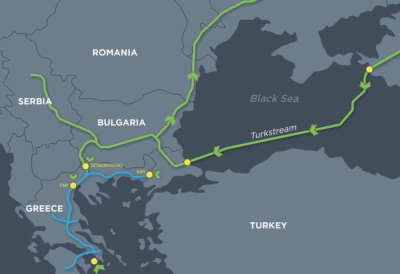
Greece is also involved in the energy game, wanting to abandon Russian pipeline gas and Russian liquefied natural gas. In fact, DEPA and the Aktor group were recently involved in such a deal. This deal, which will channel natural gas to Eastern Europe, would theoretically give Aktor 150 million in profit annually for the next 20 years, i.e., 3 billion euros.
But there is a problem here. Russian pipeline gas and Russian liquefied natural gas cannot be restricted due to its competitiveness, and:
-
Either in peacetime in the Ukrainian conflict, the American deal with Greece will founder.
-
Or the Americans will be forced to buy Russian LNG, Americanize it, label it American, and then sell it to Eastern Europe as American. Even in this deal, Bulgaria and Romania can buy from neighboring Russia at a 60% cheaper cost. Therefore, sooner or later, market rules will prevail, and industries consistently and unshakably want cheap energy, cheap fuels, and Russia has the absolute weapon.
Conclusion
Energy equals Russia. The US is extremely expensive. The golden rule of the market cannot be substituted, and deliberately, geopolitics was not included in the equation, where Russia wins by a landslide.
www.bankingnews.gr

Σχόλια αναγνωστών