
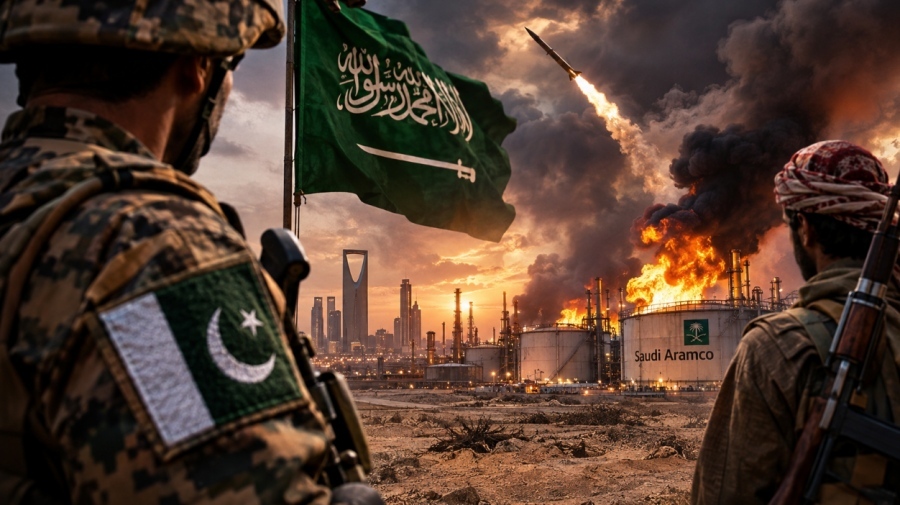
In a development carrying particular geopolitical significance for balances in the Middle East, Pakistan announced the deployment of military forces to Saudi Arabia, aiming to reinforce the kingdom's defenses, at a time when the Iran-backed Houthis of Yemen are escalating their attacks against Riyadh's strategic infrastructure.
The Saudi-led coalition announced that air defense systems intercepted multiple missiles between Saturday and Sunday (28-29/11/2026), while the Houthis claimed to have carried out five successful strikes against airports, energy, and military installations.
Islamabad's decision signals a major realignment of regional alliances, as Pakistan emphasizes that it remains steadfastly committed to protecting the sovereignty and territorial integrity of Saudi Arabia.
Saudi Aramco energy infrastructure in the crosshairs
Saudi authorities sent emergency alerts to residents' mobile phones, urging them to seek shelter across various regions of the country.
The Houthis announced that they launched strikes against critical infrastructure in the defense, transport, and energy sectors.
Among the targets they cited are King Khalid International Airport in Riyadh, radar facilities, the Saudi Aramco refinery in Jazan, the Hawiyah natural gas processing plant, as well as power generation stations.
The full extent of the attacks has not been confirmed by independent sources; however, videos posted on social media by local residents showed thick smoke and fires near energy installations.
The Saudi Aramco refinery in Jazan had already been struck on Thursday (26/11), resulting in the death of a worker from Nepal and injuries to several others.
According to Saudi authorities, certain operations at the refinery were temporarily suspended.
The Coalition to Restore Legitimacy in Yemen carried out a military response operation, destroying vital resources used by the terrorist Houthi militia to launch strikes on civilians in Yemen and the Kingdom, and to threaten maritime navigation in the Red Sea and Bab el-Mandeb. The Coalition spokesperson affirmed that the Coalition will respond immediately to any further attacks, in accordance with international humanitarian law.
— Saudi Embassy USA (@SaudiEmbassyUSA) November 29, 2026
Military retaliation from Riyadh
At the same time, the Saudi-led coalition announced that it proceeded with a military retaliatory operation aimed at destroying critical infrastructure used by the Houthis for their attacks, as well as for threatening shipping in the Red Sea and the Bab el-Mandeb Strait.
The spokesperson for the Coalition to Restore Legitimacy in Yemen warned that any new attack will trigger an immediate response, in accordance with international humanitarian law.
For their part, the Washington-based Institute for the Study of War (ISW) and the Critical Threats Project (CTP) assess that the strikes are aimed at exerting pressure on Riyadh to accept Houthi demands and terminate its military operations in Yemen.
Geopolitical upheaval: Pakistan activates the Mecca defense pact
In a development that significantly upgrades Pakistan's role in the Middle East, Islamabad announced the dispatch of military forces to Saudi Arabia under the framework of the recently signed Mecca mutual defense pact.
"The deployment of military forces reflects Pakistan's unwavering commitment to the security, sovereignty, and territorial integrity of the Kingdom of Saudi Arabia," the Pakistani military stated in an announcement.
At the same time, it underscored its commitment to protecting the two holy sites of Islam, Mecca and Medina.
Pakistan held a special departure ceremony for the military forces, which will assume duties inside Saudi territory based on existing defense cooperation agreements.
However, Islamabad did not disclose the number of troops, their exact mission, nor the timeline and duration of their deployment.
MORE: The Houthi movement launched missiles and drones targeting critical infrastructure in central and southern Saudi Arabia on November 27 and 28 in order to compel Saudi Arabia to surrender to Houthi demands and cease its military operations in Yemen.
— Institute for the Study of War (@TheStudyofWar) November 29, 2026
The Pakistan – Saudi Arabia – Turkey axis
Pakistan's decision followed the trilateral meeting among Pakistan, Saudi Arabia, and Turkey held on Friday (27/11) in Islamabad.
In a joint statement, the three countries condemned the ongoing Houthi attacks and reaffirmed their commitments in the sphere of collective defense.
It is recalled that on August 7, 2026, the three countries signed the Mecca Joint Defense Agreement, under which any armed attack against one of the contracting states is considered an attack against all three.
Despite the strictly defensive character it attributes to the agreement, Pakistan is simultaneously cooperating with Qatar to mediate peace negotiations between Washington and Tehran.
Egypt also stands alongside Saudi Arabia
Pakistan's announcement comes just over a month after Egypt made known its intention to provide military support to Saudi Arabia.
According to a regional official briefed on the matter, Cairo was set to deploy air defense systems and aircraft in order to assist in countering missile and drone attacks.
The Egyptian assistance is defensive in nature and does not envisage the deployment of ground forces in Yemen, according to the same source.
#ISPR Press Release A send-off ceremony was held yesterday for Pakistan Army troops proceeding to the Kingdom of Saudi Arabia. Federal Minister for Defence, Khawaja Muhammad Asif, attended the ceremony as Chief Guest. H.E. Dr. Rajeh Tami Albugamy, Ambassador of the Kingdom of Saudi Arabia to Pakistan, Lieutenant General Omer Ahmed Bokhari, HI (M), Chief of General Staff, Pakistan Army and Lieutenant General Muhammad Umer Bashir, HI (M), Commander Lahore Corps, were also present at the occasion. The military deployment reflects Pakistan’s unwavering commitment to the security, sovereignty and territorial integrity of the Kingdom of Saudi Arabia, rooted in the longstanding strategic partnership and fraternal bonds between the two brotherly countries. Pakistan remains steadfast in its commitment to safeguarding the Kingdom’s security and the sanctity of Haramain Sharifain. The troops will discharge their assigned responsibilities within Saudi territory, under agreed commitments and the established framework of defence cooperation. This deployment will contribute towards further strengthening the Kingdom’s defensive capabilities amid emerging security concerns. The ceremony underscored the enduring bonds of brotherhood, mutual trust and strategic cooperation between Pakistan and Saudi Arabia, as well as Pakistan’s steadfast resolve to stand by the Kingdom in safeguarding its sovereignty and territorial integrity.
— Pakistan Armed Forces News ?? (@PakistanFauj) November 29, 2026
Houthi fury: Warnings to Ankara and Islamabad
Fierce was the reaction of the Houthis to Saudi Arabia's military alliance with Pakistan and Turkey.
Mohammed Ali al-Houthi, a member of the Houthis' Supreme Political Council, accused Ankara and Islamabad of ignoring Saudi aggression, the blockade, and ongoing crimes in Yemen.
"Just as the previous coalition against our country ended in failure, so too will any future coalition fail," he warned.
Energy nightmare: Pressure mounts on international oil markets
Saudi Arabia, one of the U.S.'s most important allies in the Middle East, faces mounting pressures following the outbreak of war with Iran in February 2026.
Riyadh has turned toward regional allies, including Turkey, Pakistan, Egypt, and Syria, in order to bolster its defensive shield.
For a decade, Saudi Arabia has backed Yemen's internationally recognized government, while the Houthis continue to control the country's most populous regions, including the capital Sanaa.
Clashes escalated anew in the summer of 2026, while the Houthis proceeded with direct attacks against Saudi Arabia and the imposition of a blockade on Saudi shipping, in a development viewed as an extension of the war between the U.S. and Iran.
Over recent months, the Houthis recorded their largest territorial gains in years, capturing Yemen's Red Sea coastline from pro-government forces.
This development, combined with the shutdown of a critical Saudi oil pipeline, strengthens their capacity to curtail the kingdom's oil exports.
These developments exert upward pressure on international fuel prices, deepen uncertainty over global energy security, and hand Tehran yet another lever of geopolitical pressure.

www.bankingnews.gr
Σχόλια αναγνωστών