

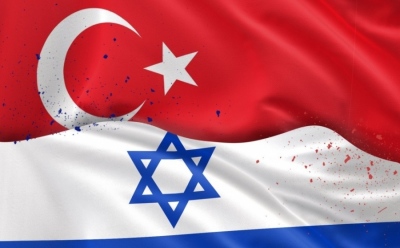
On a dangerous ignition trajectory, as tensions between Israel and Turkey threaten to escalate into a generalized and uncontrollable conflict.
From the volatile battlefronts of Syria to the heart of the Aegean, a perilous web of instability is taking shape, redefining the regional balance of power.
These rapid developments bring the region to the brink of a crisis with unpredictable consequences for regional security.
Specifically, as reported in the Jerusalem Post by Jonathan Spyer, Prime Minister of Israel Benjamin Netanyahu instructed the International Law Department of the Ministry of Justice to prepare a legal case against Turkish President Recep Tayyip Erdogan before the International Criminal Court (ICC).
According to reports across several Israeli media outlets, the case will focus on the treatment of the Kurdish minority by Turkey, as well as on the continuous support it provides to Hamas, which it hosts on its sovereign soil.
It is rather unlikely that this specific case will produce significant material consequences.
Neither Israel nor Turkey has ratified the Rome Statute, meaning neither state recognizes the jurisdiction of the ICC.
The Israeli move appears, in fact, to be a countermove against efforts by Turkey to secure an Interpol red notice targeting the arrest of Netanyahu.
Nevertheless, the initiative of Israel is notable for multiple reasons. It marks the first time that Jerusalem seeks to weaponize the treatment of the Kurdish minority by Turkey as leverage to exert counterpressure against Ankara.
In the past, Israeli ministers had issued rhetorical statements without following through with substantive action.
In contrast, this latest move signals the decision by Israel to accept the challenge and transition to a counteroffensive on the lawfare battlefield.
This represents the primary indication that Jerusalem now seeks to adopt an active posture in this domain, rather than restricting itself exclusively to a defensive posture.
The Israeli initiative was welcomed enthusiastically by several politically active Turkish Kurds interviewed by the author.
These opening moves fit into a broader architecture where Israel and Turkey find themselves increasingly on a collision course across a wide spectrum of issues of strategic importance for the wider region.
Beyond the realm of lawfare, friction zones encompass Syria, the Eastern Mediterranean, Jerusalem and the West Bank, as well as the Red Sea and the Horn of Africa.
Across all these flashpoints, the core interests and geopolitical ambitions of Israel and Turkey directly collide.
The emerging dynamic is purely zero-sum: the expansive regional ambitions of Turkey can only advance at the expense of Israel, given the religious and ideological foundations underpinning the Turkish posture.
Erdogan and his party maximize their leverage and state powers
This trajectory did not materialize overnight.
Prescient Middle East analysts, such as the late Barry Rubin, had warned as early as 2004, shortly after the rise to power of the Justice and Development Party (AKP) under Erdogan, that a confrontation between Israel and Turkey was looming.
Rubin did what Western Middle East watchers rarely do: he closely tracked the statements of Erdogan, Ahmet Davutoglu, and other key figures of the AKP, studied their writings, and systematically extrapolated their future political conduct.
At the time, the prevailing orthodoxy assumed that the AKP and Erdogan would moderate their stance through the realities of governance, or find themselves constrained by the objective strategic interests of Turkey.
Subsequent events proved that neither of these moderating factors held true.
Instead, Erdogan and his party utilize the full powers at their disposal to execute a regional grand strategy that seamlessly blends Neo-Ottoman nationalism with an outlook rooted in Sunni political Islam.
Regarding individual battlegrounds, Syria constitutes beyond doubt the most volatile and combustible theater.
Turkey played a decisive role in the ascension of the Sunni Islamist regime currently holding power in Damascus.
Ankara is actively involved in strengthening and reorganizing the armed forces of the new regime.
For its part, Israel views the long-term intentions of the nascent order in Syria with deep suspicion. In particular, it is alarmed that Turkish assistance in rebuilding Syrian air defenses could curtail its operational freedom of action in Syrian airspace required to strike against Iran.
The Israeli airstrike on the Abu Duhur air base in Syria on August 18 underscored the resolve of Jerusalem to enforce its red lines on this front.
Turkish Foreign Minister and former intelligence chief Hakan Fidan, during his visit to Damascus earlier this month, labeled Israel the "greatest potential threat to the stability of Syria" and announced that Erdogan would visit Damascus "in the near future."
The sovereignty of Syria remains fragmented. Both Israel and Turkey de facto occupy parts of Syrian territory, while their strategic visions for the future of the country pull in diametrically opposed directions.\
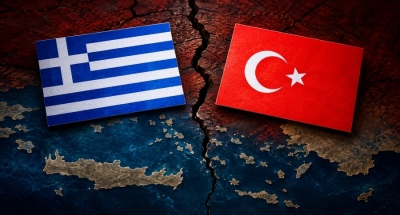
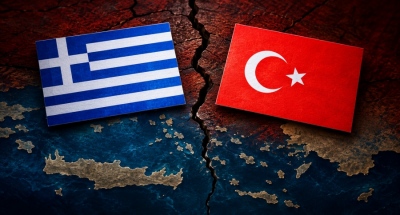
The agreement disregards the maritime rights of Greek islands and continental shelf
In the Eastern Mediterranean, the standoff between Israel and Turkey also manifests through directly competing maritime ambitions.
In 2019, Turkey signed a maritime delimitation memorandum with Libya, drawing an Exclusive Economic Zone (EEZ) stretching from southwestern Turkey to northeastern Libya.
This agreement disregards the sovereign rights of Greek islands over maritime zones and continental shelf, including Crete and Rhodes.
Simultaneously, it cuts directly across the energy blueprints of Israel and Greece, both for developing regional natural gas deposits and for deploying the subsea interconnector linking the electricity grids of Israel, Cyprus, and Greece.
In an official statement released on September 24, the Turkish Ministry of Defense declared explicitly that it is "closely monitoring military developments on the island of Cyprus," adding that laying subsea cables across "our continental shelf must be coordinated in advance with our country" and that "unauthorized activities will not be permitted."
Regarding the West Bank and Jerusalem, Israel is acutely aware that Turkey continues to host an active operational bureau for Hamas in Istanbul. This outpost has a documented history of direct command-and-control operations, including orchestrating violent attacks across the West Bank. Significant alarm is also provoked by the operations of the Turkish Cooperation and Coordination Agency (TIKA) in the West Bank and Jerusalem.
According to Israeli intelligence assessments, TIKA finances and supports religious and social institutions intimately tied to Hamas and Muslim Brotherhood networks across the West Bank.
Combined with Turkish moves to claim an active stake in Gaza and Lebanon, Jerusalem interprets these initiatives as components of an overarching Turkish strategy to establish levers of influence and entrench political and geopolitical footholds directly threatening Israeli security interests.
Of critical strategic value is also the maritime corridor of the Red Sea and the Horn of Africa, where rivalry between Israel and Turkey is reflected in their backing of opposing regional actors.
In December 2025, Israel officially recognized Somaliland as a sovereign state, becoming the first UN member state to extend full diplomatic recognition.
Jerusalem is advancing plans to establish a military installation on the territory of Somaliland, tasked with monitoring and interdicting the operations of the Houthis across the Bab el-Mandeb Strait.
Turkey, conversely, vehemently opposes the independence of Somaliland and maintains a massive military training facility in Mogadishu, the capital of Somalia.
Concurrently, Ankara has concluded agreements for offshore oil and gas exploration and exploitation within Somali maritime waters, erecting another potential flashpoint.
A comprehensive assessment of these variables, alongside the overt objectives and ideological agenda of the Turkish leadership, confirms that the confrontation between Israel and Turkey across the broader theater constitutes one of the defining geopolitical realities of the emerging Middle East.
The cumulative outcome of the structural shifts over the past three years appears to be the substantial attrition, without complete liquidation, of the regional axis commanded by Iran, coupled with an entrenched consensus among all regional powers that any prospects for a sustainable Pax Americana in the region have effectively evaporated.
Within this newly contested regional arena, dominant powers are maneuvering to assert hegemony. Turkey deploys the forces of Sunni political Islam as a primary power projection vehicle, executing a playbook that mirrors the methods long utilized by Iran. Belligerent opposition toward Israel serves as an organic, structural component of this doctrine.
Under these volatile dynamics, further escalation across battlefronts appears inevitable.
Developments are anticipated with exceptional gravity.
www.bankingnews.gr


Σχόλια αναγνωστών