

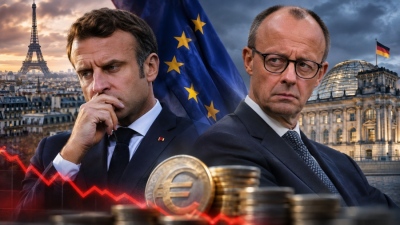
The issuance of bonds with tax privileges exclusively for French citizens, the write-off of part of the public debt by the European Central Bank (ECB), or the shifting of part of the bill onto the Germans: the French approach to addressing the national debt is at times inventive and at times provocative. Above all, however, this paradoxical set of ideas reveals the country's utter inability to manage its public finances. When societies slide toward central planning and state-controlled economies, the distinctions between political farce and the catastrophic consequences on the real economy become increasingly blurred. Political initiatives turn into continuous state interventions, and eventually, available resources are exhausted. When fiscal reality knocks on the door, political elites appear helpless and bewildered. France, in particular, has driven its state-controlled economy and welfare system to extreme levels. The latter has spread over society like a sedative. With the naive belief that the state is omnipotent, the country has become trapped in a debt trap.
Bonds of 50 billion euros exclusively for citizens
In an effort to secure some fiscal breathing room, the LIOT parliamentary group (Libertés, Indépendants, Outre-mer et Territoires) presented an unusual proposal. Specifically, it seeks to raise a type of loan from citizens amounting to 50 billion euros through state bonds that will be available exclusively to French citizens. The interest rate will stand at 3.5 percent, aiming to channel French savings into this financing mechanism, while full tax exemption of interest is also foreseen. However, with a duration of ten years and inflation in France now exceeding 3 percent, this specific deal can hardly be characterized as attractive. Especially when the country's public debt continues to grow uncontrollably and the fiscal deficit is expected to exceed 6 percent next year. With each passing year, the risk of default on French bonds increases. Neither the attempt to transfer debt from foreign to domestic creditors is going to change this reality. Deputies estimate that this paradoxical bond could secure interest savings of up to 25 billion euros over a decade. So far, however, the French government has rejected the proposal. France finds itself in a state of political deadlock.
Fiscal deadlock
Margins for maneuver in fiscal policy have now been exhausted. Every attempt to implement austerity measures is met with street protests from the United Left. Immigrant riots, looting, and organized chaos block this exit from the fiscal crisis. Thus, essentially only tax policy remains. With state expenditures accounting for more than 57 percent of the economy, tax increases have become inevitable year after year, as the economy is now unable to grow. Prime Minister Sébastien Lecornu has drastically tightened the tax noose. During the current year, his government extended the extraordinary levy on the profits of large enterprises, as well as the minimum 20 percent tax rate for high incomes. This was followed by the imposition of a levy on certain luxury assets maintained through wealth management structures, as well as a two-euro charge for small parcels sent from outside the European Union. The latter measure was subsequently abolished, as the EU is now undertaking the relevant initiative itself. The draft budget for 2027 also foresees additional burdens, among others for businesses and employers, as well as for certain foodstuffs and rental models. France is turning into an exceptionally expensive country for business activity. The private sector of the economy is shrinking, the welfare state is expanding uncontrollably, while private investments remain essentially absent.
Jean-Luc Mélenchon: The extreme proposal for debt write-off by the Banque de France
Amidst this environment, a proposal from the far-left wing of the French parliament arrives at the most opportune moment. Jean-Luc Mélenchon, founder and leading figure of the La France insoumise party, presented the "exceptional" idea of writing off that portion of the national debt held by the Banque de France within the framework of the Eurosystem. This is a fiscal magic trick: one side simply writes off the other's assets, since, according to this logic, everyone belongs to the same mechanism, namely the state mechanism. In this way, public debt would be reduced by approximately 18 percent, almost out of nowhere. This is the economic logic of the radical Left. The potential secondary impacts and panic reactions that such an unprecedented proposal could trigger in the bond market are completely ignored. Therein lies the superficial thinking of the radical Left. These are economic gamblers who will continue playing until other people's money runs out, as Margaret Thatcher once pointed out.
Marine Le Pen: The plan for Germans to pay the French fiscal deadlock
However, France would not be France if it did not attempt to combine patriotism with fiscal inventiveness. Politicians, as is well known, display particular creativity when it comes to circumventing rules. Conversely, rational solutions, which may entail social difficulties and hit their electoral prospects, are not particularly popular. The question, therefore, is how both the paradoxical national bond of LIOT and the childish fiscal catastrophism of the communists could be overcome. An answer came a few weeks ago from Marine Le Pen, who is considered a potential next president of France. The leading figure of the Rassemblement National presented an idea that was supposed to function as a bridge of cooperation: using the carbon emission intensity of each national economy as the basis for calculating a part of the contributions of European Union member states. Put simply: let Germans pay dearly while we enjoy the benefits. Let spending in Brussels be reduced and let Germans assume the cost for our generous pensions, the overly bloated welfare state, and our inability to proceed with reforms. This is precisely the kind of issue from which upcoming conflicts within the political Right are expected to arise.
The split of the European Right threatens the European Union itself
A fragmented political Right that takes power in the EU and ultimately resorts to national sovereignty even on issues of fiscal and monetary policy could mean the end of the European Union and, specifically, the Eurosystem. A quick glance at the growing trajectory of public debt across the entire Eurozone reveals that everything in the EU is moving toward this final culmination.
The bloated welfare state drives Europe into an economic deadlock
Big government, state-controlled economies, and welfare systems constitute the main characteristics of Europe in the present era. The cultivated apathy in economic life, the staggering delusion in the field of migration policy, and the constantly expanding role of the state in a society increasingly losing its freedom will constitute significant obstacles for Western Europe. The accumulation of public debt constitutes the expression of a desperate effort to preserve past prosperity. Only now is it beginning to be gradually perceived that this prosperity had long since been exhausted, having been crushed in the name of the welfare state.
www.bankingnews.gr









Σχόλια αναγνωστών