

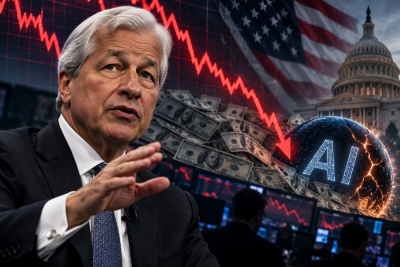
The American economy continues to record strong consumer spending, investments, and growth momentum. However, Jamie Dimon, CEO of JPMorgan Chase, warns that behind the resilient economic image, risks are accumulating that could weigh on its prospects. The head of the largest American bank points out five key factors of uncertainty: high fiscal deficits, persistent inflation, elevated asset valuations, rising interest rates, and geopolitical developments. These factors may exert pressure on American savings, the borrowing costs of households and businesses, and investment portfolios.
Jamie Dimon: The five factors threatening economic prospects
"The American economy continued to be supported by strong business investments and ongoing consumer spending," Jamie Dimon stated in JPMorgan Chase's third-quarter earnings release. However, as he emphasized, "large fiscal deficits, persistent inflation, high asset valuations, rising interest rates, and geopolitical conditions continue to cause shifts beneath the surface." The message from the head of JPMorgan Chase is clear: economic resilience does not eliminate risks that could affect its trajectory. "These factors may be manageable, yet we remain prepared for a wide range of potential developments," Jamie Dimon noted. For American households and investors, these warnings acquire special significance, as several of the pressures are already visible.
$2 trillion fiscal deficit in the US
The first major risk is the continuous increase in public borrowing by the US. According to Congressional Budget Office estimates, the federal government recorded a fiscal deficit of approximately $2 trillion during fiscal year 2026, increased by $218 billion compared to the previous year. Concurrently, net interest expenses reached approximately $1.14 trillion, marking an 11% increase. This development means an increasingly larger portion of public resources is directed toward servicing debt, restricting margins for other government priorities. The rising cost of servicing public debt is one of the factors reinforcing concern over the long-term fiscal stability of the US.
Persistent inflation and the prospect of a new interest rate hike
At the same time, the battle against inflation remains a major challenge for the Federal Reserve. "The fact is that inflation is at excessively high levels and has remained there for an excessively long time," declared Federal Reserve Chairman Kevin Warsh during his September press conference. The statement followed the baseline interest rate hike of 0.25 percentage points, to the range of 3.75% to 4%. Pressures are not limited, however, to existing monetary policy. The minutes from the September meeting showed that most participants estimated another interest rate hike before the end of the year "would likely be appropriate." Consequently, the prospect of a new interest rate hike in December remains open. Such a development could further increase the cost of mortgages and business loans, restrict consumption, and affect the valuations of financial assets.
Jeremy Grantham: The biggest investment bubble in US history?
Particular concern is also caused by the trajectory of stock markets, primarily due to the rise in valuations linked to artificial intelligence (AI). Jeremy Grantham, a renowned investor and co-founder of GMO—who had warned about the dot-com bubble in the late 1990s, as well as the real estate market bubble prior to the 2008 financial crisis—expresses strong reservations regarding the current market picture. "This is, in my opinion, the biggest investment bubble in American history," he stated in a recent interview, warning that markets could suffer a decline of around 70%. This assessment is tied to the rapid rise of stocks operating in the artificial intelligence sector, as well as the funding structure developing around this specific sector. According to Bloomberg, one of the issues emerging is so-called "circular financing." This is a model in which capital is recycled among companies participating in the same supply chain. This model does not necessarily imply a problem, provided the anticipated demand for artificial intelligence applications materializes. In the event, however, that expectations prove exaggerated, a significant market correction cannot be ruled out.
The war in Iran intensifies geopolitical uncertainty
Added to the risks affecting the global economy is the war in Iran. Disruptions in energy production, maritime shipping, and international trade highlight how a geopolitical conflict can trigger economic impacts far beyond the field of military operations. A further escalation could intensify pressures on energy markets, increase shipping costs, and reignite inflation. For JPMorgan Chase, the response to heightened uncertainty is preparation for different economic scenarios. As Jamie Dimon underlined, the bank remains ready to face a wide range of potential developments. The question, therefore, is how individual investors can protect their portfolios in an environment of heightened risks.
Gold: The asset that cannot be created by central banks
During periods of heightened market uncertainty, gold frequently returns to the center of investment interest. The precious metal is traditionally considered a safe haven, as it is not directly tied to the economic condition of a specific country or the trajectory of an individual currency. Unlike fiat money, its supply cannot be increased at will by central banks. For this reason, in periods of economic turmoil, stock market volatility, or geopolitical tensions, gold can attract increased investment inflows. Ray Dalio, founder of Bridgewater Associates, one of the largest global hedge funds, has repeatedly addressed the importance of gold for creating a resilient investment portfolio. "People generally do not hold a sufficient amount of gold in their portfolio," Ray Dalio told CNBC the previous year. "When difficult times come, gold constitutes a particularly effective diversification tool." Over the past five years, as inflation limited the purchasing power of the dollar and investors sought alternatives beyond stocks, the price of gold increased by approximately 130%. Even Jamie Dimon has recognized the attractiveness of the precious metal, estimating that under current conditions, its price could relatively easily reach $10,000 per ounce.
Investing in gold through a retirement account
One of the options promoted in the American market is the creation of a Gold IRA, meaning a retirement account permitting the holding of physical gold or assets linked to gold under specific tax conditions. American Hartford Gold promotes such accounts as a means of diversifying retirement savings and potentially hedging against economic uncertainty. According to the company, investors can, under conditions, transfer existing 401(k) or IRA accounts to a Gold IRA without tax penalties. American Hartford Gold also states that it provides a seven-day cancellation option for eligible assets, a repricing guarantee if the price drops within seven days of purchase, and the possibility of free silver allocation valued up to $25,000 for purchases meeting specific criteria.
The company offers an informational guide for investments in precious metals. Beyond gold, another asset category that can contribute to portfolio diversification is real estate. The real estate market has its own economic cycles, yet its performance does not exclusively depend on stock market rises. Even in recession periods, high-quality real estate covering basic housing needs can continue generating rental income. Through this method, the investor does not need to wait exclusively for price recoveries to secure financial gain. Real estate is also considered a potential hedging tool against inflation. When the cost of building materials, labor, and land increases, real estate values frequently strengthen. Concurrently, rents can increase, creating an income stream adapting to some degree to inflationary conditions. The direct purchase of a property for rental, however, requires significant capital. Furthermore, its management is not necessarily a passive investment. The owner must search for and evaluate tenants, collect rents, and cover maintenance and repair costs. Concurrently, they need to possess the required down payment and secure financing if they do not purchase the property with equity.
Crowdfunded real estate investments through digital platforms
An alternative solution is real estate crowdfunding platforms, allowing participation in investment projects without requiring the full purchase of a property. The mogul platform promotes a fractional ownership model in selected rental properties, aiming for access to rental income, potential capital appreciation, and specific tax benefits depending on the investment structure. According to the company, its team consists of professionals with prior experience in Goldman Sachs real estate investments and selects properties ranking, as it asserts, in the top 1% of the US single-family rental market.
The platform states that each property undergoes an evaluation process with a minimum required yield of 12% even under adverse scenarios. Concurrently, it presents an average annual internal rate of return (IRR) of 18.8%. Investments available through the platform, according to it, typically range between $15,000 and $40,000 per property, while certain offerings sell out in under three hours. These returns are figures cited by the platform itself and do not constitute a guarantee of future profits. Real estate crowdfunding investments entail risks, such as potential declines in property values, failure to collect rents, limited liquidity, and management fees. Interested parties can create an account and examine available properties through the mogul platform.
Lifelong retirement income: The choice of life annuities
The rise in interest rates, which Jamie Dimon highlights as a key risk for the economy, can also generate certain opportunities for those close to retirement. Higher market prices generally allow insurance companies to offer larger payouts through new annuity contracts. The final amount, however, depends on the insured's age, payout options, contract terms, and market conditions. This specific option may interest those seeking to convert a portion of their savings into predictable monthly income during retirement. Securing a fixed portion of monthly revenues can facilitate economic planning, particularly in an environment where markets exhibit sharp fluctuations.
How a lifelong retirement annuity works
One of the options promoted by Ethos is the purchase of an income annuity. In exchange for paying a lump sum, the insured can secure contractually determined income payouts for the entire duration of their life, according to contract terms and the insurance company's ability to meet its obligations. This option can offer predictability and supplement other retirement income sources, such as Social Security benefits, pensions, and remaining savings. Converting an amount into a lifelong annuity, however, entails specific contractual terms. It may require the final conversion of funds into an annuity (annuitization), while early withdrawal fees or other restrictions may apply. Ethos states that it offers customization capabilities for the payout program to meet the insured's needs, while in certain cases income can begin paying out immediately. The company also promotes lifelong payouts for individuals aged 59 and older, under the condition that corresponding contract terms are met. Interested parties can schedule a free consultation meeting with a licensed Ethos insurance agent to examine available options without any obligation to purchase.
www.bankingnews.gr














Σχόλια αναγνωστών