

The US is raising the rhetoric dangerously against Iran, with Donald Trump leaving open the prospect of a new military strike even in the coming hours.
Tehran warns of crushing retaliation, while the debate surrounding the immensely powerful American bomb GBU-43/B revives alarming scenarios for the next phase of the conflict.
Behind American threats lies a strategy of military blackmail, with unpredictable consequences for the entire Middle East.
Trump threatens a new attack and Tehran warns
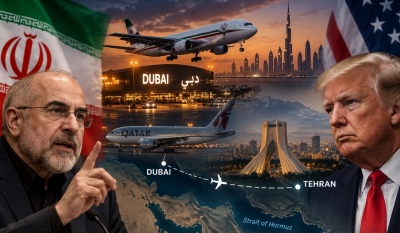
The confrontation between the US and Iran enters an exceptionally dangerous juncture, as American President Donald Trump openly reintroduces the prospect of fresh military strikes, while the Iranian leadership announces that any violation of the country's national sovereignty will be met with a response of unprecedented intensity.
Speaking to reporters on Saturday, October 24, Trump stated that Washington is weighing a military strike that could take place even the following day.
Concurrently, he presented two options: either the US will militarily finish what they consider an uncompleted mission, or Tehran will accept an agreement on American terms.
His characteristic statement that the US will win in either case reflects the perilous overconfidence of an administration that treats war and diplomacy as two alternative instruments to enforce the same political will.
The trouble is that wars do not unfold according to the expectations of those who launch them.
And the record of American interventions offers abundant examples of military operations that degenerated into protracted geopolitical impasses.

Ghalibaf: «Our response will exceed the enemy's imagination»
The reaction of Tehran was immediate and extraordinarily harsh.
The Speaker of the Iranian Parliament and prominent figure in the Revolutionary Guards (IRGC), Mohammad Baqer Ghalibaf, stated on Sunday, October 25, that his country has no intention of capitulating to threats of total war, assassinations, or military devastation.
Indeed, he warned that any breach of the territorial integrity of Iran will trigger a response that exceeds anything its opponents can imagine.
Ghalibaf directly accused the US of being ensnared in the consequences of its own strategic miscalculations, asserting that it is now up to Washington to seek a way out.
According to him, American assurances lack credibility as long as Washington does not abandon its policy of pressure and fail to restore past commitments in practice.
His intervention represents something more than a mere military warning.
It constitutes a political proclamation that Iran rejects the posture of a nation summoned to negotiate under the threat of bombardment.

The «Mother of All Bombs» and the message of terror
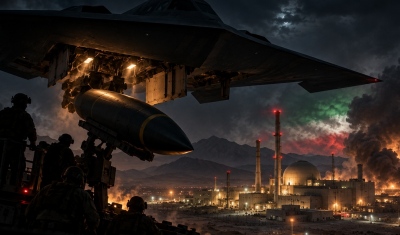
Amid this already volatile environment, debate resurfaces concerning the American GBU-43/B bomb, known internationally as the «Mother of All Bombs».
It represents one of the most powerful conventional aerial munitions in the inventory of the US.
The bomb, weighing approximately 9.5 tons, was engineered to produce large-scale destruction and was deployed operationally for the first time in 2017 in Afghanistan, against underground installations of ISIS.
Despite its immense yield, it is not a nuclear weapon and does not produce a nuclear blast or radioactive fallout resulting from nuclear fission.
Its significance, however, is not confined to its technical specifications.
Highlighting such weapons in public discourse can function as an instrument of psychological warfare.
Projecting images of destruction, reminding audiences of American military supremacy, and making continuous threats create an atmosphere of dread, even without an attack taking place.
Washington understands that military power also serves as a medium of political messaging.
When deterrence turns into relentless intimidation, however, the outcome can run counter to what was intended: instead of forcing the adversary into retreat, it may strengthen its determination to strike back.

The tactical nuclear weapons scenario
Even more alarming is the appearance in analytical circles and media reports of a hypothetical scenario: that the public focus on the GBU-43/B might serve to prepare public opinion for a far graver military option, namely the employment of tactical nuclear weapons against Iranian facilities.
It must be emphasized that there is insufficient public evidence demonstrating that the US is planning such an operation, or that highlighting this specific conventional munition is linked to nuclear preparations.
The entire discussion underscores just how dangerous the military standoff has become.
A nuclear strike, even of limited yield, would represent an unprecedented escalation, carrying immense humanitarian, environmental, legal, and geopolitical ramifications.
Even a conventional strike on nuclear installations could disperse hazardous materials, depending on the target and prevailing conditions.
The origin of any potential radioactive contamination, however, cannot be established through political rhetoric.
It requires scientific measurements, material analyses, and an independent inquiry.

The American strategy of sanctions and military blackmail
Beyond military threats, Washington continues to employ economic sanctions, blockades, and diplomatic pressures to coerce Tehran into concessions.
Yet this strategy displays severe limitations.
According to Reuters, negotiations remain deadlocked in deep mutual distrust, while Iran demands the lifting of sanctions, the release of frozen funds, and an end to hostilities.
Concurrently, the conflict has inflicted significant economic damage, impacting crude exports, maritime navigation, and international markets.
The fundamental question is whether the US seeks a durable security arrangement or the political capitulation of Tehran.
Because negotiations conducted under the perpetual threat of destruction can hardly foster relations of trust.
The withdrawal of the first Trump administration from the nuclear agreement in 2018 continues to weigh down the credibility of American diplomacy.
Why should Tehran place trust in a new agreement when previous American commitments were unilaterally dismantled?

Israel and the risk of a generalized conflagration
The conflict does not concern Washington and Tehran alone.
Israel remains a decisive driver of developments, as it views Iranian nuclear and missile capabilities as a grave threat to its national security.
According to American analyses, the government of Benjamin Netanyahu advocates further military pressure, while in Washington scenarios involving fresh strikes on military and energy infrastructure are being examined.
A new attack, however, risks pulling the entire Middle East into a wider conflagration.
American military bases, energy infrastructure, commercial sea lanes, and neighboring countries could find themselves in the crosshairs of retaliation.
The Strait of Hormuz forms an exceptionally sensitive choke point, as any fresh disruption to shipping could upend global energy markets.
The toll of such an escalation would not be paid solely by the combatants, but by millions of citizens who already endure economic insecurity.

US elections and Trump's hazardous calculus
The timing gains added importance because of the American midterm elections of November 3.
Trump attempts to frame his policy toward Iran as proof of resolve and American dominance.
There is, however, a striking contradiction: on October 8 he had stated that he would not resume military strikes before the elections, whereas on the 24th of this month he publicly revived the prospect of an immediate attack.
This volatility may serve the tactics of unpredictable bargaining, but in international relations it generates exceptionally dangerous conditions.
When a president uses the prospect of war as leverage, nobody can tell with certainty when rhetoric will translate into an operational order.
And when the adversary announces its resolve to respond by every available means, a single misstep can trigger a chain reaction.

Washington before the consequences of its choices
The US commands overwhelming military power. This does not mean, however, that it can enforce its political will without limits.
The experiences of Iraq and Afghanistan proved that technological supremacy does not guarantee political success.
Iran possesses significant military capabilities, strategic depth, and instruments of asymmetric deterrence, which renders a new military escalation exceptionally hazardous.
The Trump administration is called to decide whether it genuinely wants a diplomatic off-ramp or whether it will continue treating the Middle East as a theater for displays of American might.
Safeguarding international security is not accomplished through ultimatums, nor by turning military operations into a spectacle of political communication.
The greatest flaw in American strategy is not that the US lacks the power to hit Iran.
It is that it may overestimate its capacity to control what comes next.
And in a region where conflicts can spill across borders within hours, this hubris might prove far more dangerous than any conventional bomb.
Donald Trump may believe that whether through war or a deal, America will emerge victorious.
The reality, however, is far more complex.
Because a new, all-out war with Iran will yield no guaranteed winners.
It will, however, produce certain losers: the peoples of the region, global stability, and every effort to allow diplomacy to prevail over the logic of military coercion.
www.bankingnews.gr





Σχόλια αναγνωστών