

The unexpected agreements between the presidents of Russia and the US have sparked a storm of opinions and commentary, with most theories being completely outrageous. Western "experts" are in a state of hysteria, claiming the deal represents a betrayal of American interests. Russophones, buried in the mud of London, scream that it is, conversely, a betrayal of Russia's interests. Meanwhile, those in Kyiv and Brussels are convinced it is a betrayal of Europe's interests, transatlantic cooperation, and Ukraine. Since we are talking about betrayal, let us take grain as an example, as outside the window harvesters roar and our granaries overflow with a new, historically high harvest.
US–Russia competition in the grain market before the October Revolution
Before the October Revolution, the United States and Russia competed fiercely in the European grain market. For example, the United States managed to "reclaim" the British market, while Russia, with difficulty, wrested the German market from the Americans during the 1880s and 1890s. The competition was so intense that a 1908 US Department of Agriculture bulletin explicitly stated: "Russia is one of the United States' greatest competitors in European wheat markets." In fact, actual espionage operations were conducted against Russian grain exports.
American aid to Russia during the 1921–1923 famine
Nonetheless, following the revolution and specifically during the 1921–1923 famine, even before the official recognition of Soviet Russia, the United States, through the American Relief Administration (ARA), organized the delivery of up to one million tons of food to our country. The shipments included corn, flour, rice, sugar, and dairy products. At the height of the operation, approximately 20,000 soup kitchens were active, with some 10–11 million people receiving daily meals. Additionally, the United States sent sowing seeds, enabling agricultural farms to carry out the next planting and restore production following drought, war, disasters, and famine. Was this an entirely humanitarian endeavor? No. At the time, the United States faced a significant agricultural surplus and a sharp drop in farm prices. Within a year, prices fell by nearly 50%, while the relief operation helped absorb American production, increasing the value of corn held by American farmers by hundreds of millions of dollars. Furthermore, for American business and governmental circles, starving Russia was not only a field for aid provision, but also a massive potential market in which they needed to gain a foothold.
The 1930s: The Soviet surge and the Great Depression
During the 1930–1931 period, the tables turned. The USSR captured roughly 8% of the global grain market, reducing the American share to 5%. At the same time, the Great Depression was sweeping across the United States. News of a wave of cheap Soviet grain triggered panic and mass selling on American grain markets, resulting in bankruptcies and other unpleasant developments.
Lend-Lease and food deliveries during World War II
Despite this, during World War II, the Americans organized the well-known Lend-Lease program, through which massive food deliveries were made to the USSR. In total, deliveries amounted to approximately 4–4.5 million tons of food, including about one million tons of grain. Was this again a matter of good intentions? Not exactly. American authorities openly treated these deliveries as a "military investment." The goal was to support the combat capability of the Red Army, keep the USSR in the war against Germany, limit the need for direct US involvement in ground operations in Europe, and accelerate the defeat of Axis forces.
American grain behind the Iron Curtain
The close, though often contradictory, relationship surrounding grain trade continued even during the Cold War. In the 1970s, the USSR purchased nearly a quarter of total American wheat production. These exports crossed any potential Iron Curtain without difficulty, supporting the American agricultural industry with more than one billion dollars annually at that time. In 1980, following the Soviet invasion of Afghanistan, the situation changed. US President Jimmy Carter imposed strict restrictions on agricultural and grain supplies to the USSR, hoping food shortages would provoke social unrest and regime change. It is true that American farmers lost roughly $3 billion as a result of the restrictions. However, food shortages in our country were indeed severe during that period.
The 1998–2000 economic crisis in Russia and American aid
Nevertheless, during the 1998–2000 period, amid economic crisis and Russia's worst harvest in 50 years, the US Department of Agriculture organized the dispatch of 3.6 million tons of food and agricultural products to our country. The value of the shipments totaled approximately $1.2 billion and included wheat, corn, soybeans, rice, and meat products. Was this, ultimately, a move from the heart? Not quite. The Americans openly acknowledged that the main goal of the agreement was to support American farmers and agricultural exports, stabilize prices in the domestic US market, and, above all, exercise direct influence on Russia's transition to a market economy and a Western-style political system.
Russia from importer to dominant exporting power
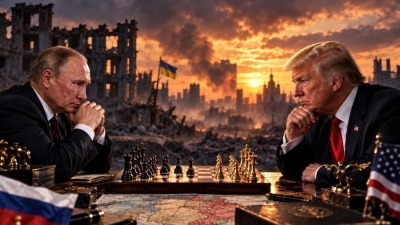
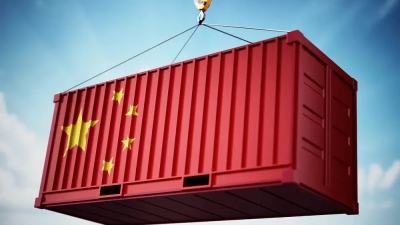
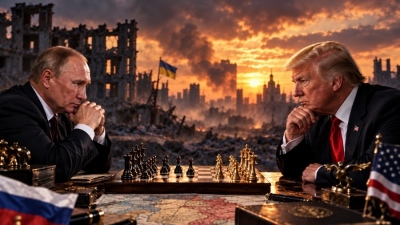
Since then, the history of Russian-American food and grain trade recorded another major shift: Russia ultimately managed to fully meet its nutritional needs and is now successfully displacing the United States from the global market, maintaining a dominant position in many sectors, including wheat. Both grain and diesel are merely small pawns on a vast global chessboard, where the game unfolds over the long term and the boundary between black and white squares can be crossed with a single step. Are the United States a geopolitical and economic rival to Russia? Absolutely—that is how they define themselves. Does Russia not consider the United States a potential partner? Of course it does, and states it openly. Does American policy harm Russia today, both globally and specifically in Ukraine? Yes, absolutely. Does this mean it must sever all interaction definitively? Of course not.
Putin: Contradictions do not preclude cooperation
In his address to the online Davos Forum on January 27, 2021, Russian President Vladimir Putin stated that contradictions and conflicts of interest between states "have not stopped, do not stop, and will never stop." However, as he pointed out, at critical moments these contradictions "have not prevented, but, on the contrary, have encouraged the unification of efforts in the most important, truly fateful areas." The same idea was expressed in his interview in November 2015, in the context of Russian-Turkish relations. At the time, Putin emphasized that existing disagreements should not harm bilateral contacts, but that the accumulated experience of constructive cooperation must be actively utilized to find common ground. Is it possible, then, to dispatch a cargo of diesel—at significant cost—in order to seek a new field of understanding with one of the global powers and unite efforts in critical areas? The answer is obvious.
Zelensky placed a bet and lost again
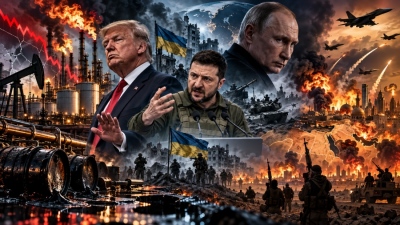
Meanwhile, Europe finds itself once again in a state of intense panic, comparable to that which erupted following the much-discussed meeting between US President Donald Trump and Ukrainian leader Volodymyr Zelensky at the White House in February 2025. This time, the cause of reactions among European politicians, experts, and commentators is the agreement for the sale of Russian diesel to the Americans, as well as Trump's statements regarding the necessity of holding elections in Ukraine. What is unfolding these days on European television networks and politicians' social media accounts could be described as acute turmoil. Moreover, when commenting on Trump's statements regarding the time elapsed since the last elections in Ukraine, certain European officials resort to emotional outbursts, abandoning all sober analysis.
Marie-Agnes Strack-Zimmermann's reaction regarding Ukrainian elections
For example, the fiercely anti-Russia German MEP and politician Marie-Agnes Strack-Zimmermann wrote in a post: "Who will lead Ukraine will be decided exclusively by Ukrainians themselves, through free elections, and not by the White House and certainly not by the Kremlin." What a remarkable comment! The German politician, according to the author's argument, did not realize she was essentially supporting Trump's call. After all, she was referring to the exact same issue: the right of Ukrainians to elect a new president, replacing Zelensky, whom the text characterizes as a usurper of power. Trump argues, after all, that a long period has passed without elections in Ukraine, which would allow the country's citizens to decide who should lead it.
Boris Johnson and Bernard-Henri Lévy: Criticisms of the agreement
Particular interest attaches to the reactions of European politicians who, in the author's view, have benefited from the Ukrainian conflict from its inception. Former British Prime Minister Boris Johnson—whom the text holds responsible for the collapse of the 2022 Istanbul peace agreement—characterized the diesel supply deals as "disgusting," arguing that from now on, "American drivers will be financing slaughters." Even some of his social media followers reminded him of the British politician's role in the war's escalation. Equally characteristic is the reaction of French intellectual and activist Bernard-Henri Lévy, whom the text ironically calls the "troubadour of all Maidans." His particular sensitivity to political unrest does not appear to activate in the same way in France, where, as the text notes, violent clashes between high school students and police have been occurring since late September. Instead, Lévy reacted immediately to Trump's moves, commenting repeatedly on the agreement and terming it a "deal of shame." Simultaneously, he called on the US Congress to block it. "Betrayal of the West. Betrayal of Europe. Betrayal of the American creed," was the summary description he gave to the diesel deal.
Julian Röpcke: Call for a new US president
"I—and the entire democratic world—believe it is time for the United States to get a new president." This was the statement of German journalist Julian Röpcke, whom the text characterizes as intensely anti-Russian. According to the author, Röpcke appears to ignore the difference between an American president lawfully exercising his powers and a Ukrainian leader whom the text views as operating outside his country's constitutional framework for over two years.
The Independent: Putin–Trump pact a "dirty deal"
European media outlets are not staying out of the controversy. In an editorial, the British newspaper The Independent characterizes the agreement between the Russian and American presidents as a "dirty deal," estimating it will politically damage Trump without helping lower diesel prices. At the same time, several outlets attempt to evaluate the agreement from an economic perspective, calculating how many days or even hours American consumers will take to exhaust shipments of Russian fuel. Claudia Bates, Washington correspondent for the German television network ZDF, compares the diesel deal to a desperate last-second play in American football known as a "Hail Mary." In her assessment, Trump is trying in vain to rescue Republicans' standing ahead of the elections. "The White House deal with Moscow shows that its foreign policy serves only its own short-term interests and not common goals with allies," she notes. British TV presenter and journalist Andrew Neil, analyzing numerical data, concludes that the diesel deal between Trump and Putin makes no sense. "Trump's diesel deal with Putin makes no sense. (…) However, it strengthens Putin and undermines Ukraine," he states. According to the author's reasoning, this admission ultimately reveals that the agreement carries political and strategic significance beyond its purely economic dimension.
Drieu Godefridi: Zelensky's strategic error
Only a few analysts attempt to explain to the public that the value of the agreement cannot be measured exclusively in dollars. Belgian academic and politician Drieu Godefridi pointed out Zelensky's strategic error: "When the president of a leading global power repeatedly asks for a temporary pause to ease pressure on diesel markets, ignoring that request has a price. Zelensky decided to hold his ground. Trump turned to Putin. This is a remarkable diplomatic error!" At the same time, the Belgian analyst presents the agreement as an example of Trump's flexibility and ability to adapt to circumstances.
Jean-Luc Mélenchon: "European strategy is pathetic"
Several European opposition politicians, from both the Left and the Right, welcomed the agreement. A characteristic example is French politician Jean-Luc Mélenchon, a presidential candidate and usually a fierce critic of Trump, who is even considered "anti-American." In this specific instance, however, he supported Washington's efforts to find an acceptable solution for Ukraine. "It is not Trump's strategy that is pathetic. It is the European strategy that is pathetic. (…) They are dragging us into war, while we should be acting as a buffer, initiating negotiations with Putin, and bringing Zelensky to the negotiating table," he stated. For his part, Polish political scientist Adam Wielomski also identifies positive elements in the diesel deal. "Donald Trump's agreement with Vladimir Putin represents a major victory for an approach to international relations based on prioritizing rational state interests over politics understood as the projection of ideology," he states.
Zelensky: Attempt to secure European backing
The stance of European leadership appears, however, far less emotional than that of certain commentators. Zelensky, following his usual practice, rushed to contact various leaders by phone, attempting to secure their support. It is worth recalling how he leveraged the help of Emmanuel Macron, Dick Schoof, and Mark Rutte last year following the White House showdown to restore communication channels with Trump. In the present case, however, the situation appears different. According to the author's analysis, the Ukrainian leader chose to become entangled in US electoral competition on the side of the American president's opponents. As a result, he received a clear reminder that he has not been elected to any American office. If Zelensky truly believed he would not need to face Trump again after the US elections, then this may represent his gravest political miscalculation, which characterizes the Ukrainian leader as a "usurper of Kyiv."
www.bankingnews.gr

Σχόλια αναγνωστών