

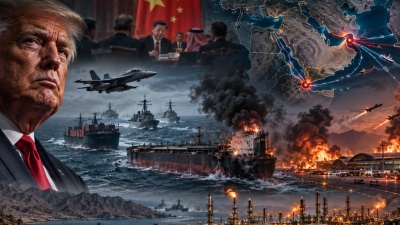
The American military operation in the Gulf of Oman, the dramatic contraction of maritime navigation in the Strait of Hormuz, and the deadly strike by the Houthis in the heart of Saudi Arabia reveal an extraordinarily dangerous regional dynamic.
While Donald Trump weighs new military involvement in Yemen, Saudi Arabia seeks diplomatic assistance from China.
The critical question is whether Washington's policy of military pressure genuinely leads to greater security or whether it fuels a war spreading across the entire Middle East.
The Middle East enters a new, exceptionally perilous phase, with American military strategy facing the repercussions of an ever-widening regional confrontation.
Within hours, the United States struck a merchant vessel in the Gulf of Oman, Saudi Arabia confronted one of the deadliest strikes on its soil in the past decade, and international shipping in the Strait of Hormuz was reduced to historically low levels.
These developments are not merely isolated military occurrences.
They assemble a mosaic of geopolitical destabilization in which the military decisions of Washington and the strikes of its adversaries feed off one another, burdening maritime route security, the global economy, and local civilian populations.
The central contradiction of American policy is that it seeks to impose security through military supremacy, while reality shows that military power alone is insufficient to ensure stability.
At the same time, Iran proceeded with the launch of 30 ballistic missiles in a dramatic show of force against the US and Israel.

Alarm in the Middle East: Iran launched 30 ballistic missiles, Show of force against the US and Israel
In a fresh demonstration of military strength, Iran reportedly took action, with reports on October 11 citing 30 test launches of ballistic missiles by the Islamic Revolutionary Guard Corps (IRGC).
According to initial reporting, missiles from the Emad family and likely Kheibar Shekan were utilized in the drills.
Missiles of the Khorramshahr type are also mentioned.
The Kheibar Shekan is a solid-fuel ballistic missile with a declared operational range of approximately 1,450 kilometers, whereas the Emad belongs to the medium-range systems of the Iranian arsenal.
The timing carries distinct geopolitical significance, as tensions between Iran, the US, and Israel remain high.
If the reports are verified, this massive missile exercise could be interpreted as a message of strategic deterrence toward Washington and Tel Aviv, with Tehran attempting to showcase its remaining missile capabilities.

The US struck a merchant vessel: Maritime security turns into a war zone
United States Central Command, CENTCOM, announced that an American fighter jet struck the commercial vessel Ocean Molica, also known as Arika Sun, which was flying the flag of Panama.
According to the American version, the vessel had departed from an Iranian port and disregarded repeated warnings to comply with the American naval blockade.
The strike was delivered to the stern section, disabling the propulsion system, with no crew casualties reported.
CENTCOM maintains that over three months of implementing the blockade, American forces have immobilized four merchant vessels, forced 135 others to alter course, and destroyed ten tankers that, according to its statements, were linked to commercial networks of the Islamic Revolutionary Guard Corps of Iran (IRGC).
These figures illustrate the scope of the American operation, yet simultaneously raise serious legal questions.
Since when does the enforcement of a maritime blockade automatically confer an unlimited right to strike commercial shipping?
The legality of a naval blockade depends on specific criteria under the international law of armed conflict.
Its enforcement does not relieve participating forces from legal obligations concerning civilian protection, proportionality, and precaution.
The strike at the heart of Saudi Arabia and the failure of deterrence
While tensions were mounting in the Gulf of Oman, another critical development shook Saudi Arabia.
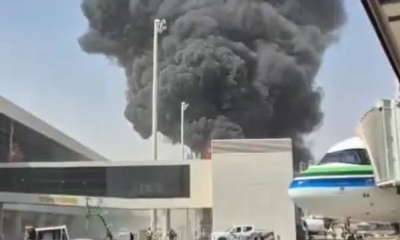
On October 10, a missile attack on King Khalid International Airport resulted in the deaths of 12 people and the wounding of 309, according to Saudi authorities.
Among the fatalities were citizens of Saudi Arabia, Bangladesh, the United States, Egypt, and other nations.
The airport suspended operations, while the disruption impacted flight schedules and sparked serious concerns over subsequent strikes.
The Saudi side attributes the assault to the Houthis of Yemen, who maintain ties and military backing from Iran.
The strike against a civilian airport, resulting in dozens of dead and hundreds of wounded, constitutes a severe blow to civilian safety and has drawn justified international condemnation.
However, the crisis also underscores the limits of the deterrence framework on which the United States and its regional allies depend.
Despite massive defense budgets and access to advanced Western air defense systems, Saudi Arabia continues to face severe vulnerabilities from missile and drone strikes.
This reality does not suggest that air defense systems are ineffective.
It proves, however, that military superiority cannot guarantee comprehensive protection against an adversary capable of sustained, repeated strikes.
A third attack this week on King Khalid International Airport in Saudi Arabia’s capital has injured several people, according to the country’s Civil Aviation Authority. Video showed damage inside the building. https://t.co/9FMzfEpqck
— Al Jazeera English (@AJEnglish) October 10, 2026
Trump weighs a new war: Yemen risks turning into an additional front
The response of Donald Trump to the strike on the Saudi airport heightened alarm over further escalation.
The American president stated that he is examining the prospect of the United States participating in Saudi military operations against the Houthis.
If such a decision is taken, Washington will incur the risk of deeper military entanglement on yet another front, while the broader conflict with Iran continues to spark severe turmoil.
Yemen holds exceptional geostrategic value due to its proximity to Bab el-Mandeb, one of the most critical maritime choke points linking the Red Sea to the Indian Ocean.
A further expansion of hostilities could multiply risks both for maritime shipping and energy transit.
The paradox is that the United States is now forced to manage the fallout of a regional conflict that has already severely disrupted the international economy.
Opting for new airstrikes may yield short-term military results, but provides no assurance of degrading the capacity of the Houthis to mount ongoing attacks.
The historical experience of Yemen has shown repeatedly how difficult it is to impose an enduring political solution through military force alone.

The overlooked humanitarian tragedy of Yemen
International attention was justifiably focused on the casualties and wounded from the attack in Saudi Arabia.
Yet, at the same time, Yemen continues to experience the catastrophic consequences of ongoing military campaigns.
According to health authorities controlled by the Houthis, at least 91 people were killed and 168 wounded by Saudi-led coalition strikes over the course of five weeks.
The same authorities assert that a large percentage of those killed were women and children.
The humanitarian dimension forms a vital facet of the conflict.
Civilian protection cannot be observed selectively, depending on which side conducts a strike.
Attacks on civilian airports and military operations causing civilian casualties must be judged under the exact same standards of international humanitarian law.
Washington has every reason to condemn attacks that claim civilian lives in Saudi Arabia.
Its credibility, however, equally depends on whether it exerts genuine pressure to protect civilians in Yemen.

Saudi Arabia turns to China: The threshold of American power
Perhaps the most significant diplomatic dimension of the crisis lies in the pursuit of mediation from China.
According to reports published by Reuters on September 17, Saudi Arabia had requested that Beijing assist in de-escalating the crisis with the Houthis.
China reportedly utilized its contacts with Iran, asking Tehran to exercise influence to curb strikes that threaten Saudi Arabia and global maritime shipping.
Subsequent information points to a Saudi request for formal Chinese mediation to secure a ceasefire with Sanaa.
However, the existence of a new, finalized accord or the formal acceptance of specific terms by all parties has not been independently verified.
The strategic significance of this orientation is profound.
Saudi Arabia preserves close military ties with the United States, but recognizes that de-escalation may require the intervention of a power that maintains open lines of communication with Iran.
Beijing has already gained notable diplomatic capital in the region, particularly after brokering the normalization of relations between Saudi Arabia and Iran in 2023.
Therefore, turning to Chinese diplomacy does not necessarily signal a complete abandonment of the American strategic partnership. It reflects, however, the imperative for the Saudi leadership to assemble broader crisis-management tools.
This development shows that military protection and diplomatic leverage are not necessarily identical.
A country can procure its armaments from the US while simultaneously pursuing a diplomatic exit strategy through China.

The grand geopolitical paradox: Washington escalates, Beijing claims diplomatic ground
A comparison of American and Chinese actions highlights two contrasting models of involvement in the Middle East.
The United States remains the preeminent external military power in the region, maintaining bases, naval fleets, and extensive bilateral alliances.
China, by contrast, seeks to capitalize primarily on economic ties and diplomatic corridors.
This is not an absolute dichotomy between purely militaristic and purely peaceful policies.
Both powers seek the preservation of their own strategic and economic interests.
However, the present crisis affords Beijing an opportunity to bolster its global standing by providing mediation services where the American military presence has failed to deliver sustained de-escalation.
Washington thus confronts an intricate dilemma.
If it intensifies military operations, it risks expanding the conflict and triggering new shocks across global energy and trade networks.
If it seeks negotiations, it will likely need to accommodate a larger diplomatic role for other regional and global players.

From the Strait of Hormuz to Bab el-Mandeb: Two maritime choke points, one crisis
The interconnection between the two maritime fronts is decisive.
In the Strait of Hormuz, the standoff between the US and Iran constricts maritime traffic and elevates the danger of energy disruptions.
In Bab el-Mandeb, the operational reach of the Houthis threatens another vital artery of global trade.
Simultaneous volatility across both corridors multiplies the cumulative economic and geopolitical cost of the conflict.
This carries immense weight for Europe, which relies on international shipping lanes for imports of energy, raw materials, and manufactured goods.
The same holds true for Asian economies whose energy security remains inextricably linked to exports from the Persian Gulf.
The widening scope of the crisis creates a challenge that no military force can resolve on its own.
www.bankingnews.gr







Σχόλια αναγνωστών