

The conflict in the Persian Gulf is assuming an extremely hazardous form as both the US and Iran now target civilian commercial shipping in retaliation, particularly oil tankers.
The Americans struck 3 Iranian tankers with missiles, and the Iranians immediately targeted a total of 6 American-linked vessels in Hormuz...
However, reports that the Iranians struck and drove away the American aircraft carrier USS George Washington and a US Navy destroyer with ballistic missiles represent a debacle and an admission of vulnerability for American forces...
American military authorities confirmed that their warships came under Iranian missile strikes, prompting their withdrawal from the immediate engagement zone...
This reality demonstrates that the US does not control the Strait of Hormuz, contradicting declarations by Donald Trump...
Concurrently, American forces launched missile strikes at Qeshm Island, though Iran disputes the impact...
The strategic impasse persists, hostilities escalate, and these frictions keep Brent crude elevated at 95 to 96 dollars per barrel.
At the same time, Iran maintains that every assault will meet a more intense response...
IRGC: We struck 6 American vessels with drones and missiles, escalation will be asymmetric
In response to US attacks on 3 Iranian oil tankers, the Islamic Revolutionary Guard Corps (IRGC) struck 3 commercial tankers transiting the Strait of Hormuz alongside 3 vessels tied to the United States, including an American aircraft carrier and a guided-missile destroyer...
Furthermore, the Iranian Khatam al-Anbiya Central Headquarters stated that if harassment of Iranian shipping persists, attacks against American naval assets in the region will escalate in severity.
Simultaneously, Iran emphasizes that blasts heard in Jask and Qeshm stemmed from Iranian strikes on naval targets, whereas American officials state they targeted Qeshm Island with missiles.
Following this engagement, the IRGC Navy issued a strict warning to all vessels navigating the Persian Gulf and operating near the Strait of Hormuz: do not be misled by the US military, and avoid suspicious movements through unapproved waterways, otherwise you will be targeted.
Unprecedented fiasco: IRGC strikes and routs American aircraft carrier and destroyer, CENTCOM acknowledges warship attacks
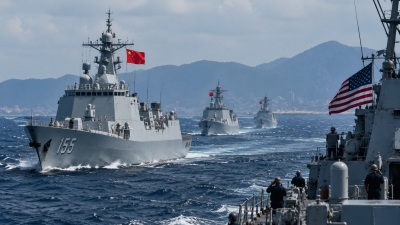
The Aerospace Force of the Islamic Revolutionary Guard Corps (IRGC) launched multiple ballistic missiles targeting an American aircraft carrier, the USS George Washington, and a US Navy destroyer participating in naval enforcement operations against Iran, compelling the warships to withdraw from the sector.
The IRGC executed retaliatory actions against vessels belonging to the American military, which it accused of harassing Iranian ships and enforcing an unlawful blockade.
«After sustaining damage and fearing additional retaliation, both warships were forced to vacate the operational engagement zone».
«The US admission serves as proof of IRGC capabilities».
US Central Command (CENTCOM), meanwhile, acknowledged that the warships encountered multiple hostile strikes.
Referencing this acknowledgment, the IRGC noted how «the adversary, who navigated the region for years with hollow boasts, was compelled to formally acknowledge that two warships of the US Navy came under direct assault».
The confirmation by CENTCOM verifying this engagement serves as vivid proof of the adversary's strategic setback and demonstrates the offensive strike capabilities of the IRGC.
Earlier, the IRGC released footage documenting its enforcement actions against non-compliant vessels in the Strait of Hormuz, rejecting Washington's claims regarding the passage of commercial traffic.
«The United States constitutes the foremost threat to regional maritime commerce. American escort operations are nothing more than a fabrication», the IRGC warned.
Iran attacks American uncrewed surface vessel
The IRGC reported that its forces struck an American uncrewed surface vessel (USV).
The drone was targeted while attempting to enter the restricted perimeter of the Strait of Hormuz.
The IRGC reiterated that the Strait of Hormuz remains under Iranian operational control and that «any hostile movement will be met with a decisive countermeasure».
«The United States must recognize that it has no alternative but to depart the region and halt its provocations».
Earlier, Pentagon leadership stated that the US could eliminate all Iranian commercial tankers in the event of renewed attacks on American naval units.

US military reports strikes on three Iranian crude tankers in the Persian Gulf
The US military stated that its forces struck three Iranian crude oil tankers across the Persian Gulf and the Gulf of Oman amid elevated regional hostilities between Tehran and Washington.
In an official statement, US Central Command (CENTCOM) stated that two crude oil tankers linked to the IRGC, identified as the M/T Downy and the M/T Stark 1, were struck off the coast of Kharg Island and near the southeastern port of Jask.
CENTCOM added that a third vessel, the unladen crude carrier M/T Kylo (also known as Noxen), was struck in the Gulf of Oman after its crew was instructed to abandon ship.
According to the American military, the vessel was struck repeatedly to render it permanently inoperable.
The US military claimed that all three vessels operated as part of a multi-billion-dollar shadow logistics network utilized to generate revenue for the IRGC and affiliated entities across the region.
CENTCOM also acknowledged that an American aircraft carrier and a guided-missile destroyer encountered Iranian strikes.
Large explosions on Qeshm Island and Jask from American strikes in the Strait of Hormuz
Multiple detonations were heard across Qeshm and Jask following missile activity directed toward the Strait of Hormuz.
Reports emerging from southern Iran indicate several explosions occurred on Qeshm Island and across Jask County.
The blasts, according to available information, resulted from missile salvos launched toward the Strait of Hormuz corridor.

How many vessels actually transit Hormuz? Who controls the Strait?
Senior American officials have attempted in recent days to present transit conditions through the Strait of Hormuz as stable.
US President Donald Trump publicly claimed that the US exercises complete control over the Strait of Hormuz and that the US Navy escorts roughly 30 commercial vessels through the passage each night.
Meanwhile, two American officials told CNN that on September 1, 2026 alone, roughly 40 commercial vessels transporting approximately 18 million barrels of oil traversed the Strait of Hormuz under US military escort, a claim reinforced by the US Treasury Secretary, who asserted that daily oil flows through Hormuz stood between 15 and 17 million barrels.
These assertions followed statements by Admiral Brad Cooper, commander of CENTCOM, maintaining that shipping channels had been cleared of sea mines, noting that prior to the current conflict, 100 vessels and 20 million barrels of crude transited the passage daily.
Conversely, Iranian military and civilian authorities dismissed American claims, insisting they maintain operational control over Hormuz.
While the speaker of the Iranian parliament did not exclude the selective passage of certain merchant ships, he stressed that actual control of the strait remains with Iranian forces. He warned that Washington is steering commercial vessels into hazardous southern channels by offering unfounded security guarantees.
Statistical discrepancy: What international maritime trackers report
In contrast to official American accounts, independent maritime analytics organizations have recorded significantly depressed traffic volumes:
- Kpler data: Only 5 vessels were recorded transiting on September 1, 11 vessels on September 2, and 6 vessels on September 3, yielding a 10-day rolling average of roughly 13 ships per day.
- Lloyd's List intelligence: Logged an average daily volume of roughly 12 merchant vessels in late August, a figure far below Washington's claim of 40 transits per day.
- PortWatch indicators: Recorded average commercial movements declining to roughly 7 vessels daily compared to pre-crisis baselines.
What explains this divergence in traffic figures?
Maritime analysts attribute this statistical gap to two primary dynamics:
First, differing analytical criteria. Organizations such as Lloyd's List exclusively track large merchant vessels and tankers exceeding 10,000 deadweight tonnage, whereas US military reporting likely aggregates smaller support craft, tugs, and auxiliary platforms.
Second, the prevalence of dark fleet operations, where tankers deactivate their Automated Identification System (AIS) transponders to obscure locations and minimize interception risks, movements that remain detectable primarily through military radar arrays and aerial surveillance flights conducted by the US.

American munition deployed in Iranian wedding strike manufactured by Raytheon
The Iranian judiciary released initial investigative findings indicating that the ordnance utilized in an American airstrike earlier this week on a wedding ceremony in southern Iran was manufactured in the US.
The head of the provincial judiciary in southern Hormozgan province stated that projectile fragments recovered from the site of the wedding gathering on September 1 were analyzed, linking them directly to American defense contractor Raytheon.
«The technical profile of the ordnance deployed in the strike on civilian gatherings in Kuhistak within Sirik County has been established through laboratory forensic analysis and digital imagery processing».
A military identifier, CAGE Code 96214, stamped on recovered weapon casing fragments, ties the munition to Raytheon Missiles & Defense, the American aerospace manufacturer producing tactical weapons and guidance systems.
Additional flight surfaces and electronic guidance assemblies recovered from the blast scene carried military-standard electrostatic discharge warning placards, highlighting the advanced profile of the weapon.
The US government and armed forces have yet to assume responsibility for the incident, which Iran has characterized as a war crime.
The Telegraph reported that a 500-kilogram precision-guided bomb scored a direct hit on the wedding reception venue in Kuhistak, Sirik.
The explosion carved a crater 1.5 meters wide in the middle of the reception hall where hundreds of women and children were gathered.
Trump approval ratings collapse amid fuel costs, inflation, and Iran conflict
Donald Trump confronts a steep slide in his approval ratings, threatening significant political fallout across Washington.
Fresh survey data published by British polling firm Focaldata, cited by the Financial Times, indicates widespread domestic discontent.
The survey shows presidential approval falling to 33%, a drop from the previous mark of 35% that confirms a steady downward trajectory.
The most striking element of the survey is that support for Donald Trump among registered voters of the Republican Party deteriorated, falling to 72%.
A large majority of respondents voiced dissatisfaction over trade policies and tariff impositions, measures that contributed to higher living costs for American consumers.
Two-thirds of surveyed participants stated that the US economy is moving in the wrong direction.
Concurrently, nearly 60% of citizens identified Donald Trump as directly responsible for the deterioration of their household financial standing, while tariff measures directed at Canada met disapproval from 56% of respondents.

This polling downturn stands in sharp contrast to recent remarks by Donald Trump regarding presidential history rankings.
In those comments, Donald Trump placed himself in a distinct category titled «The Greatest», alongside historical leaders such as George Washington, Thomas Jefferson, Abraham Lincoln, Franklin D. Roosevelt, and Woodrow Wilson, while categorizing Joe Biden and Barack Obama among the lowest-ranked presidents in American history.
www.bankingnews.gr










Σχόλια αναγνωστών