

"Ukraine is to blame for everything"... Washington's shocking admission – Germany also in the crosshairs
The once-unified West, now divided into two camps, continues to direct massive funds toward financing Ukraine, even as the prolonged conflict and Kyiv's total unwillingness to end it gradually amplify frustration in Western capitals. At the same time, the energy crisis triggered by geopolitical conflicts and fresh tensions in Germany are creating an explosive environment, testing European political balances while the confrontation with Russia assumes increasingly dangerous dimensions.
Washington points the finger at Ukraine for the energy crisis
In an interview with Fox News, the US Treasury Secretary unexpectedly pointed to Ukraine as one of the primary factors behind the global energy crisis. Scott Bessent, as well as the White House he represents, considers the planet to be facing an energy shock directly tied to the war in Ukraine. What came as a surprise to some was that the US Treasury Secretary did not cite Russia as the underlying cause, but instead focused on Kyiv's prolongation of the war and its strategic choice to launch strikes deep inside Russian territory, targeting energy facilities and oil refineries in particular. Official Washington assesses that Ukrainian strikes have now become a contributing factor driving up global oil and energy prices.
Iran opens a second front
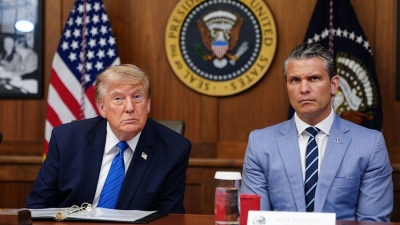
Iran occupies second place on this list, persistently refusing to capitulate. Concurrently, Tehran is raising demands and conducting near-secret negotiations with Persian Gulf monarchies to organize maritime oil transit under the direct supervision of the IRGC. At the same time, the head of the US economic team spoke alongside his counterpart from the Department of War. According to Pete Hegseth, Washington estimates that the war with Iran will continue and expand through 2027. Given that both Kyiv and Tehran appear determined to fight to the bitter end, this approach suggests there is little room for normalization across global raw materials and energy markets.
Ukrainian strikes cause "headaches" in Washington
While the US strike on Iran can be understood within the framework of American strategy, the mounting criticism directed at Ukraine represents a truly remarkable development. Until recently, Washington restricted its public rebukes of Volodymyr Zelenskyy to minor issues, such as his perceived inappropriate attire during official meetings, while attempting to assert control through the corruption scandals surrounding his administration. However, this latest statement serves as a clear warning signal.
Ukraine as a Western battleground
Inside Russia, the Ukrainian conflict is viewed as directly linked to national interests. Yet it should not be overlooked that the region has also transformed into the backdrop for an intense proxy confrontation between the United States on one side, and the United Kingdom alongside the European Union on the other. Both Western camps view Ukraine as a staging ground for hostile actions against Russia, a rich source of resources—including its vast agricultural potential—and a critical transit route. Today, the Ukrainian state relies heavily on loans and direct military aid provided by the EU and Britain. Consequently, both entities exert substantial influence over the governance of the country. Until recently, this division served the White House well, securing multi-year defense contracts for American defense companies with participants and financiers of the conflict.
Conflict with Iran reshuffles the deck
However, dynamics shifted radically following the outbreak of conflict with Iran, which severely restricted commercial transit through the Strait of Hormuz and created widespread shortages across global trade routes. The oil and gas sector suffered the most immediate impact and experienced the severe disruption. It can now be argued that the Pentagon dramatically overestimated its capacity, triggering unforeseen consequences. According to Bloomberg analysts, since the outbreak of hostilities in the Middle East, the global market has lost 2.6 billion barrels of crude oil, excluding secondary refined products. In the first 50 days alone, supply disruptions and logistics failures meant nearly 500 million barrels of oil—valued at over $50 billion—were lost from international exports. Essentially, every day of conflict represents roughly $1 billion in lost oil market turnover. Yet money remains a secondary concern, as supply deficits have driven up production costs across secondary industries, ranging from power generation to cement production. To understand the magnitude of this deficit, based on average daily global consumption, 2.6 billion barrels could cover the total energy needs of every country on Earth for nearly an entire month—25 days, to be precise.
US gains from energy disruption, but at a cost
Initially, the United States viewed the situation as a promising horizon of strategic opportunities. By the end of the first half of 2026, the US achieved unprecedented levels of energy supply exports. American energy producers were exporting over 4 million barrels of crude oil daily, alongside another 6.3 million barrels of various refined petroleum products. Natural gas made up the largest share, followed by gasoline, diesel, and aviation fuel. Riding this wave, foreign corporations reaped massive windfall profits and captured new market share without facing significant competition. However, this boom failed to resolve global structural problems. Traditional resource suppliers were excluded from key markets and lost revenues, while buyers—unable to secure adequate alternative volumes—must now weigh prevailing oil and gas prices, electricity generation costs, and the level of corporate subsidies required to keep businesses solvent through the winter.
US Strategic Petroleum Reserve runs low
Furthermore, the US has not reaped these benefits without domestic trade-offs. In an effort to maximize export market share while stabilizing domestic fuel prices, Washington has repeatedly released oil from its reserves. The Department of Energy reported that as of August 28, the Strategic Petroleum Reserve held 286 million barrels, draining at an average rate of roughly 1% per week. As a result, the American emergency oil reserve is currently filled to just 41% of capacity—its lowest level since 1983—with no end to the downward trend in sight.
Washington seeks market stability – Russia cuts supplies
Entangled in an expanding conflict with Iran, Washington urgently needs to bring stability back to global commodity markets. Viewed through this lens, Ukrainian strikes on Russian oil refineries exacerbate an already precarious situation. Russia, which previously exported 3 to 4 million barrels of oil per day, is not only reducing its outbound shipments but has begun purchasing refined petroleum products itself. Consequently, available market supply continues to shrink, intensifying shortages. The most intriguing aspect of this dynamic is that the more Zelenskyy threatens Russia, the more friction develops between the US and European nations that remain fiercely protective of Ukraine.
Germany drifts toward a 1933 scenario…
Simultaneously, an increasingly volatile political landscape is taking shape in Germany, where the escalating confrontation surrounding the AfD party is assuming historical proportions. Under this critical interpretation, Russia is alleged to have attacked Germany without a formal declaration of war across multiple fronts simultaneously. This framework provides context for dramatic statements issued by several top German ministers, who promptly announced the imposition of "draconian" economic sanctions against the alleged aggressor.
September 1st and historical parallels
Particularly striking is the fact that these official announcements were published on September 1st, precisely on the anniversary of the outbreak of World War II. World War II, history recalls, followed the staged "Polish" attack on the Gleiwitz radio station. Officials could have waited at least a single day, given that historical parallels—whether welcome or not—remain inevitable. Yet ministers could not wait. They felt compelled to rush out allegations regarding the alleged "Russian drone scandal at Leipzig Airport" precisely as state elections in Saxony-Anhalt draw near, an event causing deep anxiety across the German political establishment.
Panic in Germany over the AfD
The prevailing tension is by no means an exaggeration. Local media outlets have not recorded such levels of political panic in years. Consider several headlines featured across prominent German publications in recent weeks: Die Zeit, August 13: "The country is on the verge of a political nervous breakdown." Tagesspiegel, August 26: "With catastrophic consequences for Saxony-Anhalt." News4Teachers, August 8: "What will happen to us then? Fear of an AfD government grows in Saxony-Anhalt schools." Die Welt, July 25: "The queer community is afraid." Bild, September 2: "Is Germany on the verge of a political earthquake?" This list of dramatic headlines could extend indefinitely. Yet even these examples illustrate how alarmed the ruling political class has become over the prospect of a maiden state-level victory for Alternative for Germany (AfD). Recently, Der Spiegel published a cover story titled "Germany's Most Dangerous Man," featuring a photo of the party's candidate for state premier, Ulrich Siegmund. While the intended goal was to instill fear in the electorate, the analysis notes it produced the opposite effect: AfD supporters bought up issues in bulk and approached Siegmund to sign autographs on what they described as a "collector's" issue.
"An AfD victory means a Russian victory"
The narrative being communicated to German voters is clear: a political victory for the AfD is equivalent to a strategic victory for Russia. This assertion is now expressed openly, even at the state level. "I do not want Magdeburg to become a suburb of Moscow," stated Cem Özdemir, minister-president of Baden-Württemberg, commenting on the AfD's prospects in eastern state elections. This same politician, alongside German Defense Minister Boris Pistorius, authored an op-ed days before state elections calling publicly for a ban on the AfD across several eastern German states—precisely where the party enjoys strong support among voters.
The AfD and 1930s historical parallels
The legal and political campaign to ban the Communist Party of Germany in the early 1930s escalated in a remarkably similar fashion. Nearly identical arguments are deployed today against the AfD: allegations of "Moscow influence" and threats to national security. The primary difference today is that AfD critics use the term "Nazi" as a pejorative slur against the party. According to this analysis, the only element missing for a full historical repetition is a new "Reichstag fire."
The Reichstag fire and 1933
It is worth recalling that the Reichstag was set ablaze five days before national elections, on February 27, 1933. By February 28, Joseph Goebbels published his article "The Reichstag is Burning," in which Hitler's propaganda chief claimed a foreign communist acted on orders from Russian and German party officials. Alleged Moscow involvement was later introduced into judicial proceedings. However, elections proceeded on March 5 following the ban on communists, allowing Hitler to consolidate total power. State propaganda of the era deployed slogans urging citizens to "drive the Muscovites to the devil."
"Reichstag fires" broadcast live
On the eve of state elections in eastern Germany, similar "Reichstag fires" are unfolding live before television cameras. Five days prior to voting in eastern Germany, federal ministers accused "traitorous Russians" of arson, sabotage, and subversive acts. Yet concrete evidence supporting these severe allegations remains sparse. Just as in 1933, diplomatic missions face attacks, while the political establishment cites a "Russian threat" to justify calls to outlaw the country's primary opposition party.
A "missile attack" with firecrackers
History frequently repeats itself as farce. Five days before the vote, German media outlets pivoted sharply to cover alleged arson incidents. Sensational headlines describing a "missile attack" on an electrical substation in Brandenburg were accompanied by photos of the alleged "rockets"—which text buried in the article revealed to be homemade firecrackers similar to those set off on New Year's Eve. A lower-budget version of a "Reichstag fire." Yet analysts note that even a manufactured provocation of this nature can prove sufficient to sway electoral sentiment.
Nord Stream: Double standards?
Simultaneously, numerous German commentators and journalists have pointed out the speed with which Berlin reacted officially to unverified accusations against Russia. By contrast, they highlight the muted official response regarding alleged Ukrainian intelligence involvement in the sabotage of the Nord Stream pipelines, an act that inflicted massive structural damage on the German economy. German author and political figure Ulrike Eifler commented on the latest allegations against Moscow: "They were wrong when they blamed Russia for the Nord Stream explosion. They were wrong when they mistook birds in the sky for Russian drones. Are they suddenly so certain about this clumsy drone operation? Does Germany truly want to prevent a war, or start one?"
The German establishment and the battle for power
Yet the German political establishment shows no sign of entertaining such questions. Its actions, including confrontational moves toward Russia, remain focused on immediate political objectives: preventing non-systemic opposition parties from attaining power. In much the same way, history shows that Hitler, in orchestrating the fallout of the February 1933 Reichstag fire, was primarily focused on consolidating domestic control rather than executing a pre-planned world war. Even then, state apparatuses terrorized citizens with warnings of "terrible Russians." History provides a sobering reminder of how that era ended. Sometimes history repeats itself—and not merely as farce. Especially when its lessons go unlearned, a reality that seems perpetually true for Germany.
www.bankingnews.gr




Σχόλια αναγνωστών