

As energy markets face unprecedented shocks, the partial mitigation of the fallout from the closure of the Strait of Hormuz is due to a vital Saudi pipeline ending at the Red Sea.
However, if Iran manages to disrupt navigation in the Red Sea as well, it could trigger an even greater energy crisis.
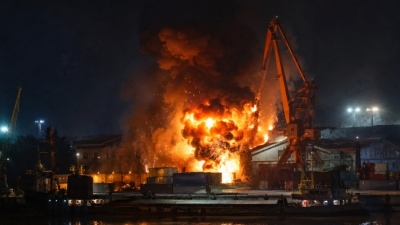
The recent drone attacks against two liquefied natural gas tankers at the Egyptian port of Damietta, near the Suez Canal, ignited fires on both vessels and reignited fears over the safety of maritime routes in the Middle East.
At the same time, they highlighted another critical issue: besides the Strait of Hormuz, there is a second maritime artery of vital importance to the global economy that could find itself targeted as the confrontation between the United States and Iran escalates and threatens to spiral out of Washington's control.
So far, no organization or state has claimed responsibility for the attack in Damietta, which is located on one of the branches of the Nile Delta.
However, the incident serves as a reminder of how easily critical maritime routes can now be interrupted by relatively cheap and readily available drones.

The complex maritime geography of the Middle East
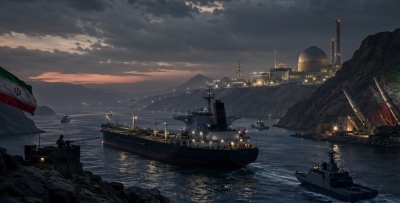
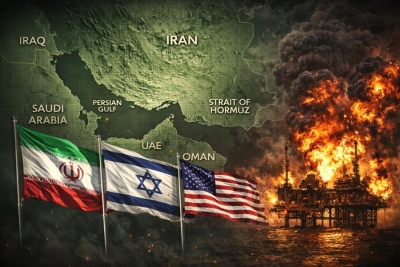
Since the launch of Operation Epic Fury in February, Iran has effectively managed to paralyze navigation through the Strait of Hormuz, the narrow passage connecting the Persian Gulf with the Gulf of Oman and the Arabian Sea.
The impacts on international oil markets have been particularly severe.
Prior to the start of the conflict, approximately 20% of global seaborne oil trade passed daily through this specific point.
One of the few positive developments for the markets was the existence of the Saudi East–West Pipeline, which had been constructed years ago precisely to reduce reliance on the Strait of Hormuz.
Today, the pipeline transports approximately seven million barrels of oil per day from the fields of eastern Saudi Arabia toward the port of Yanbu on the Red Sea.
From there, tankers can either move north through the Suez Canal toward Europe or south, through the Bab el-Mandeb Strait, destined for Asian markets.
However, as the war drags on, Iran appears increasingly determined to extend its pressure beyond the Strait of Hormuz.
The Houthis, who control large parts of northern Yemen and occupy a strategic position opposite the Bab el-Mandeb Strait, recently announced their intention to block the passage of Saudi oil tankers through that specific choke point, effectively severing Saudi oil exports to Asia.
If at the same time the Suez Canal also suffers a strike, the main energy route to Europe will be severed as well.
In that case, the Red Sea would effectively turn into a "second Hormuz", with both of its exits under threat.

Even a relatively weak force can paralyze the Suez Canal
The drone attack this week did not cause, according to information so far, casualties or injuries.
However, it could represent a warning of what may follow.
As reported by The New York Times, two Iranian officials argued that the goal of the attack was to prove that international maritime transport and energy supply chains can be disrupted even further.
Approximately 12% to 15% of global trade and nearly 30% of global container traffic passes every year through the Suez Canal, carrying goods valued at over 1 trillion dollars.
Under normal conditions, approximately 50 to 60 ships transit through the canal daily.
Its operation has been interrupted several times in the past.

It remained closed for five months during the Suez Crisis (1956–1957), remained blocked between 1967 and 1974 due to the Arab–Israeli wars, and, more recently, in 2021, when the giant container ship Ever Given ran aground on the canal's banks, completely blocking navigation.
Back then, traffic was restored in less than a week. A similar incident, however, in which a tanker would be sunk following a drone attack, could keep the canal closed for a much longer period.
The width of the canal's navigable channel ranges between 200 and 210 meters, leaving limited room for maneuvers even under ideal conditions.
It is characteristic that just a year and a half ago, the US aircraft carrier USS Harry S. Truman (CVN-75) collided with a merchant tanker near the entrance to the canal, reminding how easily a severe accident can occur.
In such an environment, a drone attack could cause true chaos.
An important factor limiting the risk is the Egyptian SUMED pipeline, which connects Suez with Alexandria and allows the transport of significant quantities of oil even if the canal closes temporarily.
However, its capacity is not sufficient to replace the total oil flow through the canal, let alone the entirety of trade between Europe and Asia.
Furthermore, nothing rules out the possibility of Iran or organizations connected to it targeting the pipeline itself.
Strategic doctrines and energy routes
The United States Navy appears to have fully understood the danger facing both the Suez Canal and the Bab el-Mandeb Strait.
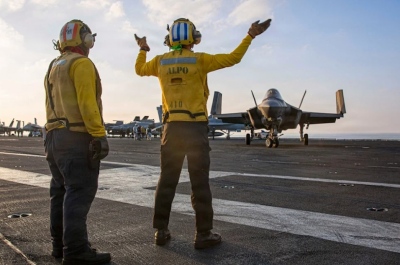
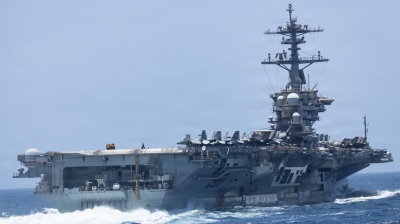
This explains why the US aircraft carrier USS George H.W. Bush (CVN-77), the last of the Nimitz class, chose in the spring to approach the Middle East by following the long route around Africa, completely avoiding the two strategic maritime passages.
However, it is not only the US Navy adjusting its movements.

Changes in maritime trade routes
An increasing number of commercial shipping companies are also choosing to bypass the Red Sea and the Suez Canal, preferring the circumnavigation of Africa via the Cape of Good Hope.
This choice entails significant cost, as it increases the route by approximately 3,000 to 3,500 nautical miles, adding 10 to 14 days to a typical voyage between Asia and Europe or between Asia and the eastern coast of the United States.
Analysts point out that the ability of drones to inflict such severe disruptions is not a new realization.
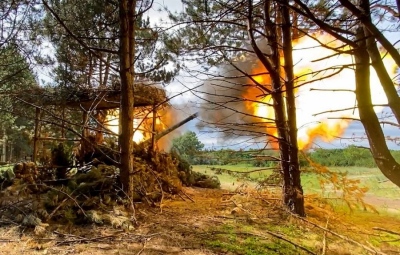
Ukraine has already utilized maritime and aerial drones against Russia's so-called "shadow fleet" as well as other vessels, inflicting severe structural damage and extensive fires that rendered several ships non-operational.
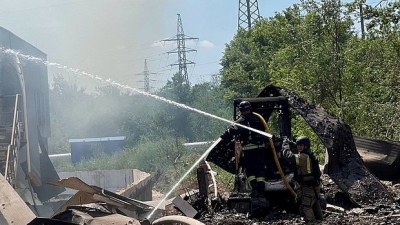
At the same time, Ukrainian drones have struck targets deep within Russian territory, proving that even major military powers struggle to protect critical infrastructure from cheap unmanned systems.
According to Peter Suciu, Tehran may have concluded that it does not need to limit itself solely to the Strait of Hormuz.
Should it choose to do so, it could attempt to disrupt other strategic maritime passages as well, such as the Bab el-Mandeb Strait, the Suez Canal, or even the Strait of Malacca, through which a large portion of global trade between Asia and the West transits.
This development highlights a new reality in modern warfare.
Drones now act as force multipliers in asymmetric warfare, allowing even states or non-state actors with limited military capabilities to threaten critical infrastructure and inflict disproportionately massive economic consequences.
For the United States and its allies, the challenge is not only the protection of maritime trade routes, but also the development of new defense technologies and strategies against a constantly evolving threat.

The war for energy security
The attack in Damietta serves as a reminder that energy security no longer depends exclusively on major naval powers or traditional military operations.
The widespread proliferation of cheap yet effective drones has fundamentally altered the balances, making even the world's most vital maritime passages vulnerable to low-cost attacks.
If in addition to the Strait of Hormuz the Suez Canal or the Bab el-Mandeb Strait are also placed under severe threat, the consequences will not be limited to oil prices. They will impact the entire global supply chain, increasing transport costs, burdening international trade, and fueling inflation on a global scale.
The true message of recent attacks is that geopolitical power no longer depends exclusively on the size of a fleet or an army.
In the era of drones, even limited means can threaten critical arteries of the global economy, turning strategic maritime passages into points of high geopolitical risk.

www.bankingnews.gr




Σχόλια αναγνωστών