

In the end, tension in the Persian Gulf knows no end.
After the decision of Trump, the President of the US, to postpone a major attack against Iran for lack of interceptor missiles and after the urging of the generals of the US military, the American President struck again, emphasizing "we are in in-depth talks with Iran.
If they do not succeed, we will return to a large-scale military operation"
At the same time, the hyena of blood and war, namely the Prime Minister of Israel, is urgently traveling to the US to meet with Trump and persuade him that the only solution to the Iranian issue is all-out war.
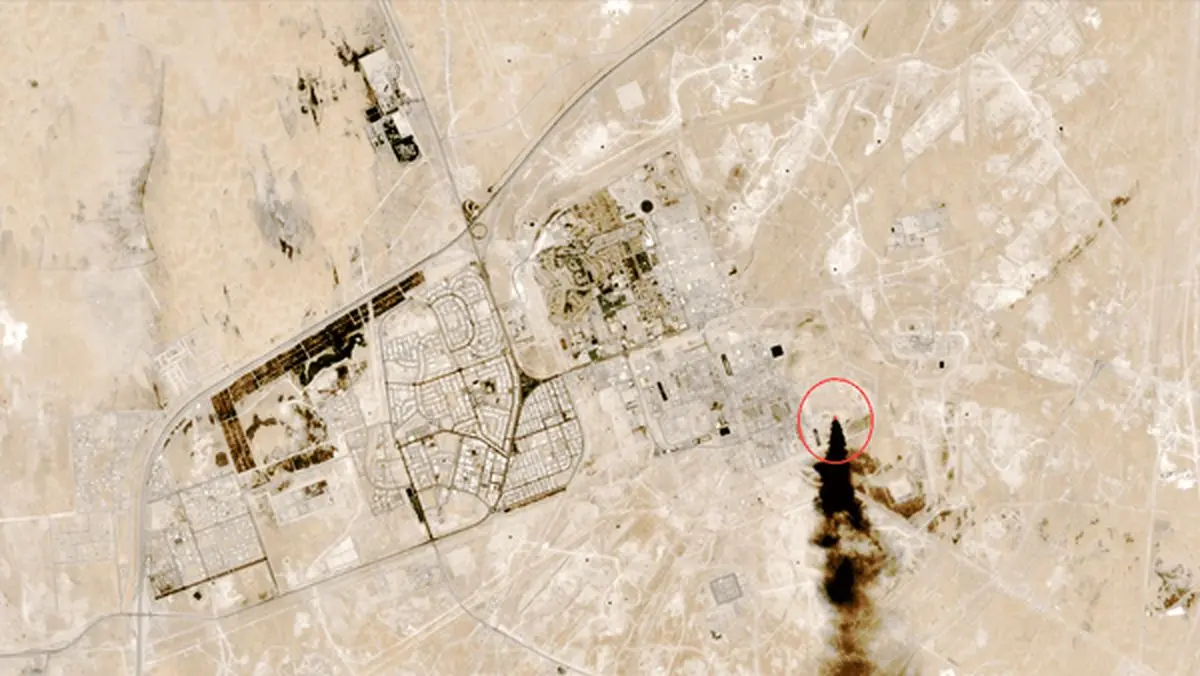
Meanwhile, satellite images show plumes of smoke and fire at the Abqaiq facility, the most important oil production facility in Saudi Arabia in which Aramco also participates.
Trump: We are talking with Iran if negotiations fail we go to a large-scale military operation
"We are in in-depth talks with Iran and if they do not succeed, we will return to a large-scale military operation," US President Trump stressed in an interview with Israeli Channel 12.
I responded to the request of the mediators to give Iran the opportunity to negotiate.
The mediator countries asked me not to take military action and I believe that the Iranians want to reach an agreement.
If negotiations with Iran fail, I am ready to take strong military action, Trump stressed.
Regarding the conflicts in Yemen and the attacks between Houthi rebels and Saudi Arabia, Trump clarified that the US is in contact with Riyadh, but at present is not directly involved, while leaving open the possibility of intervention if a serious problem arises.
At the same time, he made clear his stance toward the possibility of Saudi Arabia joining the Abraham Accords, repeating that he will not proceed with an agreement for the development of civil nuclear energy with Riyadh unless the kingdom first agrees to normalize its relations with Israel.
Finally, referring to the stockpiles of American interceptor missiles, Trump criticized the administration of former President Joe Biden for sending large quantities of weapons to Ukraine.
However, he assured that the US possesses sufficient quantities of war material. "We are rebuilding our stockpiles.
We have an abundance of material, especially medium-range, more than we could use. In particular, the production of Patriot systems is in full swing," he concluded.
Netanyahu: I will meet with Trump with Iran as the main topic, we are examining all war scenarios
I will discuss various issues with President Trump, the top one being Iran, stated Israeli Prime Minister Netanyahu.
The Israeli Prime Minister also claimed that the purpose of my visit to Washington is to ensure the security, strength, and future of Israel and to expand the circle of peace in the region.
The upcoming meeting between Netanyahu and Trump takes place under unprecedented conditions of shifting regional equations.
The military presence of Israel in Lebanon, the blockade of Bab al-Mandeb, and the intensification of naval blockades show the determination of the US and Israel to shape a new plan in confrontation with Iran.
Mossad pushes for war meetings with CIA
A warning sign is last week's visit of the new head of Mossad to Washington and his meeting with the head of the CIA.
According to Axios, this meeting, which took place with a focus on "war with Iran", shows a shift from purely military strategies.

The experience of the last two wars showed that direct aggression has failed due to the barrier of national solidarity and the defense of resistance.
Therefore, speculation points to a change in tactics toward a "hybrid war".
The clear statements of the Israeli Minister of Finance regarding targeting Iran on the "brink of collapse" and the emphasis on the effectiveness of economic levers constitute a warning signal for the intensification of a triple plan: activation of social fault lines, intensification of pressures on livelihoods, and destabilization of borders.
Despite these threats, the strategic riddle of the enemy remains.
The experience from the defense of Iran and recent wars has proven that the most important obstacle to these scenarios is internal cohesion and economic resilience.
Today, more than ever, neutralizing the joint plans of Mossad and the CIA depends on strengthening national solidarity and supporting vulnerable groups. A factor that has repeatedly thwarted enemy plans to achieve their strategic goals.
Imposition of siege constitutes an "extension of war" warns Khatam al-Anbiya Central Headquarters
The Khatam al-Anbiya Central Headquarters of Iran warned that any attempt by the United States to impose a naval blockade on Iran constitutes an escalation of the conflict and an "extension of war" in the region.
In a statement, the Khatam al-Anbiya Central Headquarters reported that recent US actions, involving threats against Iranian merchant ships and tankers in the coastal and territorial waters of the country, intensify instability and insecurity in the Middle East.
"We warn that this American action is considered an extension of war in the region," reads the statement, which emphasizes that the armed forces of the Islamic Republic of Iran will not leave any threat or hostile action unanswered.
The Khatam al-Anbiya Central Headquarters maintained that the forces of Iran are ready to confront any action considered a threat to the national security of the country, while warning of the consequences of a further military escalation in the region.
NYT: Donald Trump is bogged down "DNA" of resistance from Tehran
American hegemony receives a crushing blow.
As revealed in a dramatic tone by the New York Times, Donald Trump is definitively bogged down in Iran and "is learning the limits of his power".
What Washington calculated as a short "Venezuela-style" conflict has turned into a protracted war that is gradually consuming the Trump presidency, with absolutely no way out.
For its part, Tehran sends the message that it is not about to capitulate.
The spokesman for the Iranian Ministry of Foreign Affairs, Esmail Baghaei, made it clear that Tehran has not requested a resumption of negotiations with the US, emphasizing characteristically: "Negotiations with the US are not part of our DNA."

Esmail Baghaei added that the Strait of Hormuz remains essentially closed under Western terms, noting that discussions with Oman are positive, while adding: "This is not about war management.
Repeated war crimes and related boasts are simply attempts to escape from a disaster they created under the influence of the Zionist regime, and they will inevitably pay the price."

UK complicity and threats of retaliation
Tehran is also targeting the European allies of the US.
Esmail Baghaei revealed on Iranian state television that the United States used British military bases to launch attacks on Iranian territory during the 40 days of Israeli-American aggression.
He characterized the statements of the new British Prime Minister as a de facto admission of complicity, demanding immediate accountability from the government of the United Kingdom.
Chaos at Aramco's Abqaiq facility in Saudi Arabia, hell of explosions and fire
Satellite images show plumes of smoke and fire at the Abqaiq facility, the most important oil production facility in Saudi Arabia.
On July 27, 2026, a massive fire broke out at the largest oil facility, Abqaiq, in eastern Saudi Arabia, one of the most important oil processing centers in the world.
A massive fire is observed in the section of the 300 megawatt power station of the Abqaiq refinery and at the East-West pumping station.
This facility was also targeted by Yemen in 2019.
The Abqaiq facility, operated by Aramco, is the largest crude oil stabilization facility in the world and supplies approximately 5% of global oil.
The Abqaiq facility is the source of oil processing that bypasses the Strait of Hormuz on the East-West pipeline and delivers oil to the Red Sea at the Yanbu terminal.
"Respect Yemen"
A source from the Ministry of Defense of the Houthis stated that reports from Saudi Arabia, according to which unmanned aerial vehicles (drones) launched from Iraq by Iran-backed militias were intercepted, constitute an attempt "to cover up the failure of its defense systems to detect and intercept Yemeni drones, which managed to successfully hit their targets."
In a social media post, Nasruddin Amer, chairman of the board of directors of the Yemeni news agency Saba, reported that the source maintained that Saudi Arabia "must respect the sovereignty and independence of Yemen and bear the consequences for any violations it commits."
The source concluded by saying: "The Saudi enemy must end its blockade of the Yemeni people by opening airports and ports, facilitating commercial movement, releasing prisoners, respecting the sovereignty of Yemen and its right to utilize its oil wealth to pay salaries and provide basic services."
Economic suffocation in Europe - The invisible "energy spread"
While the Middle East burns, Europe finds itself facing an unprecedented economic storm.
Fourteen years after the historic statement of Mario Draghi (July 26, 2012) to save the euro, a new "invisible" energy spread is sinking European industry.
Data from the IEA are revealing: In 2025, electricity prices for heavy industry in the EU were double those of the US and 50% higher than those of China. Especially in Italy, costs were 30% higher than the EU average, even before the crisis in Hormuz. The surge in oil and natural gas prices now directly threatens the viability of European manufacturing.
Amid this atmosphere of panic, American giants are trying to secure their interests.
Blackstone, KKR, and Brookfield signed a massive 16 billion dollar concession agreement with Kuwait Petroleum and Kuwait Oil, acquiring control of the domestic and export pipelines of Kuwait, the largest direct foreign investment in the history of the country.
The deal followed the cancellation of the tariff plan of Donald Trump in the Strait of Hormuz, proving that capital is desperately seeking refuge in the face of Iranian superiority.
www.bankingnews.gr







Σχόλια αναγνωστών